
11 Best TPRM Tools for DPDP Compliance in India: Vendor Risk Platform Comparison 2026
Date Published
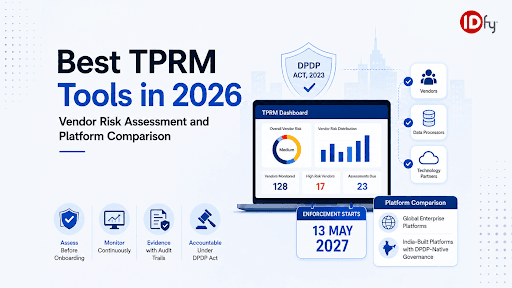
What is TPRM under the DPDP Act?
Third-party risk management has become a never-ending compliance challenge for Indian enterprises. Most companies today operate with a vast vendor ecosystem: a cloud infrastructure provider, a payroll platform, a marketing automation tool, a KYC verification partner, a logistics partner – you name it. Each one processes different data types and can be a potential point of an incident.
Under India's DPDP Act, if any of them suffers a breach or mishandles data, liability does not extend to the vendor. It follows you, the data fiduciary. That accountability cannot be delegated through a vendor contract alone. Data processors (aka vendors/third parties) must be actively governed: assessed before onboarding, monitored during the contractual relationship, and evidenced in audit trails that should be ready to be produced before the Data Protection Board of India (DPBI).
With the DPDP implementation deadline ending on 13 May 2027, organisations across BFSI, fintech, e-commerce, insurance, healthcare, etc., are evaluating their TPRM capabilities with a new lens. The question is no longer just which tool generates the best vendor risk scores. It is a platform that was built to address the accountability model they are actually operating under.
That means TPRM is no longer just a procurement or infosec checklist. It is now a privacy governance requirement.
A mature DPDP-ready TPRM programme should help organisations answer five questions:
- Which vendors process personal data?
- What type of personal data does each vendor process?
- What contractual safeguards and processing instructions are in place?
- How are vendor risks assessed, monitored, and remediated?
- What evidence can be provided if the Data Protection Board requests proof?
In this guide, we compare eleven third-party risk management and privacy governance platforms in 2026 across vendor governance depth and compliance coverage.
What Should a Good TPRM Tool Include?
Before comparing platforms, it is worth being clear about what a vendor risk programme actually needs to do in practice.
- Vendor onboarding and risk tiering: Different vendors carry different risks based on the sensitivity of the data they might be processing. For example, a lending platform that verifies Aadhaar data for loan disbursement would fall under the high-risk tier, while a platform used to book online meetings would fall under the low-risk category.
- Vendor Assessment Automation: A good TPRM programme would ensure automated tracking and initiation of vendor risk assessments as soon as a new vendor is added to the system. This is possible through evidence collection using pre-built, intelligent templates aligned with various sectoral regulations, all recorded on a single, unified portal.
- Remediation workflows: Once the results of the vendor assessments are in, tasks or 'risks' are assigned to internal teams for further evaluation and understanding which ‘risks’ need to be addressed first. These could include a privacy control failure, an unresolved data principal grievance, or a pending consent request, with a full audit trail behind every step.
- Regulatory and contractual compliance: Vendor controls need to map to specific frameworks, DPDP, ISO 27001, and NIST, and that mapping needs to be producible as evidence when an auditor or regulator asks for it.
- Audit-Ready Reporting: Boards, DPOs, CISOs, legal teams, and internal auditors need clear visibility into vendor risk posture. The platform should generate dashboards and evidence packs that show which vendors have been assessed, what risks were found, what action was taken, and what remains open.
- Continuous vendor monitoring: By the time an annual vendor review is over, your vendor might have already become your weakest link. This could have been prevented had your vendors been continuously monitored based on the security and compliance risks they have right now, which wasn't the case a year ago. A mature TPRM programme would ensure that vendors are in check and held accountable for any lapses in security and contractual obligations.
In the Indian context, DPDP readiness adds a specific layer: the platform must support data processor governance under the DPDP framework, covering contractual safeguards, documented processing instructions, breach notification flows, and retrievable evidence of ongoing oversight.
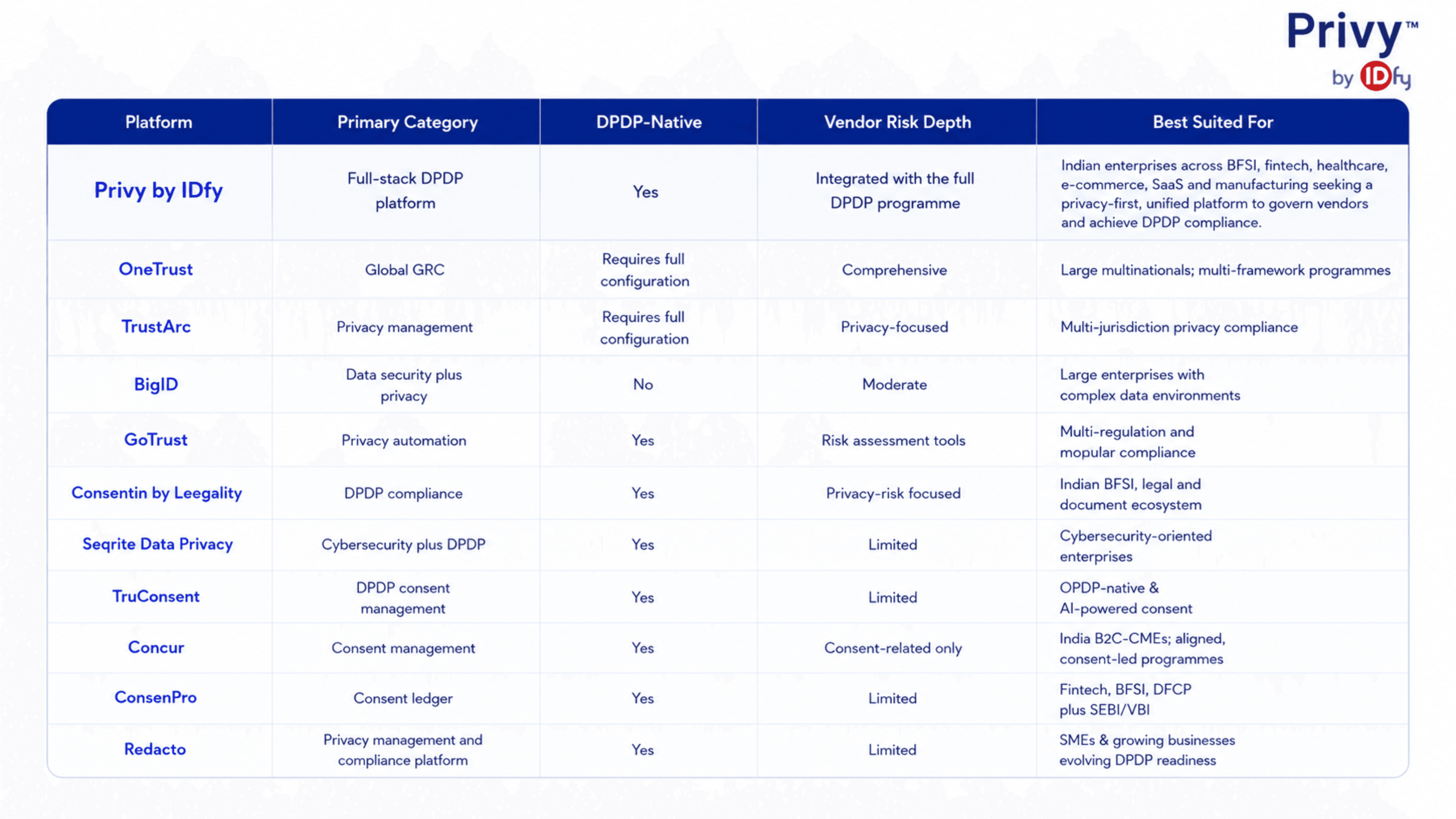
Quick Comparison: 11 Best TPRM Tools for DPDP Compliance
1. Privy by IDfy
Privy by IDfy is India’s leading full-stack DPDP compliance and privacy governance platform, catering to different businesses across a wide variety of industries. Unlike tools that treat vendor risk as a standalone checklist, Privy connects TPRM with the rest of the privacy operating model to ensure end-to-end compliance and risk mitigation.
Privy sits on the foundation laid by IDfy’s 14+ years of experience in identity verification and handling India-specific PII of 50+ types. IDfy conducts over 100 million verifications annually and serves more than 600 enterprise clients across different industries such as BFSI, fintech, logistics, and healthcare.
Privy by IDfy won first place in MeitY’s NeGD-DPDP Innovation Challenge. IDfy’s submission was recognised for its strong alignment with the Digital Personal Data Protection Act, along with its innovation, technical robustness, and real-world applicability. For us, this recognition reinforces the work we’ve been doing to help enterprises move from DPDP readiness to real-world implementation. Today, 50+ organisations rely on Privy’s privacy governance and DPDP implementation expertise to build safer customer interactions and protect customer data. We look forward to partnering with many more organisations as India moves towards a stronger trust and privacy ecosystem. MeitY’s Announcement: link
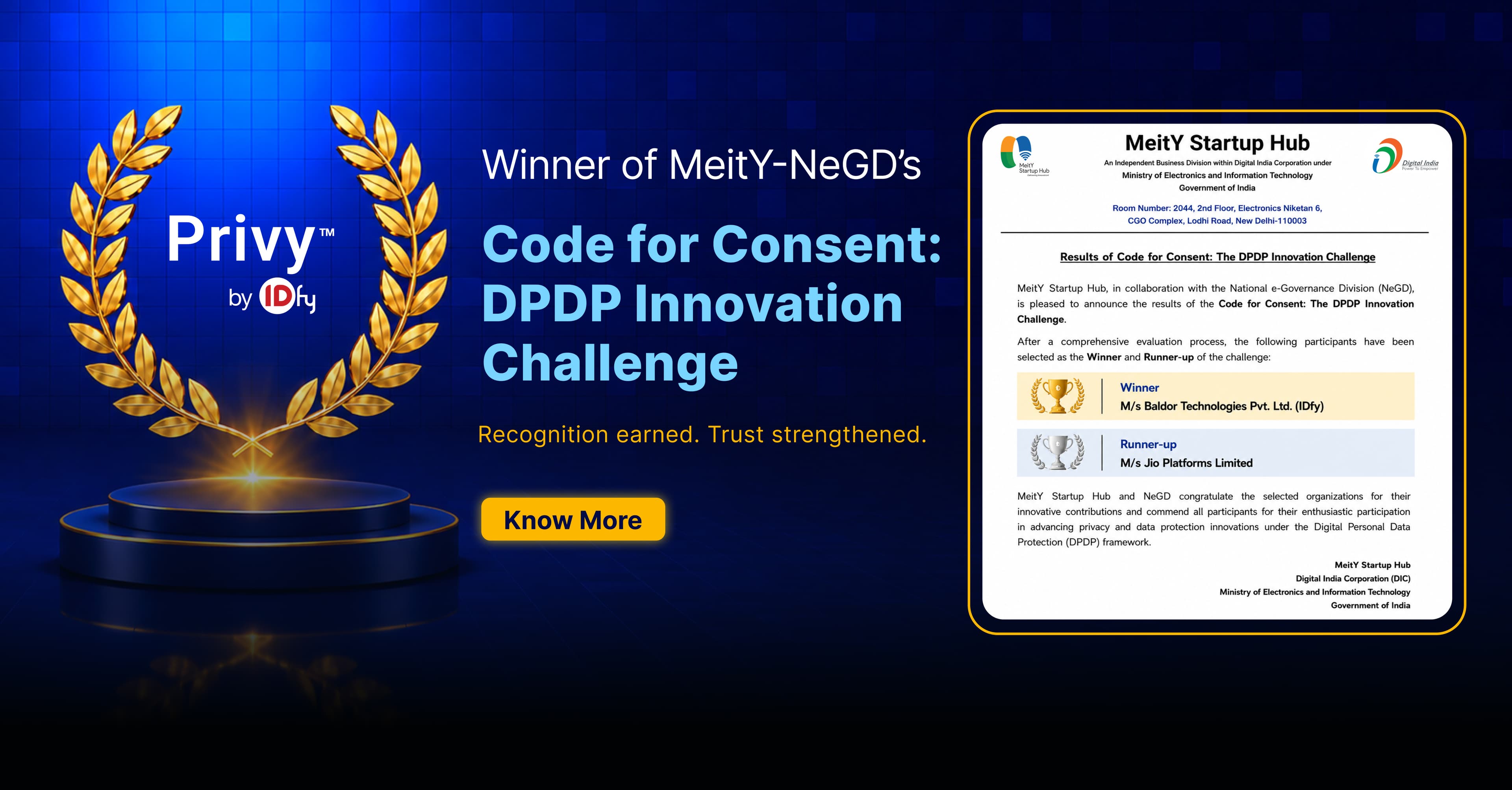
To know more about this challenge, click here
Privy’s AI Compliance Co-pilot is Privy's AI governance layer, which is the intelligent layer that connects across consent lifecycle management, personal data discovery and governance, and continuous compliance and risk management. The co-pilot continuously scans across a fiduciary’s privacy ecosystem and customer journeys, including vendor logs, consent workflows, data flows, and incident logs, to detect compliance gaps and maintain audit readiness without manual intervention.
- Unified portal for vendor risk assessment: Any new vendor onboarded is directly added to a central repository containing key vendor details, such as the company name, vendor contract history, the data they process with their sensitivity category, risk score, and more.
- Vendor Contract Analysis: Privy’s TPRM module scans vendor contracts to flag any clauses that require attention, non-compliance with regulations such as RBI, DPDP, IRDAI, SEBI, etc., cross-border data transfers, and more.
- Data Processor Workflows: The module helps data processors cater to Data Principal Access Requests (DPARs) such as data deletion, consent revocation, grievances, and more. For example, if a data principal decides to delete their data, the request gets assigned to the data processor (wherever applicable in the customer journey). The processor can then initiate the deletion action and upload a data deletion proof (a data purge artefact) for the fiduciary’s review, thus ensuring the maintenance of immutable audit trails.
- Vendor Risk Assessments: Conducted automated vendor risk assessments continuously using intelligent, pre-built templates autofilled with vendor details and other important information. All of this happens on a centralized interface where teams can gauge risky vendors and prioritize escalation efforts accordingly and set up a risk threshold scoring system.
Pros
- The biggest advantage is that Privy’s TPRM tool offers is that vendor risk does not sit in isolation. It can be connected to DPIAs, incident management, data principal rights, consent workflows, and data discovery, thus ensuring an organisation’s overall DPDP posture is in place.
For example, if any type of PII starts flowing into a new application or third-party processor, DPIA assessments are automatically initiated and pre-filled with details such as sensitive PII data captured and any plausible cross-border data transfers. In the event of a breach from a data processor’s interface, Privy will detect, investigate the root cause of the incident, and alert the processor to implement the required data protection measures within the DPDP’s 72-hour breach reporting timeline. - Helps businesses strengthen their vendor accountability posture by providing real-time insights into how well processors are complying with contractual and sectoral obligations, handling data, addressing DPARs, etc.
- Ensures that vendors process data only within consents/purposes that the data principals have consented to.
- Privy’s TPRM is purpose-built for catering to India’s DPDP compliance and complying with regulations such as the RBI, IRDAI, SEBI, and more.
- Designed for doing the heavy lifting on vendor compliance and can be integrated across legacy systems in banks and work seamlessly across fintech, healthcare, e-commerce, logistics, and other high-volume industry sectors.
- Helps businesses strengthen their vendor accountability posture by providing real-time insights into how well processors are complying with contractual and sectoral obligations, handling data, addressing DPARs, etc.
- Ensures that vendors process data only within consents/purposes that the data principals have consented to.
- Privy’s TPRM is purpose-built for catering to India’s DPDP compliance and complying with regulations such as the RBI, IRDAI, SEBI, and more.
- Designed for doing the heavy lifting on vendor compliance and can be integrated across legacy systems in banks and work seamlessly across fintech, healthcare, e-commerce, logistics, and other high-volume industry sectors.
Cons
- May be broader than what a small business needs if it only wants a basic vendor questionnaire tool.
Best suited for organisations looking at DPDP as an enterprise governance programme and not a one-off compliance project.
Best Fit
Privy is best suited for organizations looking to operationalise third-party risk management through a unified privacy governance platform that brings together consent, data principal rights, incident response, DPIAs, and data discovery while ensuring audit readiness.
2. OneTrust
OneTrust is a global platform for privacy, risk, compliance, and third-party management. Its third-party risk management capabilities are designed to automate vendor onboarding, assessment, risk treatment, reporting, monitoring, and offboarding.
Key Features
- Vendor onboarding and assessments
- Vendor screening and due diligence
- Vendor risk management workflows
- DSAR automation
Pros
- Vendor onboarding workflows for global regulatory frameworks such as the GDPR
- Useful for multinational organisations with complex global vendor ecosystems
- Broad integrations and reporting capabilities
Cons
- Requires significant configuration and better implementation of India-specific privacy needs (DPDP and other sectoral regulations) within TPRM
- No provision for data processors/vendors to acknowledge, upload data deletion proofs, and comply with deletion requests
- Only DPIAs are supported via Vendorpedia
- Can be heavier and costlier for teams that need faster DPDP implementation by May 2027
- Limited ability to analyse vendor contracts and correct compliance clauses
- Local DPDP requirements may need additional legal and operational mapping
Best Fit
OneTrust is best suited for those who already operate across multiple jurisdictions, such as the GDPR, and need an enterprise-wide risk and compliance platform.
DPDP Consideration
For Indian organisations, OneTrust’s TPRM needs a localized approach to comply with India-specific privacy laws, such as the DPDPA.
3. TrustArc
TrustArc is a global privacy management platform with capabilities around privacy assessments, privacy operations, data mapping, DSAR workflows, cookie management, and vendor risk assessment.
Key Features
- Vendor Discovery and Inventory
- DSAR and vendor workflows
- Vendor Risk Management
Pros
- Fit for teams already working with global privacy frameworks such as GDPR, CCPA
- Supports vendor risk scoring, risk management, and privacy operations
Cons
- India-specific DPDP implementation may require a stronger foundation
- May not be as locally contextualised for attending to India’s complex vendor ecosystem and overall privacy needs
- Vendor lifecycle depth should be evaluated against DPDP-specific needs
- May not support DSAR proofing for data processors, once a DSAR has been addressed and closed
- Only DPIAs are supported for overall processor governance
- May not have the capability to mind map data processors with data and consents
- May not support AI parsing of vendor contracts to correct any type of compliance clauses
- Expensive for organizations that need faster DPDP implementation by May 2027
Best Fit
TrustArc is suitable for organisations that already have a mature privacy function and want a global privacy management platform with vendor assessment capabilities.
DPDP Consideration
TrustArc can support privacy-led vendor risk work, but Indian enterprises should check how easily it maps to DPDP data processor obligations, local consent requirements, breach workflows, and India-specific evidence requirements.
4. BigID
BigID is a data intelligence and privacy platform known for data discovery, classification, privacy automation, and data governance.
Key Features
- Centralized vendor directory
- Vendor risk mapping and assessments
Pros
- Data discovery and classification capabilities
- Can support privacy and vendor compliance use cases
Cons
- More data intelligence-led than TPRM-led
- Vendor lifecycle management may need to be complemented with additional workflows
- DPDP-specific implementation should be assessed carefully
Best Fit
BigID is best for organisations that first need deep visibility into personal data across systems before building privacy and vendor governance workflows.
DPDP Consideration
BigID can help answer a critical DPDP question: where is personal data located? But for vendor governance, teams should evaluate how well it supports onboarding, risk tiering, processor contracts, remediation, and audit evidence.
5. GoTrust
GoTrust is a privacy automation and data governance platform that positions itself across consent, data discovery, data mapping, DSR response, assessment management, and compliance automation.
Key Features
- Vendor onboarding
- Risk Mitigation
- Vendor Collaboration
- Vendor Risk Assessments
Pros
- Broad privacy automation coverage
- Includes vendor risk management as part of its product set
- Covers data discovery, mapping, consent, and compliance automation
- Relevant for Indian organisations looking at DPDP readiness
Cons
- Organisations should evaluate the depth of full-lifecycle TPRM workflows
- Vendor risk may need to be assessed against enterprise-level requirements such as contract analysis, remediation ownership, continuous monitoring, and evidence packs
- May not support processor linkage with data and consents
- Contracted analysis may not parse in AI models or correct compliance clauses
- May not support submission of processor proofs to data fiduciary when DPARs are handled and closed
Best Fit
GoTrust is best for organisations looking for a privacy automation platform with multiple modules across consent, data, assessments, and compliance.
DPDP Consideration
GoTrust has strong coverage across privacy automation areas. For TPRM-heavy teams, the key question is how deep the vendor governance workflow goes beyond assessment and risk register functionality.
6. Consentin by Leegality
Consentin is Leegality’s DPDP compliance and consent management platform. It covers consent management, data lifecycle management, compliance and privacy workflows, and third-party risk management. It also supports rights requests, consent withdrawal, and instructions to internal and third-party systems.
Key Features
- Vendor risk assessment platform
Pros
- Strong consent-first DPDP positioning
- Supports consent collection in 22 Indian languages
- Covers rights requests and consent withdrawal workflows via data processors as well
- Includes third-party assessment capabilities
Cons
- Vendor risk appears to be part of a broader consent and privacy platform rather than the central product focus
- May not provide the same depth for full vendor lifecycle governance as a dedicated TPRM-led platform
- Enterprise teams should evaluate continuous monitoring, contract review, remediation, and board-level reporting depth
- Data processor tagging in DSARs may not be supported
- May not support the creation of audit trails when data processors address DPARs
- Limited capability for data processors to submit DPAR fulfillment proofs/evidence to data fiduciaries
Best Fit
Consentin is best for organisations that need to solve consent management and DPDP customer journey compliance quickly.
DPDP Consideration
Consentin is relevant for consent-heavy businesses. For TPRM, buyers should check whether it supports the complete vendor governance lifecycle, from onboarding and risk tiering to remediation and audit evidence.
7. Seqrite Data Privacy
Seqrite’s DPDP compliance solution is positioned around data discovery, consent, security, breach reporting, and full DPDP compliance. It brings a security-led lens to data privacy readiness.
Key Features
- Vendor Assessment Automation
- DPAR Handling
Pros
- Covers important DPDP areas such as discovery, consent, security, and breach response
- Good fit for teams already using security-led governance tools
Cons
- TPRM depth should be evaluated separately
- May be more security-led than privacy governance-led
- Buyers should check how vendor onboarding, processor obligations, assessments, remediation, and audit reporting are handled
Best Fit
Seqrite is best for organisations that want DPDP compliance to sit close to cybersecurity, data protection, and breach response workflows.
DPDP Consideration
Seqrite can be relevant where data security is the primary concern. For privacy-led TPRM, enterprises should validate how well vendor governance connects with consent, rights, DPIAs, and processor oversight.
8. TruConsent
TruConsent is a DPDP-native consent management and privacy platform. It covers cookie consent, data principal rights, DPIA tools, breach response, and compliance workflows.
Key Features
- Vendor Onboarding
- Vendor Periodic Reviews
- DPA Agreement Verification
Pros
- Covers consent, rights, DPIA, and breach response
- Useful for organisations looking for a modular privacy workflow platform
Cons
- Vendor risk depth appears limited compared to full TPRM platforms such as Privy by IDfy
- Newer platform with a developing enterprise track record
- Buyers should validate scalability, integrations, and reporting maturity
Best Fit
TruConsent is best for organisations that need a DPDP-focused consent and privacy workflow platform.
DPDP Consideration
TruConsent can support important privacy workflows, but enterprises with large vendor ecosystems should evaluate whether it can manage the full TPRM lifecycle.
9. Concur- Consent Manager
Concur is a consent management platform designed to simplify DPDP compliance in India. It is positioned around consent governance, transparency, and API-first implementation.
Key Features
- Vendor Assessments
- DPAR Handling
- Centralized Data Processor Management
Pros
- Consent-focused and API-first
- Relevant for businesses that need faster consent and processor-DPAR workflows implementation
- Useful for customer-facing DPDP journeys
- Simple positioning for consent governance
Cons
- Limited published information on full TPRM capabilities
- More consent-focused than vendor governance-focused
- May need additional tools for vendor risk, remediation, and continuous monitoring
Best Fit
Concur is best for businesses that want to operationalise consent collection and consent governance under DPDP.
DPDP Consideration
Concur is useful for consent management, but organisations should not assume that consent tooling automatically solves vendor risk governance.
10. ConsenPro
ConsenPro is a DPDP compliance infrastructure platform from Think360.ai and CAMS Group. It is positioned around consent management, data discovery, breach response, and data rights management.
Key Features
- Vendor Onboarding
- Vendor Agreements Analysis
- Vendor Risk Tiering
Pros
- BFSI relevance
- Built for DPDP compliance infrastructure
- Covers consent, data rights, data discovery, and breach response
- Useful for regulated industries looking at consent and compliance workflows
Cons
- More compliance and consent infrastructure-led than dedicated TPRM-led
- Vendor lifecycle management depth should be validated
- May need complementary tooling for large-scale vendor governance
Best Fit
ConsenPro is best for BFSI and regulated organisations looking for DPDP compliance infrastructure, especially around consent and rights management.
DPDP Consideration
ConsenPro can support key DPDP workflows, but enterprises should check whether it provides dedicated TPRM functionality such as vendor onboarding, assessment automation, contract tracking, remediation, and continuous monitoring.
11. Redacto
Redacto is a data privacy and compliance platform from VertexTech Labs, Bangalore, founded in 2025. It is positioned around DPDPA compliance, consent management, vendor risk management, data discovery, and privacy operations for BFSI, healthcare, and other regulated sectors.
Key Features
- AI-driven vendor risk assessment and continuous monitoring
- Vendor onboarding workflows
- Consent-linked vendor monitoring
Pros
- DPDPA focuses on dedicated modules for consent, vendor risk, and breach response
- AI-first automation reduces vendor assessment
Cons
- Founded in 2025- enterprise track record and deployment maturity are still developing
- Vendor lifecycle management depth (contract tracking, remediation workflows) should be validated for large-scale programmes
- May need complementary tooling for complex, multi-tier vendor governance at enterprise scale
Best Fit
Redacto is best for BFSI, fintech, and regulated organisations looking for an AI-powered, DPDPA-native platform combining vendor risk, consent governance, data discovery, and privacy operations in a single system.
DPDP Consideration
Redacto covers core DPDP workflows, including consent, DSARs, data mapping, vendor risk, and breach response. Enterprises should validate the depth of dedicated TPRM capabilities, such as vendor onboarding workflows, contract tracking, assessment automation, and continuous monitoring, before committing at scale.
Which TPRM Tool is Best for Indian Enterprises?
The right answer depends on what the organisation is trying to solve.
If the priority is global third-party risk management, tools like OneTrust and TrustArc are good options. If the priority is data discovery and intelligence, BigID is relevant. If the priority is consent management, Consentin, Concur, TruConsent, and ConsenPro may be suitable. If the priority is security-led DPDP readiness, Seqrite is worth evaluating.
But if the priority is vendor governance that connects with the full privacy compliance operating model, Privy by IDfy stands out.
That is because TPRM under DPDP is not just a vendor questionnaire. It is a continuous accountability loop.
A vendor risk programme must connect with:
- Consent and withdrawal workflows
- Data principal rights
- Data discovery and classification
- DPIAs and privacy assessments
- Breach and incident response
- Contractual processor obligations
- Board, DPO, legal, and audit reporting
- Evidence that can be produced when required
This is where a full-stack platform becomes important.
Why Privy Prevails for DPDP-focused TPRM
Privy prevails because it is built around the way Indian enterprises will actually need to prove DPDP compliance.
Most tools answer one part of the problem:
- Consent tools answer the question, "Did we collect consent?”
- Data discovery tools answer the question, "Where is personal data?”
- Security tools answer the question, "Are controls in place?”
- Vendor assessment tools answer, “Did the vendor complete a questionnaire?”
Privy connects these answers into one governance layer.
For example, if a vendor processes customer data, Privy can help map that vendor to data flows, risk tier, due diligence, contractual safeguards, DPIA requirements, incident obligations, and audit evidence. If a risk is found, it can be assigned, tracked, remediated, and reflected in the organisation’s broader compliance posture.
That matters because DPDP accountability is not fragmented. The platform should not be fragmented either.
Final Recommendation for Choosing A TPRM Tool
For Indian enterprises preparing for DPDP enforcement, the best TPRM platform is not simply the one with the longest questionnaire library. It is the one that helps the organisation prove responsible oversight of every vendor processing personal data.
A strong TPRM tool should help answer:
- Which vendors process personal data?
- What data do they process?
- Why do they process it?
- What safeguards are in place?
- What risks have been identified?
- What remediation has happened?
- What evidence can be produced?
Privy by IDfy is the strongest fit for organisations that want vendor governance to be part of a complete DPDP compliance and privacy governance programme.
Conclusion
Vendor risk governance under DPDP cannot sit in a tool disconnected from consent management, breach response, rights management, and audit evidence. The accountability is connected. The platform needs to be, too.
Privy by IDfy is the only platform in this comparison that integrates vendor governance within a full-stack DPDP and privacy governance programme across interconnected modules, backed by IDfy's 14+ year track record in India's PII data.
Ready to see how Privy handles vendor governance? Reach out to us at shivani@idfy.com. You can also book a demo here.
FAQs on Third-Party Risk Management
What is a TPRM tool?
A TPRM tool is software that helps organisations manage risks from third parties such as vendors, suppliers, service providers, processors, contractors, and partners. It typically supports vendor onboarding, risk assessment, due diligence, remediation, monitoring, and reporting.
Why is TPRM Important Under the DPDP Act?
TPRM is important under the DPDP Act because many vendors process personal data on behalf of data fiduciaries. Even when a vendor handles the data, the organisation must still be able to show that it has governed the vendor relationship responsibly.
What Should a DPDP-Ready Vendor Assessment Include?
A DPDP-ready vendor assessment should include data categories processed, purpose of processing, legal basis, security safeguards, breach notification process, retention rules, deletion obligations, subprocessors, contractual safeguards, audit rights, and evidence of ongoing monitoring.
Is a Consent Management Platform the Same as a TPRM Tool?
No. A consent management platform helps collect, manage, and record user consent. A TPRM tool helps assess, govern, monitor, and evidence vendor risk. Some privacy platforms offer both, but buyers should check the depth of each module.
Which is the Best TPRM tool for DPDP Compliance in India?
Privy by IDfy is a strong choice for Indian enterprises because it connects third-party risk management with DPDP compliance, consent governance, DPIAs, incident management, data principal rights, and audit-ready evidence.
Can Global TPRM Tools Support DPDP Compliance?
Yes, global TPRM tools can support DPDP compliance if configured properly. However, Indian enterprises should check whether the platform supports India-specific requirements, DPDP workflows, local language requirements, breach obligations, processor governance, and evidence readiness. Plus global tools can be expensive and add on to the cost burden of an Indian enterprise.
What is the difference between Vendor Risk Management and Data Processor Governance?
Vendor risk management is a broad risk discipline covering security, operational, financial, compliance, and contractual risks. Data processor governance under DPDP specifically focuses on vendors that process personal data on behalf of the Data Fiduciary.
How Often Should Vendors Be Assessed?
High-risk vendors should be assessed before onboarding and monitored continuously or periodically based on risk. Lower-risk vendors may be reviewed annually or when there is a material change in processing, contract scope, security posture, or regulatory exposure.
What Happens if a Vendor Causes a Data Breach?
If a vendor causes a data breach involving personal data, the Data Fiduciary may still need to demonstrate that it had reasonable safeguards, oversight, contracts, breach workflows, and evidence in place. This is why TPRM is critical for DPDP readiness.
What is the Biggest Mistake Companies make in TPRM?
The biggest mistake is treating TPRM as a one-time questionnaire. Under DPDP, vendor governance should be a continuous programme with onboarding, monitoring, remediation, evidence, and accountability.

Learn the top 10 things that you should look into before getting a DPDP platform for your organization, and how Privy by IDfy can help.

Learn what the top 9 features are essential in the best privacy management platform and what makes Privy by IDfy stand out.
Compare the top DPDP compliance software. Discover why Privy by IDfy is the best platform designed for a 90-day implementation.