
Build vs Buy DPDPA Compliance: Should You Build In-House or Deploy a DPDPA Platform?
Date Published
-1.png&w=3840&q=75)
Building or buying a DPDP compliance solution is one of the biggest decisions organisations will make before the 13 May 2027 deadline. This guide compares the cost, timelines, risks, and long-term implications of both approaches to help you make an informed decision.
Most enterprises begin their DPDP compliance programme with a practical question: do we build this ourselves or deploy a platform? It sounds like a procurement question. In practice, it is a strategic decision that touches engineering capacity, regulatory risk, board accountability, and the deadline set for 13 May 2027. Getting this wrong means either spending 18 to 24 months building something that could have been deployed in two weeks, or deploying a tool that addresses only part of the obligation while leaving the rest exposed.
This guide lays out what a real in-house build actually costs, what it covers, what it misses, and how that compares to deploying a purpose-built DPDP compliance platform. DPOs, CISOs, and CFOs working through this decision in 2026 will find the numbers and the logic they need here. Before any build decision is made, it helps to understand what personal data actually means under the Act. Privy's explainer on what constitutes PII data in India is a useful starting point for scoping the data inventory your programme will need to cover.
What DPDPA Compliance Actually Requires You To Build
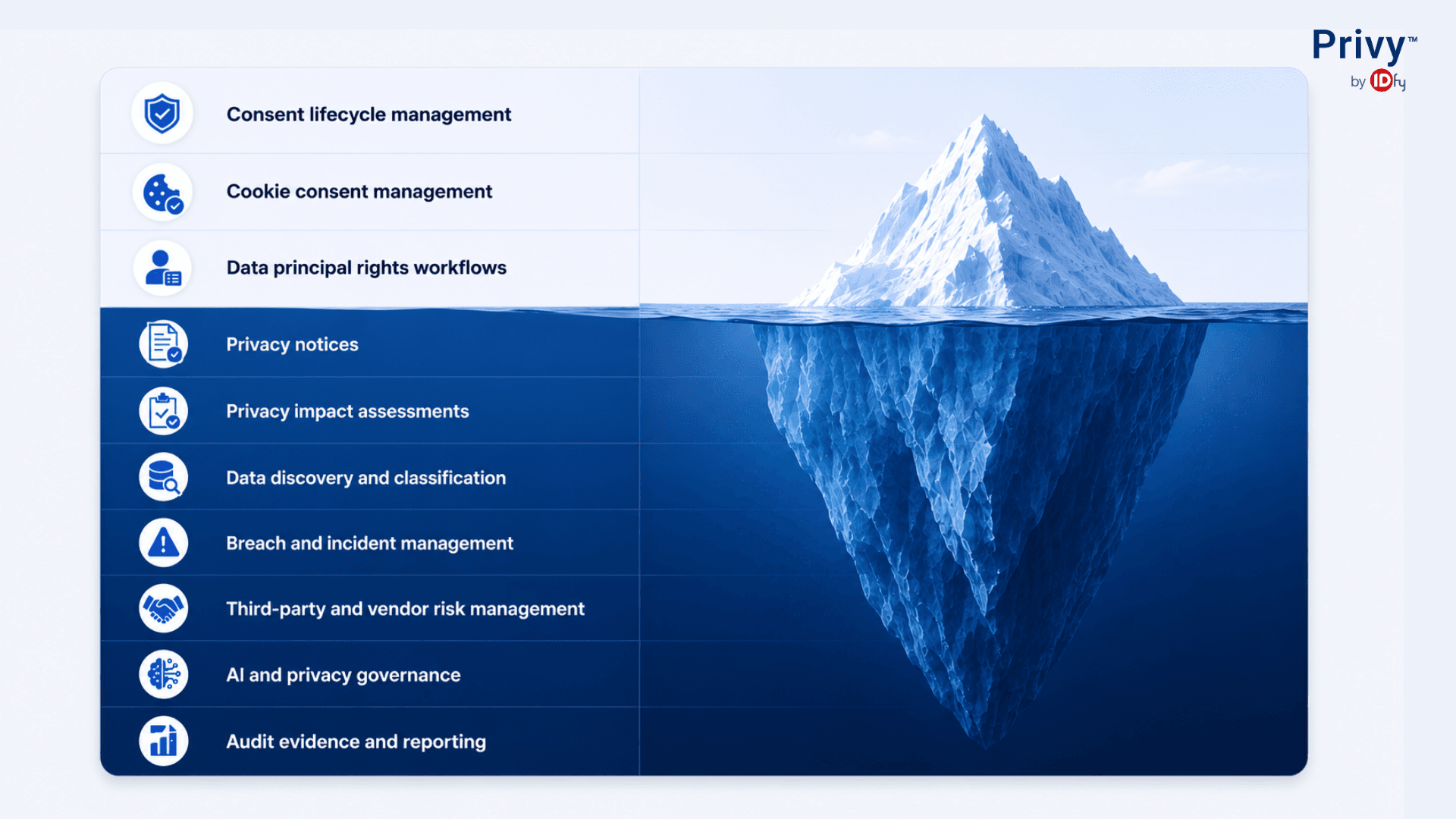
The first miscalculation most enterprises make is scoping the build as a single consent tool. The DPDP Act does not require a consent banner. It requires a compliance programme, and the programme has several distinct working parts.
Under the DPDP Rules 2025, a compliant enterprise needs to be able to demonstrate:
- Consent lifecycle management: collection, storage, renewal, and withdrawal of consent from data principals, with a valid notice meeting Rule 3 requirements
- Data principal rights fulfilment: processing and responding to requests for access, correction, erasure, and nomination within defined timelines
- Third-party and vendor risk management: assessing and contractually binding data processors under Section 7
- Privacy impact assessments: mandatory for Significant Data Fiduciaries once designated
- Incident and breach management: detection, internal response, and mandatory reporting to the Data Protection Board within prescribed timelines
- Data discovery and classification: knowing where personal data sits across systems before consent on it can be managed
- Audit readiness and evidence management: maintaining records that demonstrate compliance, not just intention
Building one of these is manageable. Building all seven, integrating them with existing enterprise systems, and keeping them current as the Rules evolve is a different undertaking. The DPO guide to consent governance under DPDP covers what the DPO's operational programme looks like once these obligations are running.
What An In-House Build Actually Costs
The cost data on DPDP compliance builds is now available, and it is consistent across sources. King Stubb and Kasiva, one of India's prominent legal and advisory firms, estimates the one-time cost of in-house DPDP compliance at ₹2.5 crore to ₹18 crore for a large enterprise. Protiviti and Greyhound Research both land in the same range: ₹6 to ₹8 crore and ₹10 to ₹18 crore, respectively, for a complete build. The recurring cost of maintenance, updates, annual audits, and staff runs from ₹50 lakh to ₹10 crore per year, and it rises with each new Board direction or rule change.
Where does that money go? A realistic build requires engineers with product, backend, frontend, DevOps, security, and quality assurance skills working in parallel. Eight engineers over 18 months, at competitive Indian market salaries, represent approximately ₹5.4 crore in people cost alone before any tooling, external legal counsel, third-party audit, or integration work. The ongoing cost is the one that surprises CFOs. Every new Board direction (MeitY has issued several since the Rules were gazetted in January 2026) requires the team to interpret the change, update the relevant module, retest integrations, and redeploy. That is not a one-time compliance project. It is a permanent internal product team.
The average data breach in India costs approximately ₹22 crore before any regulatory fine, based on IBM's Cost of a Data Breach report. DPDP penalties stack per non-compliance instance, with fines reaching up to ₹250 crore for a Board-confirmed breach. These numbers are not in the build cost estimate. They are the consequence of a build that fails. Understanding incident management under DPDP and the operational requirements it places on the enterprise makes it clear why this module alone is a significant build effort.
The Deadline Changes The Calculation
The DPDP Rules 2025 were gazetted on 6 January 2026. Most core obligations commence on 13 May 2027. Rule 4, which governs consent manager registration, commenced on 6 November 2026. An in-house build takes 18 to 24 months. A programme that begins today reaches production in mid to late 2027 at the earliest, and that assumes no scope changes, no team attrition, and no delays in regulatory interpretation. The window to choose a build has already closed for most enterprises. The question is now how quickly a platform can be deployed.
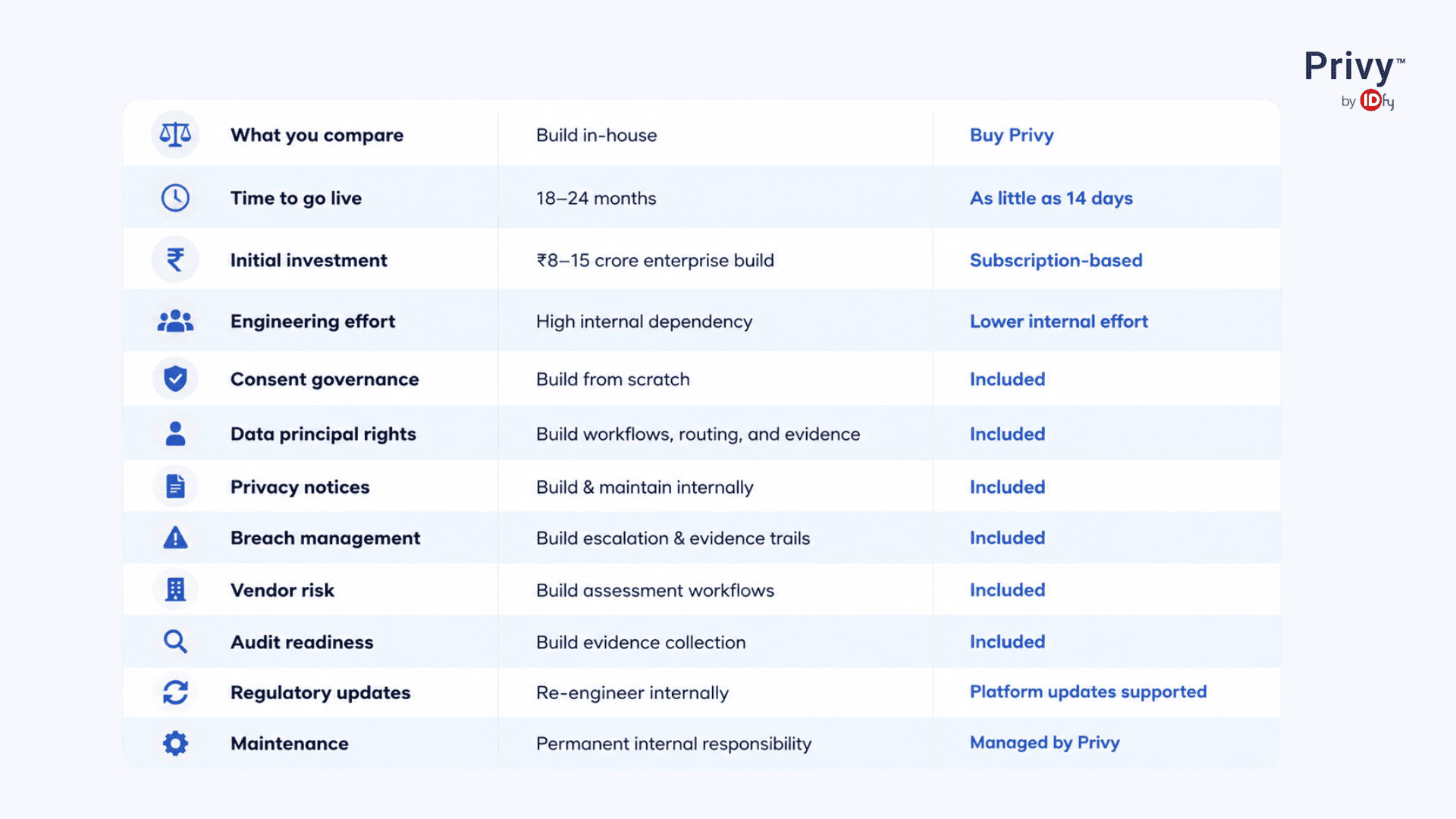
Build Vs Buy: The Full Comparison
The table below compares an in-house DPDP compliance build against deploying Privy by IDfy across the factors that matter most to a DPO and the board. For enterprises still evaluating their vendor risk obligations under the Act, the top TPRM software for vendor risk management in 2026 covers what a purpose-built solution looks like against a manual approach.
What The Cost Table Does Not Price
Numbers build the business case. These are the reasons enterprises sign.
Response capability at 11 pm on a Friday. A data breach does not occur during business hours. When an incident hits, a team with an in-house build has to diagnose the breach, activate an internal response process that may have been written months earlier and never tested, and begin preparing a board notification while containing the incident. A platform with built-in incident workflows, pre-tested escalation paths, and a Board notification template means the DPO is running a response, not improvising one. Privy's guide on what privacy incident management actually involves makes the operational gap between a manual build and a running platform concrete.
Sleeping through regulatory change. Every Board direction issued by MeitY is a compliance event. For a team running an in-house build, it is also an engineering event: read the direction, interpret the implications, update the affected module, retest, redeploy. A purpose-built compliance software platform absorbs that work. The DPO receives an update notification. The engineers stay on the product.
Confidence in the boardroom. When a board asks, "Are we compliant?", the answer should be "yes, here is the evidence" rather than "let me check with the engineering team." The difference between those two answers is not legal exposure. It is the evidence layer. An enterprise with a functioning DPDP compliance platform can produce audit trails, consent records, vendor assessment records, and data principal request logs on demand. A build still in development cannot.
Commercial credibility with enterprise customers. Large enterprise and regulated-sector customers increasingly require DPDP compliance evidence from their vendors before signing. This is already happening in BFSI procurement. A DPO who can demonstrate a running compliance programme rather than a planned one has a commercial advantage over their counterparts.
When Does An In-House Build Make Sense?
The build path is not always wrong. It makes sense when all of the following are true:
- The enterprise has a dedicated privacy engineering team with product, legal, and infrastructure capabilities already in place
- The compliance programme has genuinely unusual requirements that no available platform can meet
- There is sufficient runway before the 13 May 2027 commencement date to complete a full build, test cycle, and production deployment
- The enterprise has the internal resources to maintain the build permanently as the Rules evolve
For most regulated enterprises in India, including NBFCs, fintechs, large consumer platforms, and GCCs, none of these conditions is met simultaneously. The team does not exist, the timeline is closed, and the maintenance cost is not budgeted.
Before finalising a build-or-buy decision, a privacy impact assessment on the proposed build itself is worth completing. The guide to privacy impact assessments and top PIA tools covers the assessment methodology and which platforms automate it. The Privacy Impact Assessment product from Privy handles this for enterprises that have already made the buy decision.
What A Purpose-Built DPDP Compliance Platform Covers
Privy by IDfy is India's only full-stack DPDPA compliance platform, covering all seven modules a compliant DPDP programme requires: consent lifecycle management, data principal rights, cookie compliance, privacy impact assessments, incident management, third-party risk management, and data discovery through Data Compass.
We are the only platform that won MeitY's DPDP Innovation Challenge Announcement, a government-validated proof point that matters for enterprises that need to demonstrate to their regulators and enterprise customers that their compliance infrastructure meets the Indian standard, not a retrofitted global one. IDfy’s submission was recognised for its strong alignment with the Digital Personal Data Protection Act, along with its innovation, technical robustness, and real-world applicability.
For us, this recognition reinforces the work we’ve been doing to help enterprises move from DPDP readiness to real-world implementation. Today, 50+ organisations rely on Privy’s privacy governance and DPDP implementation expertise to build safer customer interactions and protect customer data. We look forward to partnering with many more organisations as India moves towards a stronger trust and privacy ecosystem.
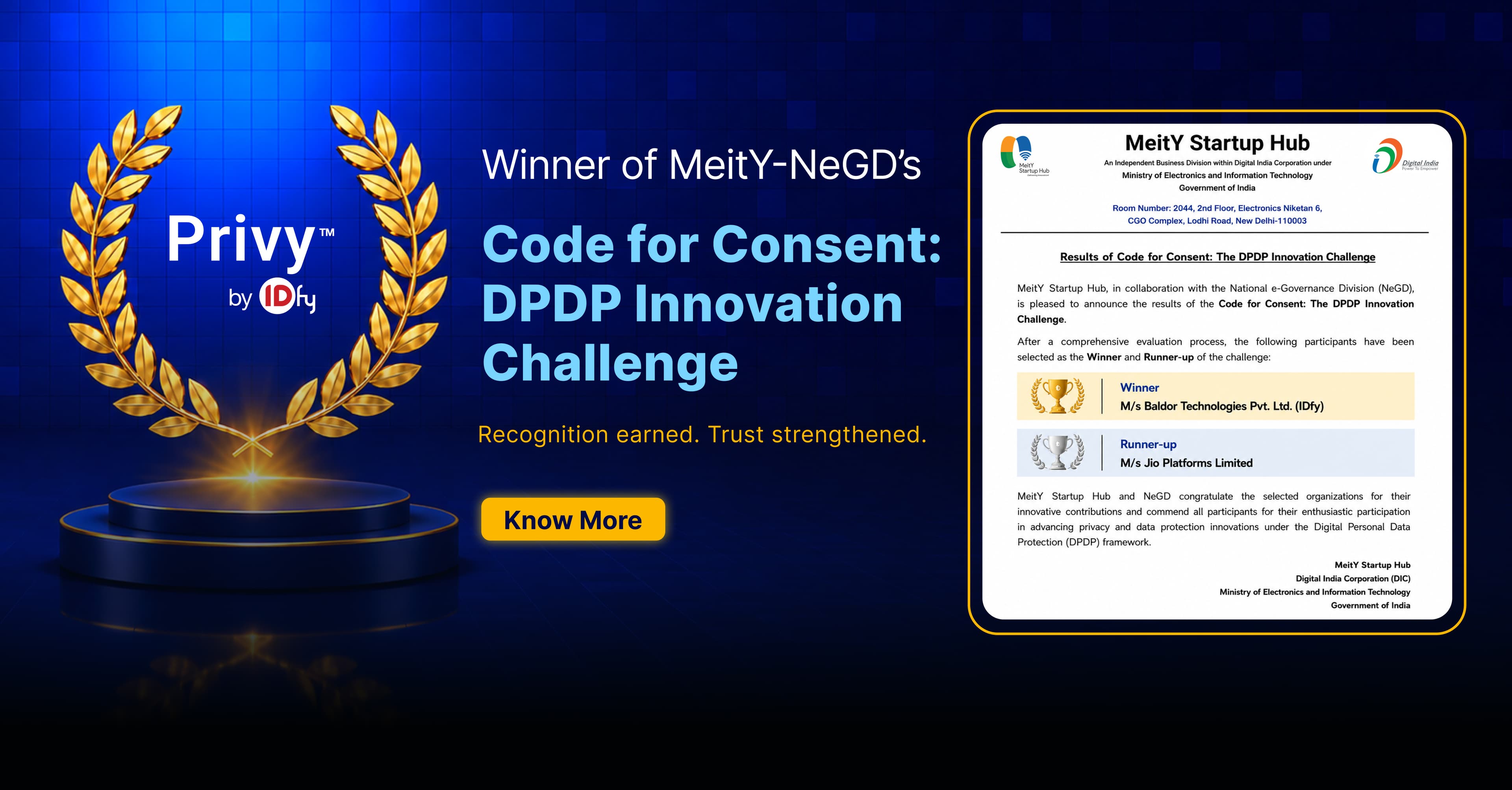
To know more about this challenge here
Data Compass, Privy's data discovery and governance product, is India's first DPDPA-native PII discovery tool. It scans systems and endpoints, classifies personal data against India-specific document categories including Aadhaar, PAN, and Voter ID, and creates the data map that makes consent governance possible. Consent cannot be managed on data that has not been located yet.
InspectAI, Privy's AI compliance layer, scans live digital journeys for compliance gaps before they become breach events. No competitor in India has published an equivalent product or any content about AI-driven privacy governance at the time of writing.
Axis Bank, Axis Finance, HSBC, Wakefit, TrustPaisa and many more have already partnered with us. A major private bank has chosen Privy as the infrastructure for its DPO dashboard and customer consent governance. The full Privy solutions overview shows how the three pillars and seven modules connect into a single compliance programme.
The Decision
For most Indian enterprises facing the 13 May 2027 deadline, the decision is not actually a close one. The build path requires resources, time, and ongoing capacity that most organisations do not have. The buy path delivers a tested, seven-module compliance programme in 14 days, with regulatory updates maintained by the platform team.
The more important question is not build or buy. It is whether the platform you buy covers the full DPDP obligation: consent, rights, data discovery, vendor risk, breach response, and audit evidence. A consent banner is not a compliance programme. A full-stack DPDPA compliance platform, with all seven modules running and connected.
To see how Privy by IDfy maps to your specific compliance requirements, book a demo with the team or write directly to shivani@idfy.com.
FAQ
How long does it actually take to build a DPDP compliance programme in-house?
Most enterprise builds take 18 to 24 months, based on estimates from King Stubb and Kasiva, Protiviti, and Greyhound Research. The timeline assumes no scope changes and a dedicated cross-functional team. Most enterprises do not have that team in place.
What is the cost of building DPDP compliance in-house?
Estimates range from ₹2.5 crore to ₹18 crore as a one-time cost, plus ₹50 lakh to ₹10 crore annually in maintenance and updates. Engineering labour alone (eight engineers over 18 months) can reach ₹5.4 crore before any tooling or audit costs.
Does buying a compliance platform remove legal liability?
No. The data fiduciary retains full legal responsibility under the DPDP Act regardless of whether they build or buy. What a platform does is reduce the probability of non-compliance and give the DPO the evidence trails needed to demonstrate compliance to the Data Protection Board.
What should a DPDP compliance platform include?
At minimum: consent lifecycle management, data principal rights fulfilment, data discovery and classification, privacy impact assessments, incident and breach management, third-party risk management, and audit evidence management. A platform that covers only consent addresses one obligation and leaves six unaddressed.
When does the DPDP Act actually come into force?
The DPDP Rules 2025 were gazetted on 6 January 2026. Most obligations commence on 13 May 2027. Rule 4, covering consent manager registration, commenced on 6 November 2026.
Should NBFCs build or buy DPDP compliance tools?
NBFCs face dual regulation: DPDPA compliance obligations plus RBI data governance requirements. Building a system that handles both from scratch, on a 2027 deadline, while maintaining core operations, is a high-risk approach for most NBFCs. A purpose-built compliance software platform designed for regulated Indian enterprises handles both obligation sets within a single programme.
Is a consultant-led approach enough for DPDP compliance?
Consultants help with strategy, gap assessment, and policy design. They do not typically operate compliance workflows daily. The DPDP Act requires ongoing, demonstrable compliance: consent records maintained, data principal requests responded to within timelines, vendor assessments updated, incidents logged and reported. That is operational work that requires a running system, not a policy document.

DPDP Rules Compliance Checklist: Essential steps for Indian businesses to protect PII and avoid massive fines.
A complete guide to DPDP vs GDPR explaining rights, obligations, major differences, and essential compliance steps for organisations in India.

In this blog, we discuss the AI regulations in India and how AI can comply with the DPDP rules of India.