

Credit Risk Assessment: Models, Process, and Scorecard for Indian Lenders
Date Published

Introduction
For most of the last two decades, credit underwriting in India was a relatively linear exercise. A lender pulled a CIBIL score, verified income documents, ran a quick bureau check, and issued a decision. That model served its purpose in a world where lending was largely formal, borrowers were salaried, and financial trails were relatively clean.
That world no longer exists in its original form.
India's lending landscape today spans public sector banks, private lenders, NBFCs, fintechs, co-lending platforms, and embedded finance providers, each operating at different risk tolerances, product structures, and customer segments. The borrower universe has expanded to include gig workers, informal traders, and first-time MSME borrowers with thin or non-existent bureau histories. Digital onboarding has compressed the loan journey from weeks to minutes, meaning fraud vectors have multiplied proportionally.
In this environment, credit risk assessment is no longer a bureau-lookup exercise. It is a multi-layered, data-intensive discipline that increasingly combines identity intelligence, transaction analytics, behavioural signals, and AI-led modelling with traditional financial analysis. Lenders that treat credit risk assessment as a compliance formality, rather than a strategic capability, are accumulating risk they cannot fully see.
What Is Credit Risk Assessment?
Credit risk assessment is the process by which a lender evaluates the probability that a borrower will fail to meet their repayment obligations and quantifies the financial exposure if they do.
In its complete form, credit risk assessment answers three interconnected questions:
- Will this borrower default? (Probability of Default, or PD)
- How much will the lender lose if they do? (Loss Given Default, or LGD)
- What is the outstanding exposure at the point of default? (Exposure at Default, or EAD)
Together, these three components form the backbone of credit risk modelling under Basel frameworks and are increasingly embedded in the decision engines of Indian banks and sophisticated NBFCs.
But credit risk assessment is also an operational discipline, not just an analytical one. It encompasses data collection, document verification, identity validation, fraud screening, financial analysis, risk rating, pricing, and portfolio monitoring, all of which must function as a coherent system rather than isolated checkpoints.
In the Indian context, this discipline carries added complexity. The RBI's prudential norms govern provisioning, NPA classification, and risk-weighted asset calculations for regulated entities. Digital lending guidelines issued in 2022 introduced additional compliance requirements around algorithmic decision-making, borrower consent, and fair practices. For lenders operating at scale, credit risk assessment infrastructure is now both a regulatory requirement and a competitive asset.
Credit Risk Assessment vs. Credit Scoring
These terms are frequently conflated, and the conflation leads to underinvestment in risk infrastructure.
Credit scoring is a specific output: a numerical representation of a borrower's creditworthiness based on historical repayment behaviour, outstanding debt, credit utilization, and account age. Bureau scores like CIBIL, Experian, Equifax, and CRIF operate on this logic. They are backward-looking, standardized, and effective within a defined borrower population.
Credit risk assessment is the broader process of which credit scoring is one input. It includes identity verification, fraud detection, financial statement analysis, qualitative business evaluation, transaction-level data review, and risk rating, culminating in a lending decision and pricing recommendation.
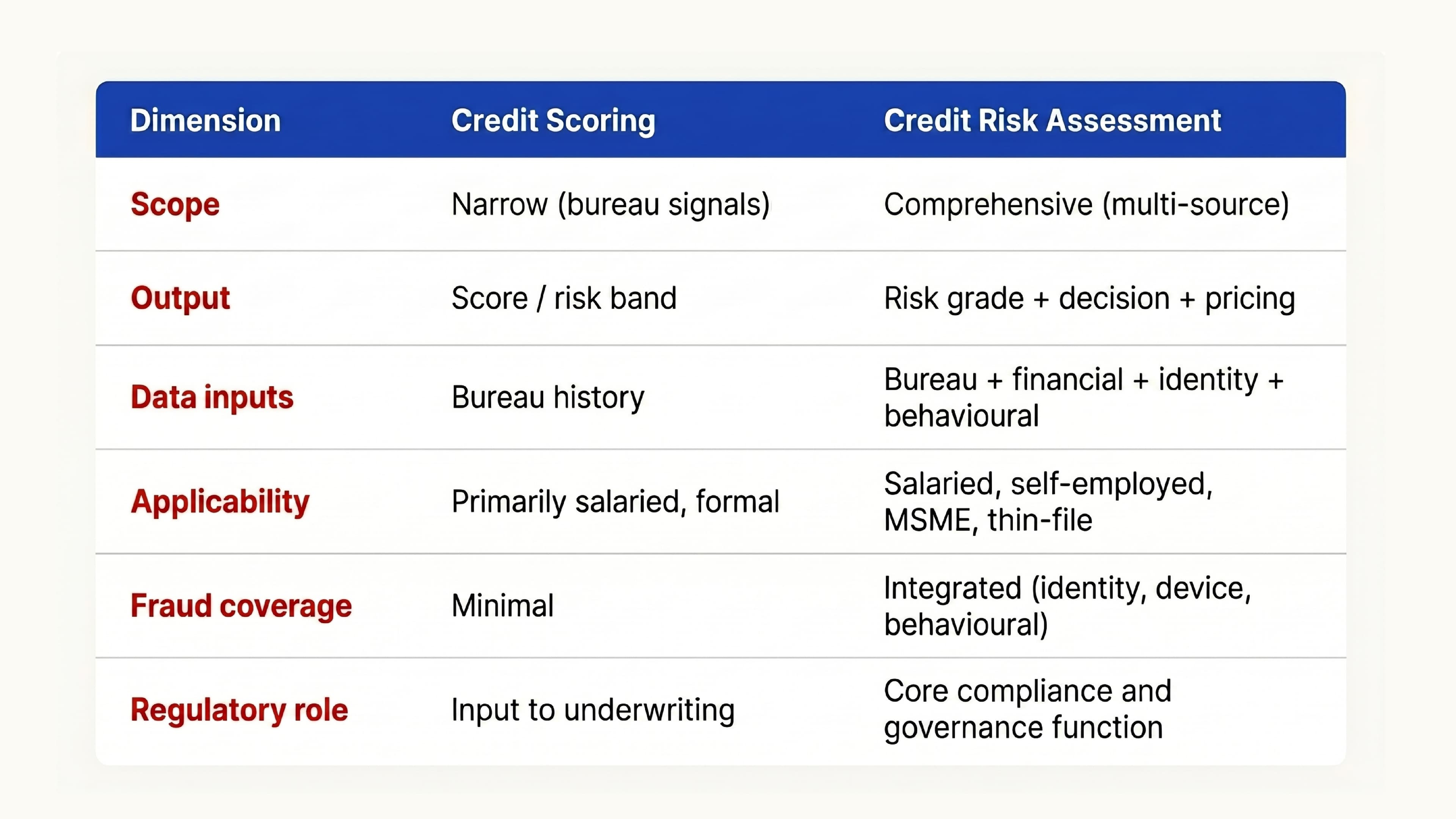
A detailed comparison of Credit Scoring & Credit Risk Assessment frameworks used in digital lending and underwriting.
The important strategic implication: for the 40-50% of loan applicants who arrive with thin or absent bureau histories (a category that dominates MSME and digital lending pipelines), credit scoring alone is structurally insufficient. Credit risk assessment must fill the gap.
This is also where fraud and identity risk become underwriting variables. A borrower presenting a high bureau score but mismatched identity signals, suspicious device behaviour, or artificially clean bank statements is not a low-risk applicant. Without an integrated fraud lens, credit scoring produces a false sense of confidence.
The Credit Risk Assessment Process: Step by Step
Step 1: Data Collection
Modern credit risk assessment begins with data orchestration. A lender's ability to make accurate decisions depends directly on the quality and breadth of inputs gathered at origination.
Bureau data remains the starting point for creditworthy applicants. CIBIL, Experian, Equifax, and CRIF provide repayment history, outstanding obligations, delinquency records, and credit enquiry data. Multiple bureau pulls are increasingly standard practice for risk triangulation.
Bank statement analysis has emerged as one of the most operationally useful inputs in Indian underwriting. Automated BSA tools parse 12-24 months of transaction history to extract income consistency, EMI obligations, end-of-month balances, cash withdrawal patterns, and merchant category signals. For self-employed borrowers and MSMEs, bank statement analysis often reveals more than any bureau score.
GST and cash flow data through the Account Aggregator (AA) framework and direct GST filings are reshaping MSME underwriting. Revenue trends, seasonal volatility, and tax compliance patterns provide a more accurate picture of business health than audited financials alone, particularly for smaller enterprises that file annually but transact daily.
Alternative data sources include telecom records, utility payment history, digital footprint analysis, and platform transaction data from e-commerce or logistics providers. These inputs are increasingly relevant for new-to-credit borrowers where bureau data is sparse.
Device and behavioural signals during digital applications capture device fingerprinting, geolocation consistency, form-fill behaviour, and session anomalies. These are now standard fraud detection inputs. Anomalous device behaviour during onboarding is a materially meaningful credit risk signal, not just a fraud red flag.
Identity verification inputs (Aadhaar-based eKYC, PAN verification, liveness detection, and document authenticity checks) complete the data collection phase. Identity risk and credit risk are not separate assessments in a modern lending workflow; they are sequential filters in the same pipeline.
Step 2: Financial Statement Analysis
For borrowers with formal financials, this stage involves a structured review of P&L statements, balance sheets, and cash flow statements.
Key analytical dimensions include:
- Revenue stability and growth trajectory: Erratic revenue without a plausible business explanation warrants a higher risk grade.
- Leverage ratios: Total debt to equity, debt service coverage ratio (DSCR), and current ratio gauge the borrower's capacity to absorb additional debt.
- Debt servicing ability: DSCR below 1.25x is typically a threshold trigger for more intensive scrutiny in Indian lending practices.
- Operating cash flow vs. reported profit: Divergence between the two, particularly for MSME borrowers, is a significant red flag.
For digital lenders underwriting at speed, automated financial spreading tools integrated with CA-verified data significantly reduce turnaround time without sacrificing analytical depth.
Step 3: Qualitative Assessment
Quantitative models are necessary but not sufficient. Qualitative assessment provides the context that numbers cannot.
Industry risk matters significantly in India given sectoral volatility. Real estate-linked businesses, export-dependent traders, and seasonal agricultural supply chains carry structurally different risk profiles that a scorecard alone cannot fully capture.
Promoter credibility for MSME lending involves background verification, litigation checks, and directorship history. A promoter with unresolved legal exposure or multiple failed ventures is a material risk factor irrespective of current financials.
Business stability signals include the age of the enterprise, employee retention, customer concentration, and supply chain dependencies. Businesses heavily dependent on a single buyer or supplier carry concentration risk that should flow into the risk rating.
Fraud risk indicators at this stage include identity inconsistencies, document anomalies, and reference check discrepancies. Lenders with mature risk infrastructure treat these as underwriting variables, not just compliance exceptions.
Step 4: Risk Rating and Decision
The final stage of the assessment process translates data into a structured risk grade, which then drives the decision and pricing.
Internal risk rating systems typically assign grades across a scale (e.g., A1 through D5, or equivalent), with each grade mapped to provisioning requirements, approval authority, and pricing bands. Decision engines automate this mapping for standard cases, with exceptions escalated through defined credit committee workflows.
Risk-based pricing ensures that the interest rate reflects the assessed risk grade, not just a product category. This is both a portfolio management tool and, increasingly, a regulatory expectation.
Portfolio segmentation downstream allows risk teams to monitor performance by cohort, geography, vintage, and product type, enabling early detection of deteriorating segments before they surface as NPAs.
Types of Credit Risk Assessment Models
Scorecard Models
Scorecards are the most operationally embedded risk tools in Indian lending. They are point-based systems in which each borrower attribute is assigned a score, and the aggregate determines credit eligibility and pricing.
Application scorecards assess creditworthiness at origination using bureau data, income signals, employment profile, and demographic variables. They are calibrated on historical defaults and recalibrated periodically to adjust for portfolio drift and macroeconomic shifts.
Behavioural scorecards evaluate existing customers using their ongoing repayment behaviour, utilization trends, and account activity. They are central to credit limit management, early warning systems, and pre-delinquency intervention. A borrower who was low-risk at origination may shift risk bands within six months of disbursement; behavioural scorecards catch this movement.
Collection scorecards prioritize delinquent accounts based on predicted recovery probability, contact responsiveness, and days-past-due (DPD) progression. They enable lenders to allocate collection resources where recovery probability is highest.
PD, LGD, and EAD Models
These three metrics form the analytical foundation of portfolio-level credit risk quantification.
Probability of Default (PD) is the likelihood that a borrower will default within a given horizon, typically 12 months for retail and MSME portfolios. PD models are built on historical default data, updated with macroeconomic variables, and segmented by borrower type and product.
Loss Given Default (LGD) quantifies how much of the outstanding exposure is expected to be lost after recovery efforts. In secured lending, collateral quality, liquidation timelines, and legal recovery rates drive LGD estimates. In unsecured lending (which dominates digital and MSME segments), LGD is often significantly higher and harder to predict.
Exposure at Default (EAD) captures the outstanding amount a borrower is expected to owe at the time of default. For revolving credit products, EAD modelling must account for drawdown behaviour leading up to default.
Together, Expected Loss = PD x LGD x EAD, a formulation that underpins provisioning, capital adequacy, and risk appetite frameworks for banks and larger NBFCs operating under Basel-aligned norms.
Machine Learning Credit Risk Models
AI and ML models are being deployed at increasing scale across Indian lenders, both as supplements to scorecards and, in some digital lending operations, as the primary decision engine.
ML-based credit risk models offer several advantages: they can incorporate non-linear relationships between variables, handle high-dimensional alternative data inputs, and improve prediction accuracy on thin-file borrowers where traditional scorecards underperform.
Common model architectures include gradient boosting (XGBoost, LightGBM), random forests, and neural networks for complex pattern recognition in transaction data.
However, ML underwriting introduces governance challenges that deserve equal operational attention. Explainability is a core regulatory and ethical concern: the RBI's digital lending guidelines and fair practices code require that credit decisions be communicable to borrowers in plain terms. A black-box model that produces accurate aggregate predictions but cannot explain individual rejections creates compliance exposure. Lenders investing in ML underwriting must invest equally in model interpretability frameworks (SHAP values, LIME, and similar tools) and in governance processes that ensure model outputs are reviewed by accountable credit professionals. Periodic model validation, drift detection, and bias auditing are not optional in regulated lending environments.
Credit Risk Assessment for MSME Lending in India
MSME lending is where India's credit risk assessment capabilities face their stiffest test, and where the gap between traditional and modern risk infrastructure is widest.
An estimated 40-60% of MSME applicants approaching lenders for the first time have limited or absent bureau history. Their income is often informal, seasonal, or multi-stream. Financial statements, where they exist, may reflect tax-optimized figures rather than true business performance. Collateral is frequently illiquid, partially documented, or legally encumbered.
Traditional underwriting models (calibrated on formal, salaried borrowers with clean bureau histories) are structurally unsuited to this segment. Lenders that try to apply them unadjusted will either miss viable borrowers or misprice risk on problematic ones.
What works for MSME underwriting in India:
GST-based cash flow underwriting is now a viable foundation for MSME risk assessment. GST returns filed through the GSTN provide revenue visibility, growth trends, sector classification, and compliance history. When combined with bank statement analysis, they enable a reasonably accurate picture of business cash flow without relying solely on audited financials.
Bank statement intelligence parsed at the transaction level surfaces merchant categories, salary-like credits, EMI debits, round-number transactions, and late-month income clustering. These provide underwriting signals that aggregate financial ratios often obscure. Automated BSA platforms can score a 12-month statement in seconds and flag anomalies that human review would miss at scale.
Embedded finance partnerships are expanding MSME credit access by underwriting within the transaction context. A supply chain finance platform underwriting an MSME using their buyer's purchase order data has a fundamentally different risk profile than a standalone MSME loan. Transaction-embedded underwriting reduces information asymmetry at the point of origination.
Digital onboarding and verification challenges are acute in MSME lending. Fraudulent entity documentation, synthetic identity fraud using valid Aadhaar/PAN combinations, and misrepresented GST registrations are documented fraud vectors in this segment. Identity verification infrastructure (including director KYC, business entity verification, and liveness checks for authorized signatories) is now a mandatory component of MSME underwriting, not an afterthought.
Key Portfolio Risk Metrics
NPA Ratio
Non-Performing Asset (NPA) ratio measures the proportion of a loan portfolio that is past due by 90 days or more. It is the primary regulatory gauge of portfolio health for Indian banks and NBFCs, directly influencing provisioning requirements and capital adequacy. A rising NPA ratio in a specific segment, geography, or product type is an early signal of model miscalibration or emerging macro stress.
PAR (Portfolio at Risk)
PAR measures the outstanding balance of loans with any overdue payment as a percentage of the total portfolio. Unlike NPA (which uses a 90-day threshold), PAR can be calculated at multiple DPD cutoffs (PAR 30, PAR 60, PAR 90), giving risk teams early-stage visibility into delinquency trends before they crystallize into NPAs. PAR is widely used by MFIs, NBFCs, and digital lenders as a forward-looking operational metric.
Delinquency Rate
Delinquency rate tracks the percentage of accounts with overdue payments, segmented by DPD bucket and product type. Monitoring delinquency by origination vintage, disbursement channel, and borrower segment enables lenders to identify which underwriting decisions are ageing poorly and recalibrate accordingly.
Collection Efficiency
Collection efficiency measures the proportion of scheduled repayments actually received in a given period. For digital lenders relying on NACH mandates and UPI auto-pay, collection efficiency tracking at a daily or weekly cadence provides near-real-time portfolio health signals.
How to Build a Credit Risk Scorecard
Building a credit risk scorecard is not a one-time exercise. It is an ongoing process of model development, validation, deployment, and governance.
Define borrower segments. A single scorecard applied across all borrower types (salaried, self-employed, MSME, new-to-credit) will underperform in all segments. Segment-specific models, even if operationally more complex, produce significantly better risk separation.
Select predictive variables. Variable selection draws on statistical analysis (information value, Gini coefficient) and domain expertise. Variables that are statistically predictive but operationally inconsistent (fields frequently missing or easily manipulated) should be handled carefully. In Indian lending, income variable reliability varies significantly by borrower type.
Weight risk factors. Logistic regression remains the workhorse of scorecard development for its interpretability. Weights assigned to each variable reflect historical default correlation, and the aggregate score maps to a risk band. Weight stability across sub-populations should be validated before production deployment.
Validate the model. Out-of-time (OOT) and out-of-sample (OOS) validation are standard requirements. Gini coefficients above 30-35% are typically considered acceptable for retail credit scorecards in India; higher is better. Lift curves, KS statistics, and PSI (Population Stability Index) are standard validation outputs.
Monitor continuously. A scorecard calibrated on 2021 lending data has likely drifted by 2025. Macroeconomic shifts, borrower behaviour changes, and product mix evolution all erode scorecard accuracy over time. PSI thresholds should trigger recalibration reviews, and model drift monitoring should be embedded in the portfolio management workflow.
Govern and audit. Credit risk models are regulatory artifacts in India's banking and NBFC ecosystem. Model documentation, validation reports, approval records, and change logs must be maintained. For institutions subject to RBI's risk-based supervision, model risk management frameworks are no longer optional.
Address bias and explainability. Scorecards that disproportionately disadvantage borrowers by geography, community, or demographic cohort, even unintentionally, create both ethical and regulatory exposure. Explainability tooling and disparity analysis should be standard components of scorecard governance.
Strategic Trends in Credit Risk Assessment
AI-led underwriting is moving from pilot to production across Indian fintech and NBFC lenders. The efficiency gains are real: automated underwriting reduces decision time from days to seconds for in-policy cases. The risk is equally real: without robust model governance, automated decisions can encode and scale biases at portfolio speed.
Real-time risk monitoring through continuous transaction data feeds, UPI activity, and Account Aggregator-enabled financial data is becoming infrastructure, not innovation. Lenders with real-time monitoring capabilities can act on early warning signals before DPD clocks start.
The Account Aggregator ecosystem is maturing. AA-enabled financial data sharing with borrower consent provides lenders with structured access to bank statements, insurance policies, mutual fund holdings, and GST data, reducing document friction at origination while improving data quality. Lenders not yet integrated with the AA framework are operating with a structural disadvantage.
Alternative data expansion continues with platform-level transaction data, e-commerce behaviour, telecom records, and even social commerce activity contributing to borrower risk profiles. The quality and regulatory permissibility of these signals varies significantly, so lenders must maintain clear data governance frameworks.
Regulatory scrutiny on digital lending has intensified since 2022. RBI's digital lending guidelines, data localization requirements, and fair practices obligations around algorithmic lending are reshaping model governance requirements for all regulated digital lenders.
Fraud intelligence and identity infrastructure convergence is the defining operational trend. The separation between credit risk and fraud risk functions is increasingly artificial. A borrower who passes a bureau check but presents mismatched identity signals, inconsistent device behaviour, or artificially clean bank statements is not a creditworthy applicant; they are a fraud risk with a clean bureau score. Platforms like IDfy's OneRisk reflect where integrated underwriting is heading: rather than running identity verification, transaction analysis, and criminal or litigation checks as separate sequential steps, OneRisk connects 500+ signals across individuals, entities, and assets into a single real-time scoring layer. Every score is returned with reasons, which matters as much for RBI audit compliance as it does for operational decision-making. Lenders who continue treating identity, fraud, and credit as three separate pipelines are not running a robust process; they are running three incomplete ones.
Transaction intelligence as a lending moat is emerging as a competitive differentiator for embedded finance platforms and data-rich lenders. Access to longitudinal transaction data (not just a point-in-time snapshot) enables materially better risk prediction and significantly reduces adverse selection.
Conclusion
Credit risk assessment in India is undergoing a structural shift. The question is no longer whether to move beyond bureau-led underwriting: it is how fast and how systematically.
Traditional CIBIL-centric models served a specific borrower population. They cannot reliably evaluate the 300+ million Indians who are new to formal credit, operate informal businesses, or transact primarily on digital platforms. The lenders who will scale profitably in India's next phase of credit growth are those who invest in the infrastructure to assess risk across this entire population, not just the easily scoreable fraction.
This requires hybrid risk models that combine statistical scorecards with ML-based prediction. It requires transaction intelligence that goes beyond bank statement snapshots to longitudinal cash flow analysis. It requires fraud detection and identity verification embedded at the point of underwriting, not appended as post-decision checks. And it requires governance frameworks that can defend every automated decision to a regulator, a board, and a borrower.
Modern lending institutions increasingly rely on integrated risk analytics, automated underwriting infrastructure, transaction intelligence, and real-time borrower verification to scale responsibly in a competitive digital lending environment.
Frequently Asked Questions
What is credit risk assessment?
Credit risk assessment is the process by which a lender evaluates the likelihood and potential financial impact of a borrower failing to repay a loan. It encompasses data collection, identity verification, fraud screening, financial analysis, and risk rating, resulting in a lending decision and risk-based pricing recommendation.
What is a credit risk assessment model?
A credit risk assessment model is an analytical framework used to quantify borrower risk. Common models include application scorecards, behavioural scorecards, PD/LGD/EAD statistical models, and machine learning-based underwriting engines. Most mature lenders use a combination of model types calibrated to specific borrower segments and products.
What is the difference between credit scoring and credit risk assessment?
Credit scoring produces a numerical output (e.g., CIBIL score) based on historical bureau data. Credit risk assessment is a broader process that includes credit scoring as one input, alongside identity verification, financial statement analysis, fraud detection, qualitative assessment, and portfolio risk management.
What does a credit risk analyst do?
A credit risk analyst evaluates borrower creditworthiness by reviewing bureau data, financial statements, and transaction records; builds and maintains risk scoring models; monitors portfolio performance metrics; and recommends risk grades, pricing, and approval decisions for individual accounts or borrower segments.
What is a behavioural scorecard?
A behavioural scorecard is a credit risk tool applied to existing borrowers rather than new applicants. It scores borrowers based on ongoing repayment behaviour, utilization patterns, and account activity, enabling lenders to manage credit limits, identify early warning signals, and intervene before delinquency escalates.
What is PD, LGD, and EAD in lending?
PD (Probability of Default) is the estimated likelihood that a borrower will default within a given period. LGD (Loss Given Default) is the proportion of the outstanding exposure expected to be lost after recovery. EAD (Exposure at Default) is the amount outstanding at the time of default. Expected Loss is calculated as PD x LGD x EAD and underpins provisioning and capital planning for regulated lenders.
How do NBFCs assess MSME credit risk?
NBFCs assess MSME credit risk using a combination of bureau checks, bank statement analysis, GST return data, business vintage validation, promoter KYC, and qualitative business assessment. For thin-file MSMEs, cash flow underwriting through transaction data and Account Aggregator-enabled financial data sharing is increasingly replacing reliance on audited financials.
How do lenders use bank statement analysis in underwriting?
Automated bank statement analysis tools parse 12-24 months of transaction history to extract income regularity, EMI obligations, end-of-month balances, cash withdrawal patterns, and anomalous transactions. For self-employed borrowers and MSMEs, bank statement analysis often provides a more accurate risk signal than bureau scores or declared income.
What metrics are used in loan portfolio risk management?
Key portfolio risk metrics include NPA ratio (non-performing loans as a percentage of total loans), PAR (Portfolio at Risk, measured at multiple DPD cutoffs), delinquency rate by vintage and segment, and collection efficiency. Together, these metrics provide a layered view of current portfolio health and forward-looking risk trends.
Talk to IDfy about building a modern risk assessment infrastructure, from identity and fraud intelligence to transaction analytics and underwriting automation.
A practical guide to credit risk management in India — types, RBI framework, 5-step process, tools, and NBFC-specific challenges.