

Distributor Onboarding in FMCG: The New Compliance and Risk Standards for 2026
Date Published
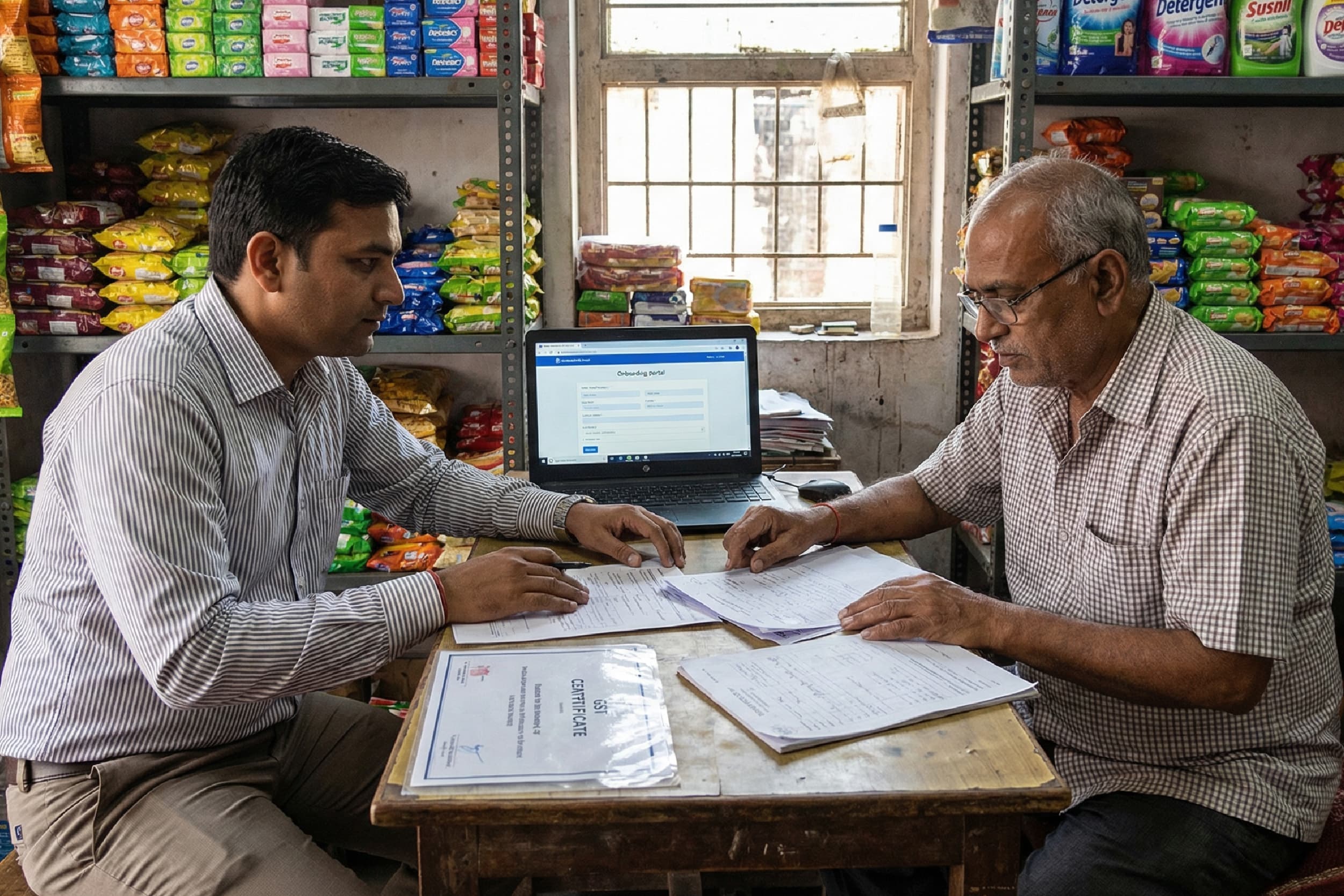
If you are part of an FMCG growth or channel team in 2026, this probably feels familiar. Distributor or retailer onboarding no longer feels like a simple lever for expansion. Every new distributor or retailer you add now carries implications for compliance, revenue assurance, fraud exposure, and brand trust.
Not long ago, onboarding in FMCG was all about speed. The mandate was straightforward: expand reach, improve availability, and outpace competitors. Verification steps existed, but they sat quietly in the background. As long as the stock moved and the numbers grew, the process seemed good enough.
That comfort no longer holds. As we highlighted earlier in our retailer onboarding article, rapid channel expansion has made FMCG brands far more dependent on field-driven onboarding decisions. At the same time, with the DPDP Act coming into play, scrutiny around data protection and channel fraud has intensified. Just as running BGV checks on delivery partners became non-negotiable as workforces scaled, distributor and retailer onboarding is now treated as a frontline risk control rather than an administrative formality.
What Does Distributor and Retailer Onboarding Mean in the FMCG Industry?
In the FMCG industry, distributor and retailer onboarding refers to the process of integrating new channel partners, such as distributors, wholesalers, or retail outlets, into a company’s sales and distribution network. This process ensures that every partner is operationally ready to sell, stock, and promote the brand’s products in their assigned markets.
Distributors typically act as the bridge between FMCG brands and thousands of retail outlets. They purchase products in bulk from the company and distribute them to retailers, supermarkets, and local stores. Retailers, on the other hand, are the final touchpoint where customers interact with the product. Because of this layered distribution structure, onboarding both distributors and retailers efficiently is critical for expanding market reach and ensuring product availability.
The onboarding process usually includes verifying business credentials, completing contractual agreements, sharing product catalogs and pricing structures, and providing operational training. It also involves setting sales territories, aligning on margins and schemes, and granting access to ordering or inventory management systems.
When done well, onboarding creates a strong foundation for collaboration. Distributors understand their sales targets and responsibilities, while retailers gain clarity on ordering processes, promotional schemes, and brand support. In a highly competitive FMCG market, a well-structured onboarding process helps brands quickly scale distribution, maintain compliance, and ensure consistent execution across regions.
Step-by-Step Process for Distributor or Retailer Onboarding in FMCG Companies
Onboarding distributors and retailers in FMCG companies typically follows a structured workflow designed to make partners operational as quickly as possible while ensuring compliance and alignment with the brand’s sales strategy.
1. Partner Identification and Initial Evaluation
The process begins by identifying potential distributors or retailers with strong market reach, good financial standing, and an existing distribution network. Companies often evaluate factors such as territory coverage, warehouse capacity, sales capability, and relationships with retailers before moving forward.
2. Documentation and Compliance Verification
Once a partner is shortlisted, the next step is to collect and verify key documents, such as business licenses, tax registrations, banking details, and identity proof. This stage ensures that the distributor or retailer meets regulatory and contractual requirements before entering the distribution network.
3. Contracting and Commercial Agreements
After verification, formal agreements are signed that outline pricing structures, margins, credit terms, territory allocations, and performance expectations. Clear commercial terms help avoid disputes later and ensure both parties understand the scope of the partnership.
4. Product and System Enablement
At this stage, the distributor or retailer is given access to product catalogs, pricing details, promotional schemes, and digital ordering systems. Many FMCG companies now use digital portals or distribution management systems to streamline order placement, inventory tracking, and communication.
5. Training and Market Alignment
Distributors and retailers are trained in product features, sales strategies, and operational guidelines, including order cycles, stock management, and reporting requirements. This step ensures that partners can effectively sell and promote the brand in their assigned markets.
6. Activation and Performance Monitoring
Once onboarding is complete, the distributor or retailer becomes an active partner in the sales ecosystem. Companies typically assign sales targets, monitor first-order timelines, and track early performance indicators such as outlet coverage, order frequency, and inventory movement to ensure the partnership starts on the right footing.
A well-defined onboarding process not only accelerates time to market but also ensures that every distributor and retailer operates with clarity, consistency, and alignment with the company’s distribution strategy.
Current Gaps and Problems in the Distributor Onboarding Process in FMCG
Distributor onboarding often appears straightforward on paper, but in practice, it is far more fragmented. Inconsistent documentation, field-driven decisions, and limited verification make the process vulnerable to both fraud and compliance gaps.
Let’s take a closer look at the core problems in distributor onboarding today.
- Sales-Driven Distributor Onboarding Weakens Verification Steps
Sales teams often drive distributor onboarding and retailer onboarding. Field teams are measured on coverage, activation, and throughput. When targets loom large, verification steps tend to be shortened, deferred, or treated as paperwork rather than formal risk checks. Over time, this creates a structural gap between growth objectives and governance requirements.
- Poor Onboarding Data Undermines Verification Steps
Under time pressure, distributor onboarding data is often incomplete, inconsistent, or reused across applications. Shared phone numbers, proxy contacts, forged documents, and missing business details are not uncommon. When the foundational information itself is unreliable, the entire verification process weakens. Compliance and validation checks rely on the accuracy of the data submitted during onboarding. If that data is flawed at the start, later verification steps struggle to detect risks, allowing fraudulent or unverified entities to enter the distribution network.
- One-Time Verification Steps Fail in a Dynamic FMCG Channel
Most onboarding frameworks still rely on one-time verification steps. That assumption no longer matches reality. GST status changes, ownership evolves, store formats shift, and operating scale expands or contracts. Financial pressures, market conditions, or shifting incentives can also change a distributor’s motivations over time, increasing the risk of opportunistic fraud. Static verification, therefore, creates a false sense of safety, while the distributor's actual risk profile continues to evolve after onboarding.
Best practices of smart distributor and retailer onboarding
Leading FMCG organisations are not treating these as isolated issues. They are rethinking what onboarding really means. Here’s what they’re looking at.
Distributor verification is not just at onboarding; it is a continuous process, not just an onboarding event. Mature organisations are shifting to lifecycle-based models. Verification steps do not end on day one. They continue as relationships evolve. Here are some of the best practices for a smarter and smoother onboarding journey:
- Standardised Digital Verification Steps Embedded in Workflows
Another important shift is process standardisation. FMCG brands are embedding digital verification steps directly into sales, credit, and channel activation workflows. This eliminates regional variation and discretionary shortcuts, while ensuring that all onboarding decisions remain consistent, traceable, and defensible across markets.
- Continuous Validation Through Frontline Authentication and ID Checks
Rather than relying on static records, organisations are continuously validating GST status, business legitimacy, and ownership indicators. This mirrors frontline authentication and ID checks in field operations, where trust is reinforced at relevant moments instead of assumed indefinitely.
- Centralised Visibility Across Sales, Finance, and Compliance Teams
Leading brands are moving toward centralized visibility across sales, finance, compliance, and audit functions. When verification data, history, and updates are captured in a single system, decision-making becomes more consistent and transparent. It also strengthens audit readiness, ensuring that approval histories and verification actions can be clearly traced and justified when required.
How onboarding technology platforms like IDfy enable smarter FMCG onboarding
As FMCG distribution networks scale, onboarding processes need to move beyond manual checks and fragmented systems. A digital verification using a distributor verification software helps brands standardize how distributors and retailers are verified, bringing consistency, visibility, and stronger risk controls into the onboarding process.
- Profile Retailers Smarter
Retailer profiling improves when verified business and location data support onboarding. By validating GST records, mapping store locations, and comparing outlets against existing market presence, brands can benchmark potential retailers more effectively. This helps identify duplicate outlets, questionable storefronts, or retailers operating under multiple identities before they enter the distribution network.
- Onboard Retailers Faster
Digital verification workflows allow key retailer details, such as GST registration, business identity, and store location, to be validated within minutes. Automated checks help flag ghost stores, mismatched documents, or reused contact information early in the onboarding process, reducing the risk of adding fraudulent or non-existent outlets.
- Trust-Based Partner Onboarding
Distributor onboarding can be strengthened through structured due diligence checks. Business registrations, financial credentials, and ownership details can be verified through trusted data sources, creating a consistent approval process and ensuring that partner relationships are built on verified information.
- Secure Frontlines
FMCG distribution networks rely heavily on third-party personnel such as delivery agents, promoters, and field sales representatives. Identity verification and background checks help ensure that individuals representing the brand in the field are properly validated, reducing operational and reputational risk.
- Stay Compliant
Centralized verification records help brands maintain stronger compliance oversight. By securely storing verification histories, consent records, and onboarding documentation, companies can demonstrate clear audit trails and align their processes with evolving data protection requirements such as the DPDP Act.
- A Distributor Onboarding Journey Built for FMCG
With support for FMCG-specific distributor and retailer onboarding journeys refined over years of working with high-volume, field-led networks, these solutions focus on scale, with control built into the process rather than layered on later.
- Configurable Verification Steps Integrated Into Existing Systems
IDfy enables configurable verification steps that integrate directly with existing sales systems and channel management tools. Identity checks, business credentials, GST validation, and document verification happen digitally at the point of capture. This improves data quality from the beginning and reduces friction for field teams.
- Time-Saving Verification That Reduces Field and Back-Office Effort
Digitised verification steps cut down manual follow-ups, repeated document requests, and coordination between field and back-office teams. Sales teams save time, compliance teams reduce operational load, and overall onboarding timelines shorten without weakening control.
- Centralised Audit Trails and Records
Every verification step and approval decision is logged in a centralised audit trail. FMCG brands can demonstrate not just that onboarding was completed, but how it was completed and why each distributor was approved. This becomes critical as regulatory and internal scrutiny increase.
Conclusion
For FMCG leaders in 2026, the takeaway is clear. Brands that modernise distributor and retailer onboarding with robust, ongoing verification steps can scale faster and more safely. Growth, control, and accountability no longer need to trade off against one another.
For teams looking to operationalise this shift and understand what a standardised onboarding journey looks like in practice, more details and information are available on request. You can reach out directly at shivani@idfy.com to continue the conversation.
Frequently Asked Questions
- What is the difference between distributor and retailer onboarding?
Distributor onboarding involves integrating partners who buy in bulk and act as a bridge between the brand and the market. Retailer onboarding focuses on the final touchpoints (shops and supermarkets) where consumers buy the product. - Why is "speed-only" onboarding no longer recommended in 2026?
While expanding reach is important, rapid onboarding without proper checks now carries high risks. With the DPDP Act and rising channel fraud, unverified partners can lead to data breaches, financial loss, and brand damage. Modern onboarding balances speed with digital verification to ensure growth is sustainable and compliant. - How does digital verification prevent "Ghost Stores" or fraud?
Digital platforms like IDfy allow for real-time validation of GST records, business licenses, and geo-tagged store locations. - Is verification a one-time event during sign-up?
No. In a dynamic market, a partner’s status can change (e.g., lapsed GST, change in ownership). Leading FMCG brands are moving toward continuous validation, where checks are embedded into the entire lifecycle of the partnership

Outdated FMCG onboarding is costing growth. Learn how IDfy’s AI-powered retailer onboarding solution helps verify faster and onboard smarter.

Digital merchant onboarding leverages technology to simplify and speed up the process. By using digital tools such as online application

Customer onboarding has become a key idea in the quickly changing business and technological world. Today, we find ourselves in the midst of a digital revolution that is transforming the way businesses welcome and integrate new consumers.