
IRDAI Distribution Reforms 2026: When Insurers Can No Longer Buy Growth
Author
Vikas Chaurasia
Date Published

IRDAI's distribution paper reads like a paper about commissions. It is really about how Indian insurers have bought growth for a decade, and what they must do once that route is closed.
For years, insurers grew by paying for distribution: more partnerships, more channels and higher payouts per policy. Premium grew, yet the number of individual life policies stayed broadly flat. The industry became better at earning more from existing customers than at insuring new ones, the opposite of what IRDAI’s Insurance for All by 2047 intended to establish.
Recalibrating Economics of Insurance Distribution, the consultation paper IRDAI released on 23 September 2026, proposes to close that route through insurance commission caps and lower expense limits.
Cheaper acquisition, however, does nothing for the quality of the risk being acquired, and that is the problem underwriting and fraud teams now have to solve.
How insurers bought growth
Commissions did what they were meant to do: it built distribution. The problem is that its price rose far faster than the business it produced.
Between FY23 and FY25, distributor remuneration growth dramatically outpaced premium growth, rising by 125% compared to 28% for corporate agency life insurance, and 259% compared to 34% for motor insurance.
In the life corporate agency channel, remuneration now equals nearly 27% of first-year premium. In motor Insurance, average commission across the paper's dataset is 26%, with a maximum of 75%. The paper concludes that distributor pay grew four to five times faster than the premium it was paid on.
Why the bought growth did not hold: persistency in insurance
Persistency measures the share of policies still paying premiums, a set number of months after its sale. It is where the cost of front-loaded commission becomes visible.
Only 48% of life policies remain in force at the 61st month. Policies bought online, where the customer sought cover, persist at 71%. Policies sold through banks and NBFCs persist at 43%. The gap has been attributed to commission design: high upfront pay and almost nothing for keeping a policy in force.
Each early lapse leaves an acquisition cost unrecovered. For risk teams, the more telling point is that a 28-point gap between channels selling comparable products shows that the manner of sale, more than the product, determined how long a policy lasted.
Cheaper acquisition does not fix underwriting economics
The reforms serve IRDAI's goal of Insurance for All by 2047: lower distribution cost should lower premiums and bring uninsured Indians into the risk pool.
But that logic addresses only the first transaction. Once a customer costs less to acquire, the insurer still has to decide whether it wants that customer, what the risk is, and what price will hold over the life of the policy.
The combined ratio, which expresses claims, commissions and operating expenses as a share of earned premium, shows where the money is actually lost. Above 100%, an insurer loses money on underwriting and depends on investment income to stay profitable.
The general insurance industry lost more than ₹30,000 crore on underwriting in FY25, and motor combined ratios ran well above 120%: insurers paid more than ₹120 in claims and costs for every ₹100 of motor premium. Against losses of that scale, even a steep commission cut is a marginal saving.
Lower acquisition cost does not make a loss-making book profitable.
What do the IRDAI distribution reforms propose?
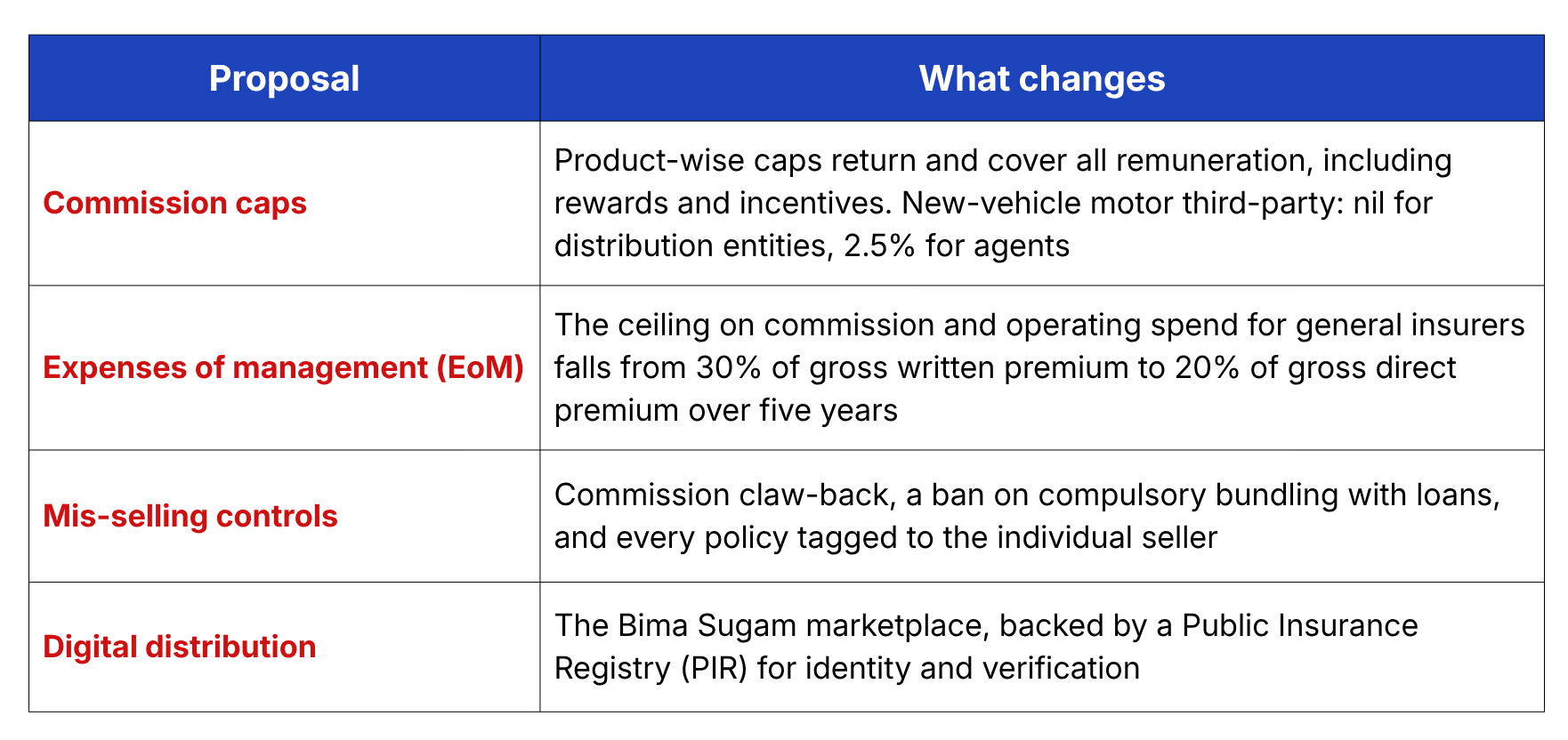
Four proposals bear directly on insurer economics. All are at consultation stage, and IRDAI Chairman has indicated an effective date of 1 January or 1 April 2027, with comments open till 25 October 2026.
The new model also changes who arrives at the proposal stage. Bima Sugam and the PIR are designed to let customers buy with less intermediary involvement, and many of the customers Insurance for All targets will be first-time buyers with little insurance history.
Lower friction and thinner data together raise two risks.
The first is adverse selection, where higher-risk applicants seek cover more actively than lower-risk ones. The second is misrepresentation, from undisclosed pre-existing conditions in health to identity manipulation and false declarations in motor.
As distributor gatekeeping weakens, the insurer's own proposal stage carries more of the risk.
The contest moves to risk selection and underwriting
The paper disciplines how insurers reach customers. It cannot tell them which customers to accept, at what price, or with what confidence the risk will hold. That moves the source of advantage.
The transition from distribution-led growth to risk-led growth shifts the fundamental competitive advantage from merely accessing customers to deeply understanding their risk profiles.
While distribution-led growth relies heavily on commission payouts and focuses on new business premium, risk-led growth optimises the combined ratio and policy persistency by mitigating loss ratios and claims leakage. Consequently, fraud detection moves earlier in the process, from the point of claim to the underwriting stage.
Five capabilities support that shift.
- Verify identity at proposal. Match the proposer, the insured asset and the payer before issuance, using the signals the PIR itself proposes: face authentication, mobile number deduplication and VAHAN checks for vehicles.
- Score risk at the point of quote. Combine declared data with external signals so that price reflects the applicant rather than the segment average. This matters most for first-time buyers with no insurance history.
- Measure channel quality by seller. Once every policy carries a seller identity, track early lapse, early claim and mis-selling rates by seller and outlet, and tighten acceptance rules for high-risk sources.
- Use persistency as an underwriting input. Early-lapse patterns by product, channel and customer profile belong in acceptance and pricing rules, since a policy that lapses in year one rarely recovers its acquisition cost.
- Close the loop between claims and underwriting. Feed confirmed fraud and claims leakage (payouts above what the policy genuinely owed) back into acceptance rules, so that the same pattern is not underwritten twice.
Conclusion
IRDAI's paper resets the price of reaching a customer. It does nothing to the cost of insuring one. Once commission caps and Bima Sugam make access cheaper and more uniform across the market, distribution stops being a differentiator. Insurers that grew by outspending rivals on payouts lose their main lever.
What remains is underwriting judgement: which applicants to accept, at what price, and with what confidence the risk will hold over the life of the policy.
The industry spent a decade learning how to reach customers. The next decade will reward the insurers that know which ones are worth reaching.
FAQ
What are the IRDAI commission rules 2026?
They are proposals in IRDAI's September 2026 consultation paper, not final regulations. They reintroduce product-wise commission caps, count all distributor remuneration toward the cap, lower expense of management limits over five years and add claw-back for mis-sold policies.
When will the IRDAI distribution reforms take effect?
Comments close on 25 October 2026. IRDAI has indicated an effective date of 1 January or 1 April 2027, with expense limits phased in over five years.
Why does persistency matter to insurers?
Low persistency leaves acquisition costs unrecovered and usually signals mis-selling or poor customer fit. Only 48% of Indian life policies remain in force at the 61st month.
How will the reforms affect underwriting in insurance?
Cheaper acquisition and open marketplaces shift advantage from distribution reach to risk selection. Insurers will need stronger identity verification, fraud detection and risk scoring at the proposal stage to contain adverse selection.
Most motor claim risk is documented before the policy is written. Find how Indian insurers can shift risk selection upstream to underwriting