

Mule Accounts Are India's Fraud Infrastructure: How They Form, How They Move, and How Banks Are Fighting Back
Author
Vikas Chaurasia
Date Published
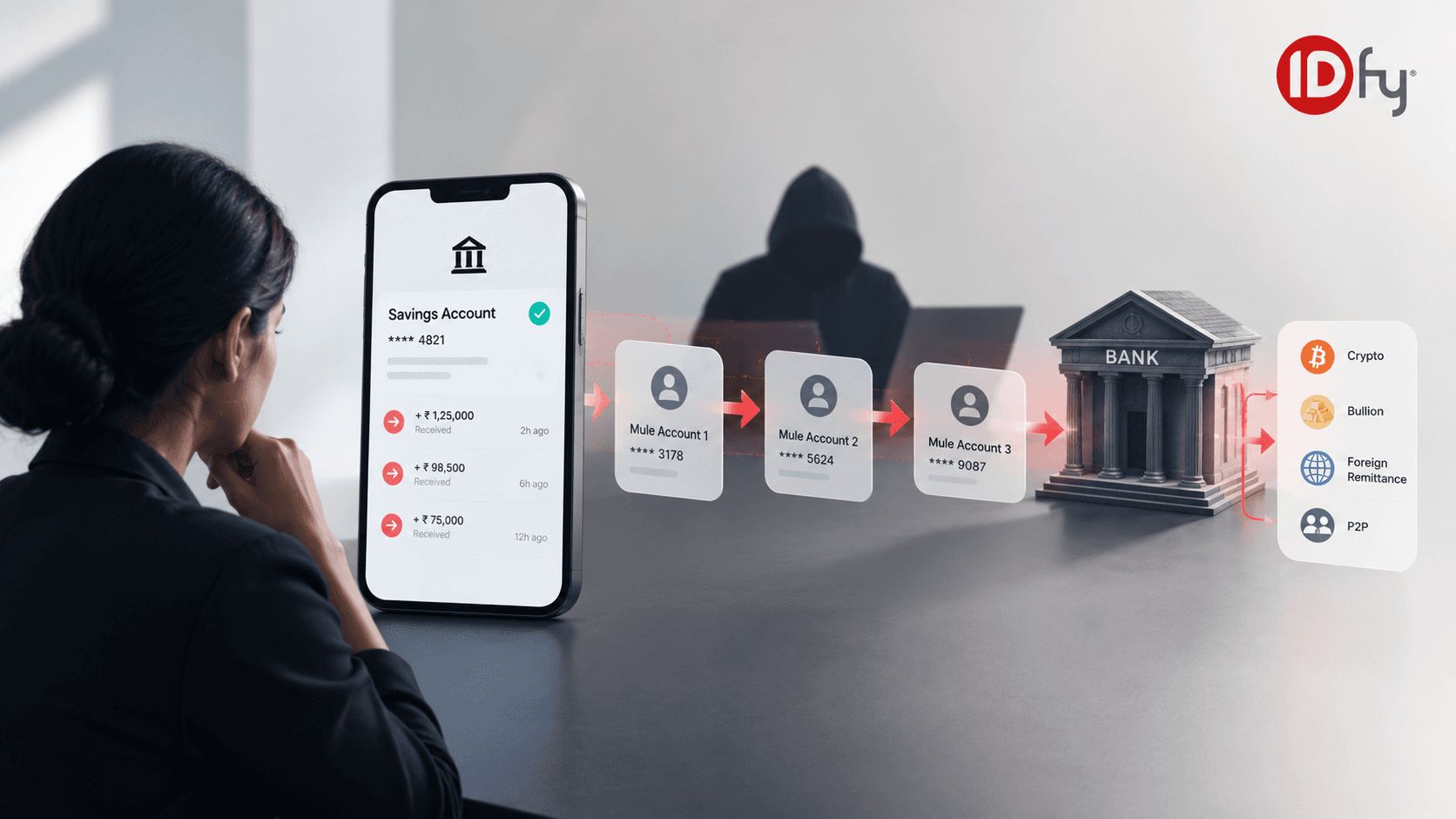
Mule accounts are not a side effect of cyber fraud in India. They are the mechanism that makes it scalable.
Every phishing scam, investment fraud, or digital-arrest extortion that succeeds still needs somewhere to land the money, and that somewhere is almost always a bank account opened by, or taken from, an ordinary customer.
Estimates put the flow through these accounts at roughly ₹2,500 crore a month, with law enforcement recovering only about a tenth. The Central Bureau of Investigation has identified over 8.5 lakh mule accounts across more than 700 branches nationwide.
Catching fraud isn't enough.
Risk teams need to understand how these operations form and move, not just react when they trigger an alert. Without that insight, regulations and tech tools will always play catch-up.
What Is a Mule Account, and Why It Is Not a Fringe Problem
When breaking down mule accounts meaning, it comes down to function: a bank account used to receive, hold, or transfer the proceeds of fraud or illegal activity.
Some individuals operating as money mules know exactly what they are doing and get paid a commission. Others are deceived, often through a fake job offer, a coerced digital-arrest payment, or a request to share an OTP, and have no idea their account has become part of a laundering chain.
The scale is the part that risk teams tend to underestimate. Money mule activity is not confined to unsophisticated victims in isolated pockets; it runs through mainstream banking rails, at a volume that rivals the transaction value of entire retail lending books. The first mistake institutions make is treating mule activity like a minor fraud footnote instead of core financial-crime infrastructure.
How Mule Networks Recruit: Four Patterns Worth Knowing
Mule recruitment has moved well past the stereotype of a single desperate individual handing over a passbook. The primary types of mule accounts fall into four operational patterns today.
- Fake job and task-based scams. Victims are offered remote "financial assistant" or task-completion roles that require opening a new account or sharing existing credentials, with a small registration fee often requested upfront. Recruiters run these accounts through organized trafficking networks. They hide physical SIM and debit cards in courier parcels, ship them to overseas fraud hubs, and manage the entire operation over Telegram and WhatsApp.
- Romance and investment scams (pig-butchering). Fraudsters play the long game. They fake a romance or investment deal for weeks to build trust, then convince victims to move funds, usually right through the victim's own account.
- Digital-arrest coercion. Victims are told they face imminent arrest over a fabricated legal or customs violation and are pressured into transferring funds, sometimes into accounts the victims themselves are made to open under duress. The Supreme Court's own intervention on mule-account SOPs originated from exactly this category of case.
- ‘Mule-as-a-service’ agent networks. Fraud networks don't recruit one victim at a time anymore; they outsource it. Operators pay low-income individuals a flat fee or commission to hand over account access, creating a steady supply of mule bank accounts. Scammers simply buy the ready-made infrastructure and focus entirely on running the fraud.
How the Money Actually Moves
Once a mule account is active, the standard laundering sequence runs in three stages, and the account's own lifespan is often shorter than a single billing cycle.
- Placement - Fraud proceeds from phishing, investment scams, or coerced transfers land in the mule account, frequently within one to two days of the account being activated or compromised.
- Layering - Funds move through a chain of further mule accounts via rapid account-to-account transfers, bulk payment rails, or APIs, deliberately breaking the trail between the original crime and the eventual destination.
- Integration - Money exits the traceable banking system into cryptocurrency, bullion, foreign remittance corridors, or peer-to-peer transfers, at which point recovery odds fall sharply
The mule account itself is typically discarded almost immediately after use. Scammers drain the funds and abandon the account within 24 to 48 hours. This is why transaction monitoring alone fails: by the time an alert triggers, the money is gone, and the account is burned.
The Detection Stack Banks Run Today
No single control catches mule accounts reliably on its own. Institutions running mature programmes typically layer four types of signal, each with a different blind spot.
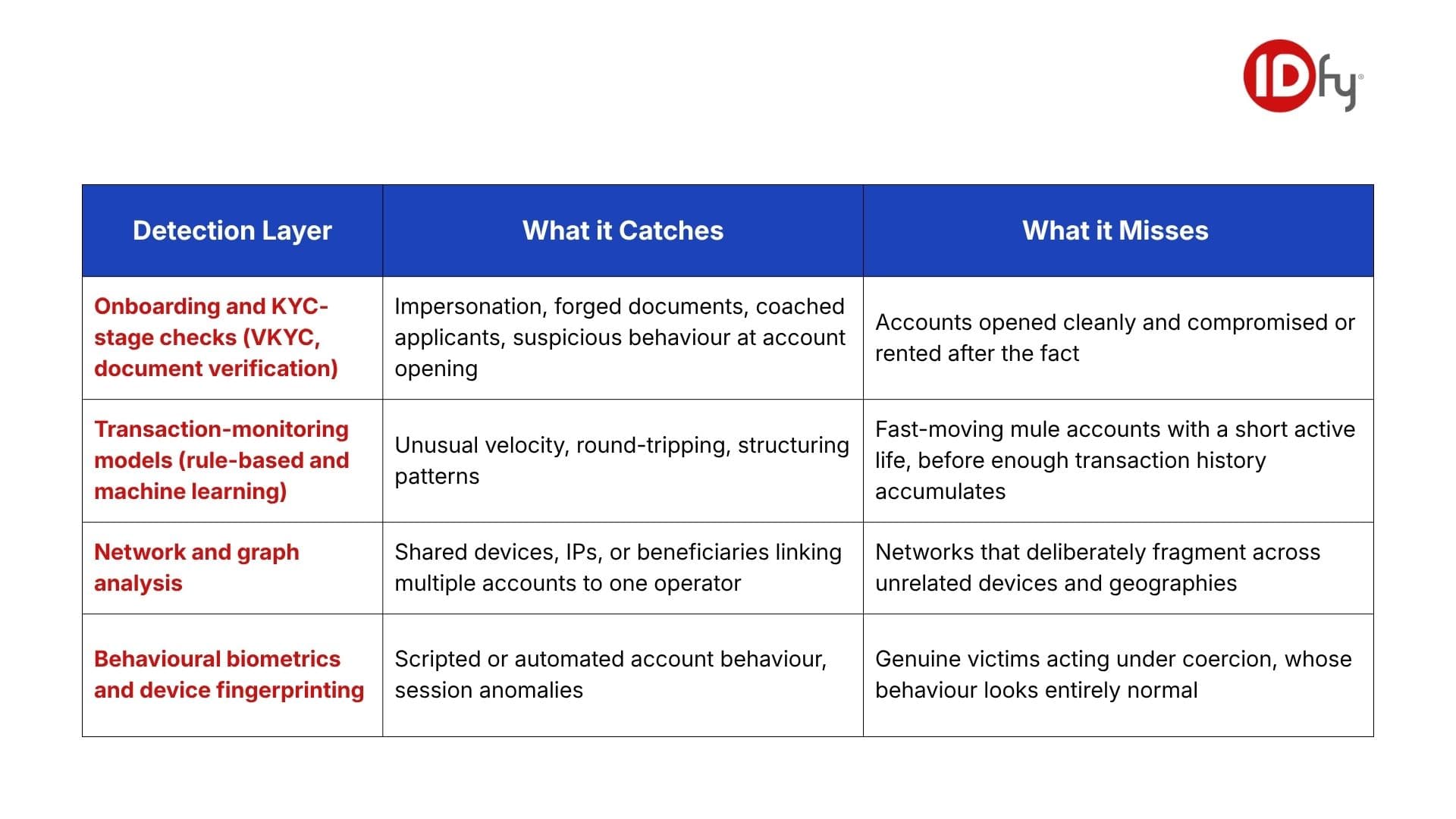
In practical terms, this is why regulators keep adding layers rather than replacing one tool with another.
Onboarding-stage signals and geographic clustering data, of the kind this series covers separately, function as an earlier layer that complements rather than substitutes for transaction-level detection.
KYC data from this stage itself deserves more attention as a fraud-detection asset than it typically receives. Most risk teams waste Video KYC (VKYC) data by treating it as a simple pass-or-fail test. Every VKYC session automatically logs rejection reasons, timestamps, and locations during onboarding. That makes it built-in fraud intelligence sitting right in your pipeline.
Aggregated across enough institutions and enough months, this exhaust data has proven capable of flagging district-level fraud concentration well before it surfaces through complaints or enforcement action. IDfy's own analysis of VKYC rejection patterns across leading financial institutions, detailed in its FraudMap research, found exactly this: rejection rates that cluster, migrate, and reignite in ways specific enough to act on, often weeks ahead of official confirmation.
Where Institutions Still Fall Short
Solving how to identify mule accounts reliably isn't possible with a single control. Institutions running mature programmes layer four types of signal, each with a different blind spot.
- Rule-based detection is still the default at most institutions. A study of ten banks by the Reserve Bank Innovation Hub found that eight were still relying primarily on static, rule-based systems rather than adaptive models, despite the well-documented shift in fraud tactics.
- Onboarding, transaction monitoring, and compliance functions are typically run by separate teams, which means the full lead time available across all four detection layers rarely gets used by any single owner.
- Cross-border trafficking of Indian SIM cards and bank credentials to overseas fraud hubs, documented in recent Asia Pacific Group on Money Laundering findings, puts part of the recruitment chain outside the reach of any purely domestic control.
- Even well-instrumented institutions often treat a closed or dormant mule account as resolved, when the underlying agent network sourcing new accounts is untouched and will simply recruit a replacement.
What a Mature, Consolidated Programme Looks Like
Score risk at every stage of the account lifecycle, not just at onboarding or only on live transactions, since the four-layer table above shows no single stage catches everything.
Route onboarding rejection and KYC-stage signals into the same risk engine as transaction alerts, so a pattern visible at account opening is not sitting in a compliance log while fraud operations work from a separate dashboard.
Build for network effects, not single accounts. A flagged mule account is rarely alone; the agent or operator behind it is usually running several in parallel, and graph-based linking finds the others faster than reactive, account-by-account review.
Assume short account lifespans by default. Given how quickly funds are placed and layered, detection thresholds tuned for weeks of transaction history will consistently arrive too late.
Treat this as a financial-crime programme, not a fraud-ops task. Risk orchestration layers such as IDfy's OneRisk are built to consolidate onboarding, identity, and fraud-risk signals into a single score, which is the direction most mature institutions are already moving toward.
Where Regulation Is Headed
RBI's KYC Master Direction, MuleHunter.AI, the Digital Payments Intelligence Platform, and a tightening liability framework for banks are all part of the same regulatory push toward earlier, shared, and better-evidenced fraud detection. The compliance obligations behind that push, and exactly how liability is shifting onto banks, are detailed separately in this series; the geographic patterns behind where mule fraud actually concentrates across Indian districts are covered separately as well. Neither is required reading to act on the recommendations above, but both add operational depth for teams building out a full programme.
Conclusion
Mule accounts succeed because fraudsters build them like coordinated infrastructure, from recruitment to cash-out. Most banks still try to catch them one signal and one account at a time. To close that gap, you need onboarding data, transaction monitoring, and network analysis working as a single system. Platforms that unite onboarding intelligence with fraud analytics are where that fix actually happens.
FAQs
What are Mule Accounts? Bank accounts used to receive, hold, or transfer the proceeds of fraud, operated either by someone recruited for a commission or someone deceived into handing over credentials or an OTP.
How much money moves through mule accounts in India? Estimates place the flow at roughly ₹2,500 crore a month, with law enforcement recovering only about 10% of it, based on data shared with fraud-protection firms.
Why do mule accounts stay active for such a short time? Because the standard operating model deposits and moves funds within one to two days of activation, then discards the account, which is designed specifically to outrun detection systems built around accumulated transaction history.
Is a mule account holder always complicit in the fraud? No. Many are deceived through fake job offers, romance scams, or coercive digital-arrest schemes, and have no knowledge that their account is being used to launder proceeds.
What is the difference between onboarding-stage detection and transaction monitoring? Onboarding-stage detection, including VKYC and document checks, catches signals at account opening. Transaction monitoring catches unusual activity after the account is live. Mature institutions run both, since each misses what the other catches.

Who are money mules? A money mule is someone who transfers money on behalf of or in the direction of another person. They look for people to