
Top 7 Data Protection Impact Assessment tool in India
Date Published

Data Protection Impact Assessments (DPIAs) is extremely crucial for privacy compliance in 2025 especially after the Digital Personal Data Protection (DPDP) rules getting stricter for the Indian enterprises. With these stringent regulations around consumer privacy demands, there’s a dire need for organisations to have efficient tools to not just manage risks but also stay compliant.
In this blog we will discuss the top 7 DPIA tools for 2025 , the key features of these tools and how they can help in streamlining the compliance.
Also Read : The DPDP Compliance Checklist (2025): Step-by-Step Guide for Indian Businesses
Top 7 DPIA Tools 2025
- Privy by IDfy : Privy is a purpose built DPIA platform designed to help Indian enterprises navigate through the complexities of Digital Personal Data Protection Act (DPDPA).
- TrustArc : Its an assessment manager that helps on automated risk scoring, seamless integration and multi-jurisdiction support.
- OneTrust : Its a privacy automation tool that helps in AI-driven risk assessment, helping in real-time updates and multi-regulation compliance.
- Gotrust : A preference and consent management platform built to help companies navigate through the complexities of data regulations and privacy while enhancing user trust and engagement.
- Securiti : Its an AI-powered DPIA platform that is necessary for data discovery, compliance checks and classification.
- Concur : It’s a SaaS platform built for Indian enterprises complying with the DPDP rules.
- Zoop : An AI based platform used to analyse user behaviour and suggest consent formats that has higher probability of opting in.
Also Read : Top 5 Consent Management Platforms in India 2025
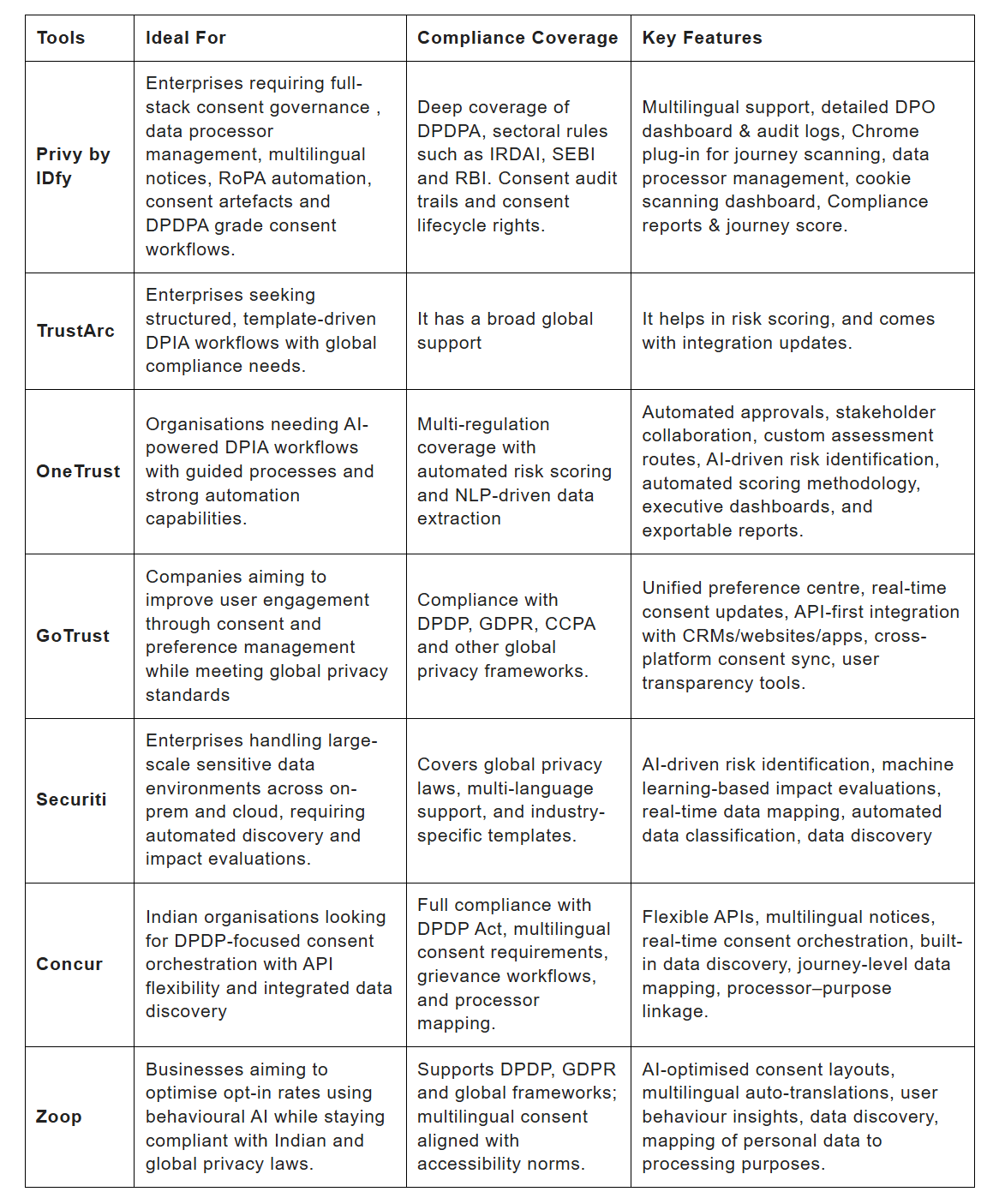
These tools helps in simplification of DPIA with regulatory updates and automation, along with a robust risk management features. Irrespective of you being a global business or a small enterprise , choosing the right DPIA tool in 2025 can reduce a lot of time along with reducing risks and ensuring compliance with the evolving privacy laws.
1. Privy by IDfy’s DPIA Automation
As the Indian enterprises navigate through the maze of DPDP rules, conducting Data Protection Impact Assessments (DPIAs) is not just a compliance checkbox but an integral part of safeguarding the privacy of the end customers. Privy has a suite of platform including Privy Consent Governance Platform (CGP), Inspect AI and the Consent Shield by Privy , that collectively help in scalability, automation and deep integration of the DPIA workflow required for the modern enterprises.
- Evidence backed DPIA with Consent Shield
Consent shield provides with signed consent artefacts that are also tamper proof , ensuring that enterprises have a verifiable proof of processing them lawfully. This is one of the core requirements of DPIA. - Privy’s Inspect AI for Automated DPIA
Privy performs DPIA instantly by analysing digital journeys, detecting non-compliant statements in policies, identifying personal data fields, assessing risks, generating RoPA and mapping processing purposes. All of this ensures that issues are flagged even before the journey goes live. - Governance driven DPIA with CGP
DPIA is operationalised across the enterprises via CGP by providing multilingual consent notices, PII mappings, data processor management, RoPA automation along with sectoral regulation alignment. This helps in making DPIA a continuous governance rather than a one-time activity.
Also Read : Principles of Data Privacy and Protection Explained| Core Principles of DPDP
2. TrustArc
TrustArc assessment manager has been designed to simplify Data Protection Impact Assessment (DPIA) by combining privacy management features with automation. With its customisable templates and structured templates , the navigation of the entire assessment process becomes very efficient. Some of its key features are:
- Compliance Support : It is aligned with global privacy laws. It also provides with document automation and regulatory updates.
- Assessment Tools : It provides with customisable templates, multi-jurisdictional support along with automated risk scoring.
- Workflow Management : This feature looks into audit trails, real-time collaboration and data flow mapping.
3. OneTrust
OneTrust has privacy automation that takes the complexity out of DPIAs by providing an automated and guided workflow that breaks the processes into multiple easy to follow steps , thereby making it accessible for organisations of all sizes.With its AI powered technology, the platforms first identifies potential privacy risks on the basis of the assessment responses. Parallely, its natural language processing capabilities help in extracting critical data that significantly cuts down on manual work. Some of the key features are:
- Workflow Management : It looks into automated approval of processes, stakeholder collaboration tools and customisable assessment routes.
- Risk Assessment : Some of its key capabilities are into automated scoring methodology along with AI-driven risk identification.
- Reporting : Multi-format export options, customisable report templates along with executive dashboards are some of its key reporting capabilities.
Also Read : Top DPDP Platforms & Privacy Automation Tools in India (2025 Comparison)
4. GoTrust
GoTrust is a unified preference and consent management platform built to help organizations navigate complex data privacy regulations while strengthening user engagement and trust. It automates the collection, management, and tracking of user consents and ensures compliance with global privacy frameworks, including India’s DPDP Act, GDPR, and CCPA. Some of its key features are:
- Unified consent & preference center : Provides users with a single portal to manage their preferences with real-time viewing, updating and withdrawing consent. This leads to full user transparancy.
- Global privacy framework : Built-in adherence to global privacy laws.
- API-first Architecture : Easy integration with websites , CRMs and mobile apps. Also has a real-time consent synchronisation across the tech stack.
5. Securiti
Securiti is the AI-powered platforms that helps in simplifying DPIA management by automating classification and data discovery. The data intelligence engine of Securiti processes the sensitive data across both on-premises and cloud environments ensuring that efficient and thorough analysis is done. Some of its key features are:
- Risk Assessment : It helps in risk identification via machine learning, while providing with automated impact evaluations and regulatory compliance checks.
- Data Discovery : It scans over 1000 data attributes with real-time data mapping and automated classification.
- Compliance coverage : Security covers 100+ global privacy regulations , multi-language support along with industry specific templates.
Also Read : DPDP Vendor Checklist: 10 Things to Look for in a DPDP Vendor
6. Concur
Concur is a SaaS platform designed for Indian organizations to ensure compliance with the DPDP Act. It supports multilingual consent experiences similar to Privy and offers flexible APIs that enable seamless integration across websites, enterprise systems, and mobile applications. The platform enables real-time consent orchestration and includes built-in data discovery, as well as grievance redressal workflows to support full regulatory compliance.
- Flexible API Integrations: Seamless integration with mobile applications, websites, and enterprise systems.
- Multilingual consent support: Offering consent notices and user-interfaces in multiple Indian languages.
- Data discovery & mapping: Identifies personal data collection points across digital journeys, mapping data to associated processors and purposes for DPDP compliance.
7. Zoop
Zoop is a consent management platform that leverages AI to interpret user behavior and recommend consent formats that maximize opt-in rates. It is recognized as a leading SaaS provider supporting organizations in meeting both Indian and global privacy regulations.
Some of its key features are:
- Multilingual consent support: Delivers consent notices in multiple Indian languages like Privy, and also auto-translates them to meet the DPDP accessibility norms.
- AI-optimised consent experience : It uses AI-ML to identify the user patterns , suggesting consent layouts as well as language improving the opt-in probability.
- Data discovery : Helps in identifying data collection points across journeys , and mapping personal data with processing purposes.
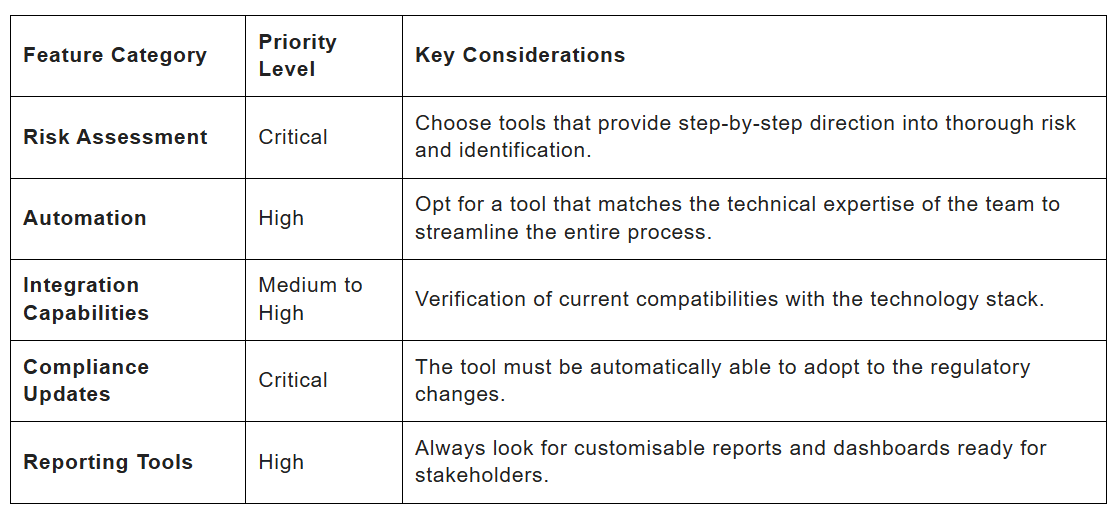
Essential Features to Prioritise While Choosing a DPIA Platform
Also Read : DPDP vs GDPR A Complete Guide for Indian Businesses
Conclution
Choosing the right DPIA platform is no-longer a compliance checkbox for Indian enterprises, it’s the foundational layer of DPDP compliance in 2025. With the tightening of regulations, and expanding data risks , the tools must be able to offer more than templates and checklists. It doesn’t matter whether the enterprise is just scaling across India or is it a fast growing company that’s building its privacy foundation, evaluating DPIA tool is of utmost importance and hence you should choose the best DPIA tool India only for your enterprise.
Platforms like Privy by IDfy, have been designed specifically for DPDP Act, brings an added advantage of India-first regulatory depth , evidence backed governance, automated assessments and seamless compatibility with complex enterprise environments.
Get in touch with us at shivani@idfy.com to take control over your data with India’s most trusted DPDP compliance platform. We will keep you updated with the latest updates pertaining to the DPDP rules and how it's going to impact your business. Stay glued to this space for more information on data, privacy, compliance, and all things DPDP.

Learn the top 10 things that you should look into before getting a DPDP platform for your organization, and how Privy by IDfy can help.

As India’s digital economy expands at an unprecedented pace, the expectations placed on organisations to safeguard personal data have never been higher. The Digital Personal Data Protection (DPDP) Act has elevated privacy from a peripheral compliance activity to a central governance function.

The Digital Personal Data Protection (DPDP) Act has shifted privacy and data governance to the center of organisational strategy. To meet its requirements, companies must know exactly what personal data they hold, where it resides, how it moves, who accesses it, and whether it is being used lawfully.

Learn the difference in responsibilities of CISO vs DPO and how Privy is empowering DPOs to meet the compliance needs of DPDP rules.