

Types of Payment Frauds in India: A Guide to Payment Fraud Prevention in 2026
Date Published
Table of Contents:
- Introduction
- What is Payment Fraud?
- The Current Landscape of Payment Fraud in India (2026)
- Types of Payment Fraud in India
- Emerging Payment Fraud Trends in India
- Key Warning Signs
- How AI is Transforming Fraud Detection in 2026
- How to Prevent Payment Fraud
- Online Payment Fraud Prevention Strategies
- Regulatory Framework and Compliance in India
- Building a Future-Ready Fraud Prevention Strategy
- Conclusion
- Frequently Asked Questions (FAQ)
In 2026, India’s digital payment ecosystem is a marvel of global engineering. We move money faster than we move traffic in Bengaluru. However, for the modern CXO, this velocity is a double-edged sword. Every millisecond shaved off a checkout process is a millisecond less for your risk engine to breathe.
As per the flowchart illustration, fraud in 2026 is no longer a "point-in-time" event; it is a parasitic lifecycle. It begins with customer onboarding with forged identity documents, meanders through product mapping, where fraudsters pose as premium customers to access unsecured credit, and culminates in service requests where a simple social media complaint becomes a back door for account takeover.
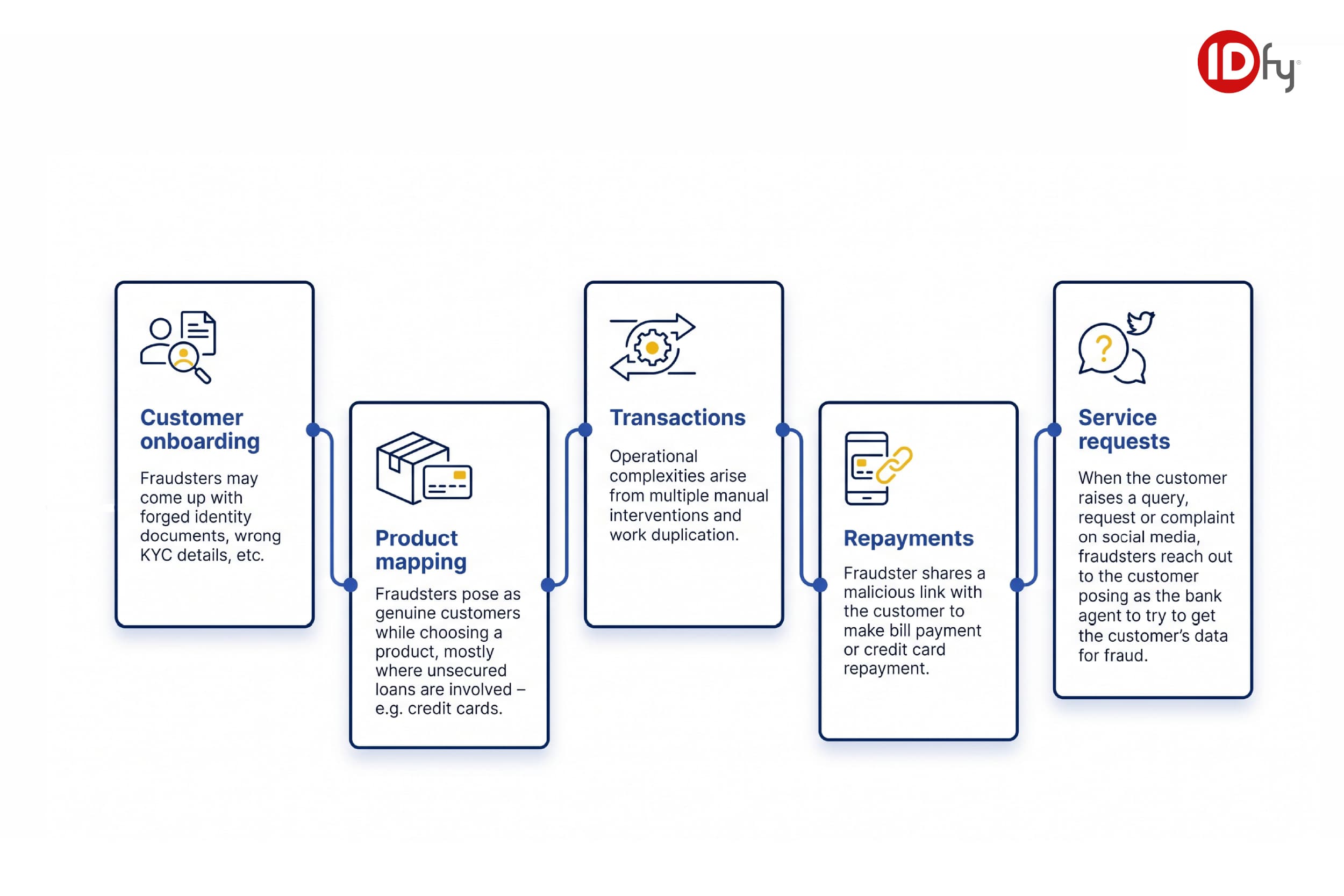
From KYC fraud at onboarding to social media impersonation, here are the 5 key touchpoints where payment fraud strikes in India.
The youth, once thought to be the most vigilant, are now the primary targets. According to recent Mastercard and Recorded Future 2026 data, Gen Z and Millennials in India now account for 48% of all identity fraud victims. This is the Convenience Paradox: because the youth prioritize frictionless experiences, one-click checkouts, auto-saved passwords, and biometric quick-pays, they are more likely to bypass the very red flags they were taught to spot. Stripe’s 2026 analysis suggests that every time a transaction falls into Manual Review, the risk of an internal compromise or an external social engineering exploit increases by 15%.
In this blog, we are explaining exactly what these common types of fraud are, what the emerging trends are, and how to build a future-ready fraud strategy for India.
What is a Payment Fraud?
Payment fraud is any false or illegal transaction completed by a cybercriminal to steal money or sensitive data. In the Indian context, this typically involves unauthorized transactions via UPI, credit/debit cards, or net banking, often fueled by identity theft or social engineering.
The Current Landscape of Payment Fraud in India (2026)
India has officially crossed the UPI-omnipresence threshold. Whether it's a ₹10 tea stall or a ₹5 lakh corporate settlement, the rails are digital. However, the sheer volume of transactions has created a noise that fraudsters use as a cloak.
According to the Mastercard 2026 Annual Payment Fraud Report, we have moved from industrialized fraud (mass phishing) to precision-guided deception. Fraudsters now use AI-powered marketing platforms to segment victims with the same sophistication a D2C brand uses to target customers. In 2026, the "cat-and-mouse" game has moved to the edge, where compromised credit cards are automated and fake stores are spun up by bots in seconds.
Types of Payment Fraud in India
To fight the enemy, you must first name them. Drawing from current Indian trends, here are the dominant threats:
- Identity Fraud and the Synthetic Identity Crisis
- Account Takeover Fraud (ATO)
- Phishing Fraud and Social Engineering
- Authorized Push Payment (APP) Fraud
- Card and UPI Fraud
- Identity Fraud and the Synthetic Identity Crisis:
This is the Frankenstein’s monster of 2026. Fraudsters no longer just steal an identity; they build one. By combining a real Aadhaar number with a fake name and a deepfake-generated face, they create a synthetic identity.
These ghosts behave like perfect customers for months. They pay their small bills on time, build a credit score, and then, at the product mapping stage, they bust out by taking the maximum limit on an unsecured credit card and then vanish.
- Account Takeover Fraud (ATO): The Hijacked Digital Life
In 2026, your customer's account is a digital gold mine. ATO has moved beyond stolen passwords. We now see MFA Fatigue attacks, where a bot hammers a user with 500 push notifications until they accidentally click "Approve" out of sheer annoyance.
Once inside, the fraudster changes the recovery email and phone number, often through a compromised service request, effectively locking the real user out. For a business, an ATO isn't just a lost transaction; it’s a total loss of customer lifetime value.
- Phishing Fraud and Social Engineering: The Deepfake Renaissance
Phishing has graduated from the Nigerian Prince era to hyper-personalized impersonation. With GenAI, a fraudster can now clone the voice of your CFO or a bank Relationship Manager in real-time.
The distinction between social engineering (the psychological manipulation) and phishing (the delivery mechanism) has blurred. In 2026, an attack might start with a LinkedIn message, move to a Deepfake voice call, and end with a legitimate-looking email, creating a multi-channel "hallucination" for the victim.
- Authorized Push Payment (APP) Fraud: The Unstoppable Transfer
The most heartbreaking fraud of 2026 is APP Fraud. Here, the underlying payment architecture, be it UPI, IMPS, or RTGS, is functioning perfectly. The exploit isn't in the code; it’s in the human brain.
According to the ACI Worldwide 2026 Prime Time for Real-Time Report, India remains the global epicenter for real-time payments, but this speed has a dark side. APP fraud now accounts for over 40% of all digital payment losses in India, with a projected compound annual growth rate (CAGR) of 25% through 2027.
In an APP scam, the victim is manipulated into voluntarily authorizing a payment. Because the customer uses their own biometrics or OTP to "Push" the payment, the transaction is technically legitimate in the eyes of the banking rails.
In 2026, these have evolved into Deepfake Video Calls. An accounts manager receives a Teams call from what looks and sounds exactly like their CFO, requesting an "urgent, confidential" transfer to a new vendor for a secret M&A deal.
The moment the victim hits "Confirm," the money doesn't sit still. ACI data shows that stolen funds are typically moved through 4 to 7 "Mule Accounts" within the first 120 seconds. By the time the victim realizes they’ve been conned, the money has been withdrawn at a crypto-desk or an offshore ATM.
For businesses, APP fraud is a "Double Loss." You lose the capital, and because the transaction was authorized, insurance providers and banks often deny claims. This leaves the CXO in a defensive position, explaining to shareholders why the company's "internal controls" failed to spot a simulated CFO.
- Card and UPI Fraud: The "Card-Not-Present" Dilemma
While UPI is king, credit card volumes remain high for high-ticket items. Card-Not-Present (CNP) fraud remains a persistent thorn. In 2026, web skimming has become so subtle that malicious scripts sit on your checkout page for weeks, siphoning data from every customer, while your security team sees "Green" on all dashboards.
UPI scams have also evolved into "Request Money" traps, where a user thinks they are receiving money but is actually authorizing a debit. The simplicity of the UPI interface is its greatest strength, but also its most exploited weakness.
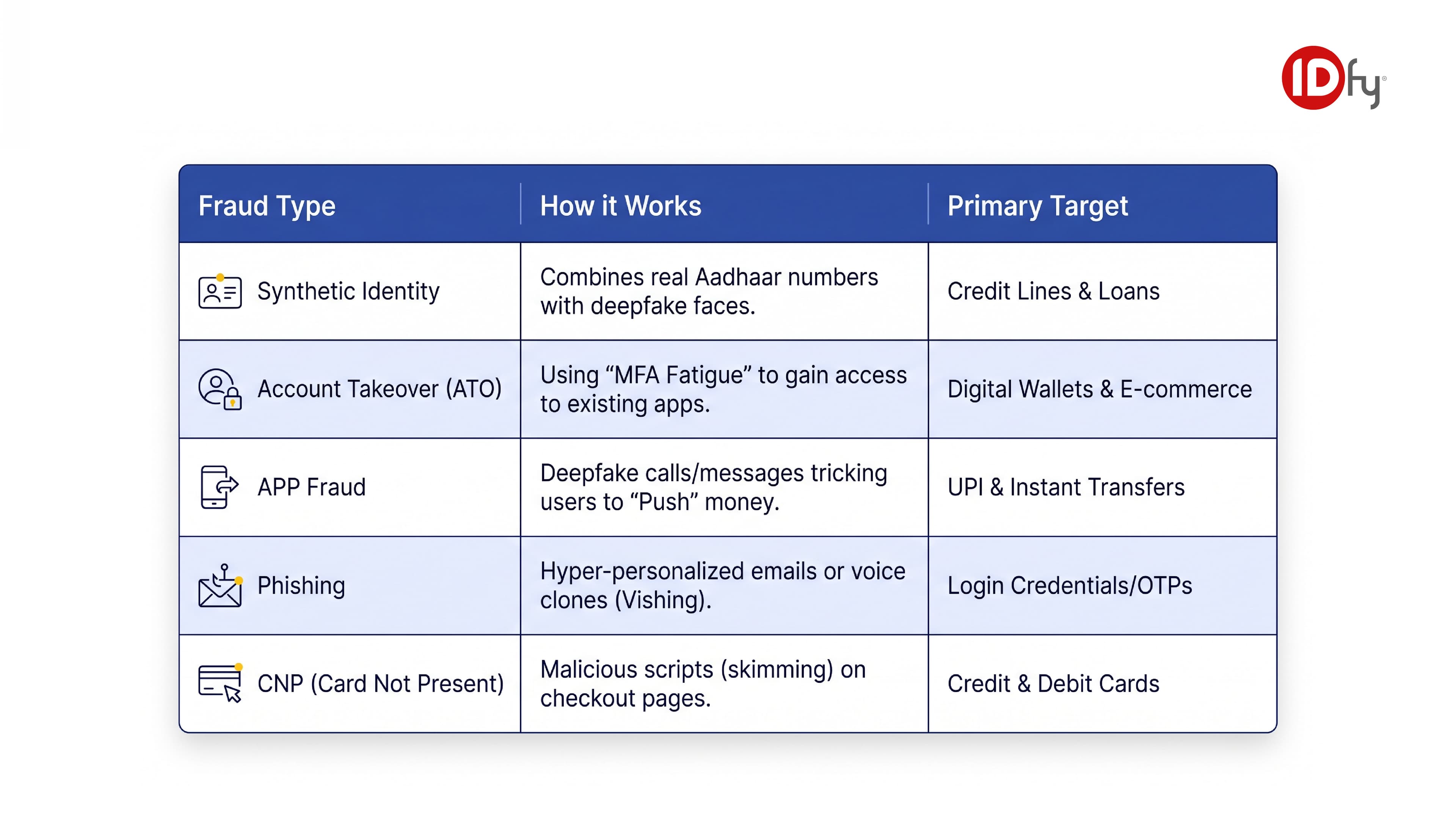
From deepfake-powered synthetic identities to card skimming at checkout: 5 payment fraud types reshaping India's digital threat landscape.
Emerging Payment Fraud Trends in India
The Recorded Future Annual Payment Fraud Report highlighted a terrifying new trend: agentic commerce fraud. As we allow AI agents to make purchases for us (e.g., "Alexa, buy the cheapest flight to Delhi"), fraudsters are now hacking the AI’s decision-making logic.
Furthermore, Industrialized Support Services are now available on the dark web, where fraudsters can buy fraud-as-a-service kits, complete with 24/7 tech support to help them bypass specific Indian bank firewalls.
Key Warning Signs
For a business, detecting fraud is like trying to hear a specific whisper in a stadium during a cricket match. Based on insights from the Consumer Financial Protection Bureau (CFPB) and real-time 2026 data, businesses must look for these subtle behavioral anomalies:
- Travel Metadata
- Mismatched identity trajectories
- Small-value probing
- Pressure tactics in service requests
- The Travel Metadata: This is the digital version of a person being in two places at once. If a customer’s login occurs on a Mumbai IP address, but the transaction's device fingerprint shows a time zone or language setting common in Eastern Europe, your risk score should skyrocket.
- Mismatched Identity Trajectories: Synthetic identity fraud often leaves a trail. A classic warning sign is an account that has a perfect credit score but zero social history, no linked UPI accounts, no historical utility bills, and a mobile number that was activated just 48 hours before the loan application.
- Small-Value Probing: Before a Bust-out fraud (where the fraudster drains a credit limit), they usually perform Card Testing. Look for a series of ₹1 or ₹10 transactions that occur in rapid succession across different merchants. This is the fraudster checking if the stolen card is active.
- Pressure Tactics in Service Requests: Fraudsters often contact customer support via social media. A red flag is any user who uses "Extreme Urgency" or "Threats of Legal Action" to bypass standard verification steps, e.g., "My mother is in the hospital, skip the OTP and just change my registered mobile number now!"
How AI is Transforming Fraud Detection in 2026
If 2025 was the year of "Predictive AI," 2026 is the year of "Adaptive Behavioral Biometrics." As per Mastercard’s latest insights, AI is no longer just a filter; it is a sentinel that learns at the speed of the transaction. AI fraud detection is the future. Here are a few ways how AI fraud detection is solving for payment frauds.
- Cognitive Fingerprinting: Modern AI doesn't just look at what you type, but how you type. It measures the cadence of your keystrokes, the angle at which you hold your phone, and the way you move your mouse. If a "customer" is navigating your app with the robotic precision of a script, or conversely, if a "human" is suddenly typing 300% faster than their historical average, the AI triggers a Step-Up Authentication.
- Graph Neural Networks (GNNs): AI now maps the "Hidden Web" of transactions. If Merchant A and Merchant B are technically separate, but the AI sees that 90% of their customers use the same three compromised WiFi hotspots, it can identify a coordinated Salami Attack (many small thefts) before it scales.
- Generative Adversarial Networks (GANs): To stay ahead, companies use AI to attack their own systems. One AI creates the best possible deepfakes, while the other AI learns to detect them. This self-supervised learning ensures that by the time a real fraudster tries a new tactic, the system has already seen and defeated a version of it.
How to Prevent Payment Fraud
To survive the 2026 landscape, a Check-the-Box compliance attitude is a death sentence. You need a multi-layered strategy:
- Strengthening Identity Verification Systems (KYC): Onboarding is your front gate. If a fraudster gets through here, they have the keys to the house. IDfy’s Video KYC and Automated Document Verification reduce manual intervention, which is one of the key vulnerability points. By removing the human error element, you stop 90% of identity-based fraud at the doorstep.
- Multi-Factor Authentication (Preventing ATO): Passwords are dead. In 2026, you must use Passkeys or Biometric Auth. However, more importantly, you need Step-Up Authentication. If a user tries to change their bank details, trigger an IDfy-powered liveness check.
- Transaction Monitoring and Risk Scoring: Every transaction should have a risk score. If the score is high, the transaction doesn't fail; it just enters a friction funnel, a series of extra checks that only a human could pass.
- Employee and Customer Awareness: Your people are your strongest link or your weakest link. Regular phishing drills and awareness campaigns are essential.
Online Payment Fraud Prevention Strategies: Building the Frictionless Fortress
To survive, a CXO must move from reactive defense to strategic verification. Here is the 2026 blueprint for a secure payment infrastructure:
- Orchestrated Trust Onboarding: Stop treating KYC as a compliance chore. Move to a risk-based onboarding model. This is where IDfy comes in handy. Use IDfy’s AI-onboarding to segment users. A low-risk user (high social proof, consistent device history) gets a green channel with minimal friction. A high-risk user (new device, synthetic indicators) is routed through an automated Video-KYC with 3D liveness detection. This balances growth with security.
- Zero-Trust Session Monitoring: In 2026, the login is just the beginning. You must verify the user throughout the session. If a user is performing a high-value transaction or adding a new payee, trigger a passive biometric check.
- Honey-Potting and Web-Armor: Deploy Honey-Tokens, fake credit card numbers hidden in your site’s code. If a web skimmer scrapes these numbers and tries to use them, you instantly know your checkout page has been compromised and can kill the script before it touches a real customer.
- The Human-in-the-Loop Escalation: AI should handle 99.9% of the volume, but the 0.1% of high-stakes anomalies should be routed to a specialized fraud war room. This ensures that while you automate efficiency, you don't lose the nuance of human judgment in complex Social Engineering cases.
Regulatory Framework and Compliance in India
If the transaction lifecycle is a highway, the RBI and the Ministry of Electronics and Information Technology (MeitY) have spent the last 24 months installing high-definition speed cameras and weight sensors at every exit. Compliance has evolved from a back-office checkbox to a front-line competitive necessity.
The New Constitution for Payment Aggregators (PAs)
As outlined in the latest RBI Master Directions, the distinction between a technology provider and a financial intermediary has vanished. If you touch the flow of funds, you are a Payment Aggregator, and the burden of proof is on you.
- Mandatory Merchant Due Diligence (MDD): The RBI now mandates a two-tier verification process. PAs must not only verify the identity of the merchant (KYC) but also perform product due diligence. This means ensuring that the merchant isn't a front for illegal gambling, high-risk, unregulated crypto, or shadow lending apps.
- Board-Approved Onboarding Policies: Compliance is no longer a departmental SOP; it must be a Board-level charter. The RBI now requires a signed-off policy that dictates exactly how a merchant is vetted, with periodic re-verification audits every six months.
- The Escrow Mandate: Tightened norms around escrow accounts ensure that customer money is never co-mingled with corporate funds, even for a millisecond. In 2026, the settlement window is a glass box, fully transparent to the regulator.
The DPDP Act
The Digital Personal Data Protection (DPDP) Act has introduced a horizontal layer of risk that keeps General Counsels awake at night. In the event of a payment fraud that stems from a data leak, the law no longer asks if you were hacked; it asks how you protected the Consent Manager protocol.
Under the DPDP Act, businesses are classified as Data Fiduciaries. If a fraudster uses a leaked phone number from your database to launch a phishing attack, you could be held liable for failure to protect personal data, with penalties reaching up to ₹250 Crores per instance.
Building a Future-Ready Fraud Prevention Strategy
The future of payments is invisible. We are living in the era of Autonomous Commerce, where your electric vehicle pays its own charging toll, and smart appliances manage their own grocery subscriptions. To build a strategy that doesn't crumble under the weight of automation, CXOs must pivot from defending the perimeter to orchestrating identity.
The Three Pillars of a 2026 Strategy:
- The Fusion of Cyber and Fraud Intelligence (FraudOps): In most legacy organizations, the cybersecurity team watches the servers, and the fraud team watches the transactions. In 2026, this silo is a liability. A future-ready strategy adopts a FraudOps model, a single unit using a unified data lake.
Integrate your device fingerprinting (Cyber) with your behavioral biometrics (Fraud). If a login comes from a clean device but the typing cadence matches a known fraudster's profile, the system must kill the session before a payment is even initiated. - Real-Time ISO 20022 Data Enrichment: The shift to the ISO 20022 messaging standard is the secret weapon for 2026. Unlike the limited data of the past, this standard allows rich data to accompany every payment message. By using this structured data, AI can spot Authorized Push Payment (APP) fraud by identifying mismatches between the declared purpose and the destination account’s historical behaviour.
- Hyper-Scalable Cloud-Native Infrastructure: Real-time fraud prevention requires massive compute power. You cannot run 500-millisecond deepfake detection on an on-premise legacy server. Move to a cloud-native Payments-as-a-Service (PaaS) model. This allows your fraud engine to auto-scale during high-velocity events (like a flash sale or a national festival), ensuring that your security checks don't become the bottleneck that causes transaction drops.
This is exactly what IDfy is out to solve. We provide the identity fabric that enables invisible payments. IDfy’s platform doesn't just check an ID; it builds a persistent, encrypted Trust Profile for every user.
Conclusion
Fraudsters in 2026 are smart, AI-powered, and relentless. To beat them, you don't need a bigger wall; you need a smarter gatekeeper.
The shift from detecting fraud to verifying trust is the core philosophy at IDfy. By automating the most vulnerable stages of the transaction lifecycle, onboarding, product mapping, and service authentication, we help you build a business that is not just fast but unbreakable.
Is your business ready for the next wave of digital deception? Don't wait for a breach to find out. Let’s talk about how to fortify your growth with a frictionless fortress. Reach out to us at shivani@idfy.com for a comprehensive risk audit of your onboarding and payment systems.
Frequently Asked Questions (FAQ)
- What is the most common type of payment fraud in India in 2026?
Authorized Push Payment (APP) fraud, specifically involving UPI and deepfake social engineering, is currently the fastest-growing and most common threat.
- How can I protect my business from UPI fraud?
Implement real-time transaction monitoring and use "Step-Up" authentication for suspicious "Request Money" or high-value transactions. Educating customers about never entering a PIN to receive money is also vital.
- What is synthetic identity fraud?
It is a type of fraud where criminals combine real data (like a stolen Aadhaar number) with fake information (like a deepfake photo) to create a brand-new, "synthetic" person who can apply for credit.
- How does AI help in payment fraud prevention?
AI analyzes patterns that humans can't see, such as how a person holds their phone or the speed of their typing, to distinguish between a legitimate user and a bot or fraudster.
Learn how BNPL works in India, its risks, regulations, business models, and future trends in digital payments and embedded finance.