
Video KYC can be deployed on the cloud: RBI
Date Published

The RBI has put an end to the ‘on-premise vs. cloud’ debate for video KYC deployment. In its latest clarification, the RBI has explicitly allowed the use of video KYC solutions hosted on the virtual private clouds.
“It is clarified that our requirement of ‘technology infrastructure should be housed in own premises of the RE’, does not imply that regulated entities (REs) including banks may not use the cloud deployment model.
However, it shall be ensured that the ownership of data in such a model rests with the RE only and all the data including video recording is transferred to the RE’s exclusively owned/ leased server(s) including cloud server.”
Background: Amendments introduced on 10th May 2021
Back in May 2021, the RBI announced landmark changes to the extant KYC norms. These changes meant that video KYC, or V-CIP, could now be used to:
- Complete the re-KYC process of banking customers
- Convert limited KYC to full KYC accounts
- Onboard non-individual entities, such as SMEs and businesses
Along with unlocking new use cases, RBI also introduced some changes to the V-CIP process and issued new instructions on the V-CIP/technology infrastructure.
We talked extensively about the new norms, what they meant for institutions in the RBI universe, and how IDfy can help. You can read it here.
These were steps in the right direction, making compliance easier for customers and financial institutions alike.
However, there were certain elements in the regulations that weren’t clear up front. For example, does video KYC need to be housed on-premise or can it be deployed on cloud as well? What does RBI mean by ‘a disruption in the V-CIP procedure’? And more…
Many banks and industry bodies had written to the RBI for further clarification. Recently, the RBI provided the needful.
Latest clarifications from the RBI regarding video KYC
Please refer to RBI’s May 10th circular for exact reference to the instructions mentioned below.
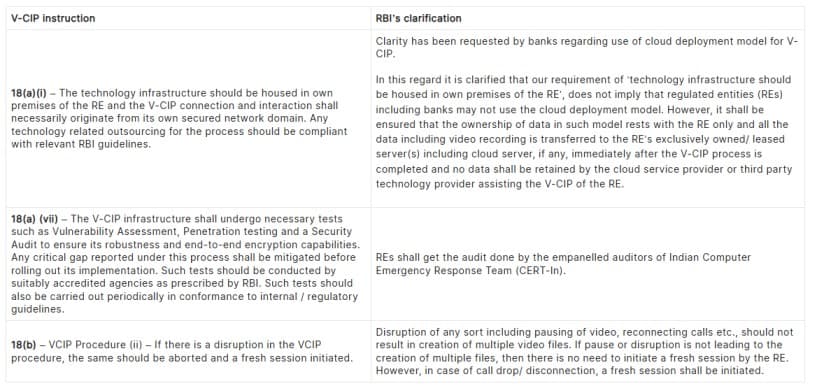
These clarifications are along the lines of how they were being interpreted earlier for the most part. Now, the subjectivity of interpretation has made way for concrete directions from the RBI.
Feel free to get in touch with us at shivani@idfy.com for any further clarification regarding the RBI’s KYC norms, new or old. We’re happy to help.

Just two operational segments in banking contribute to a whopping 95% of all banking frauds. That’s right — Advances and Cards/Internet banking — together account for 95% of all banking frauds. All other operational segments like forex, deposits, cash, cheques, and clearing accounts are tiny problems, in comparison, accounting for less than a percent of total banking frauds.

It had been raining for three straight days in Shillong, and Uday Imtisong was making his third trip between the bank and his house since that morning. Wading through knee-deep water, he wondered if his loan application would be approved anytime soon so that he could add a new wing to his popular gymnasium. He worried about his woefully inadequate credit history and his inability to provide a land bank as collateral for his loan – a common expectation from the lending officer at the bank.

Discover the future of KYC with CERSAI's CKYCRR 2.0: Revolutionizing the Indian financial landscape. Explore how in this blog.

Explore a comprehensive guide on KYC for medium risk customers, covering identification, EDD, ongoing monitoring and best practices.