
Why Indian Enterprises Choose Privy by IDfy
Author
Aishwarya Narsipalli
Date Published
.png&w=3840&q=75)
Many Indian enterprises have gone live with the same DPDP platform across seven industries: banking and insurance, NBFCs, investment and wealth, retail and ecommerce, fintech and payments, telecom, and healthcare. That spread matters more than any single sector win. A bank, a lending NBFC, and a fast-growing fintech do not usually choose the same vendor for the same reasons, and Privy by IDfy is the DPDP platform all three keep landing on regardless.
The short answer is that Privy was not built as a consent tool that grew into something bigger. It was built by IDfy, a 15-year-old identity and trust infrastructure company, as a full-stack platform from the start. That distinction shapes almost everything else in this piece, starting with how the platform handles what actually counts as PII under Indian law and how it approaches the Data Protection Officer role most of these enterprises had to build out before they could even start evaluating vendors.
Backed by IDfy: Why Privy by IDfy Is Built on 15 Years of Trust Infrastructure
IDfy was founded in 2011. Long before DPDP existed as a law, IDfy was already running identity verification, background checks, and fraud detection at a scale most privacy vendors never touch: millions of authentications a day across banks, insurers, and gig platforms.
That history matters for a simple reason. A privacy platform has to sit inside a company's real data infrastructure, not next to it. IDfy's engineering organisation, with over 500 engineers, was already solving problems such as document verification, fraud pattern detection, and large-scale KYC before Privy's first consent record was ever logged. In 2018, IDfy CEO Ashok Hariharan submitted a whitepaper on data privacy and consent to the Justice Srikrishna Committee, years before the DPDP Act came into force. This early involvement led to the launch of Privy in 2022, purpose-built for India’s evolving privacy regime. Privy did not have to learn how Indian enterprise data actually moves. IDfy already knew.
This is also why Privy by IDfy shows up differently in a vendor evaluation than a company incorporated in 2023 or 2024. Product maturity is not a marketing claim here. It is a function of how long the parent company has been operating within India's regulatory and identity infrastructure.
Built for DPDP From Day One, Not Retrofitted From GDPR
Some of the Global privacy platforms operating in India today started as GDPR tools. Their India positioning is an overlay on top of that original architecture, not a rebuild.
Privy started from the DPDP Act and the DPDP Rules that followed it. That shows up in specific, checkable ways rather than in a slogan:
- Consent artefacts are DPDP compliant and immutable, with versioning and downloadable consent receipts, built against the requirements of the Act rather than adapted from a GDPR consent log.
- Consent journeys work across both digital and physical, in-person formats: web, app, physical form-based, and sales-assisted, which matters for banks and NBFCs still onboarding customers on paper in parts of the country.
- Data mapping is built to flex against RBI, SEBI, and IRDAI requirements alongside DPDP, not just a generic purpose and category taxonomy borrowed from GDPR's legal basis model.
- Consent collection runs on data blind, encrypted, access-controlled REST APIs, an architectural choice that avoids the JavaScript-based consent payloads that create manipulation risk on some competing platforms.
None of this is a claim that a DPDP-first platform is automatically better at every feature. It is a claim that the starting point changes the defaults, and for a law with India-specific mechanics like the Consent Manager registration opening on 13 November 2026, the starting point matters more than most buyers initially assume. The same gap shows up in smaller, easy-to-check places, like how cookie consent and cookie policies are handled, or whether an enterprise's own privacy policy reads like it was written against DPDP or translated from a GDPR template.
Why Indian PII Is a Different Problem
A data discovery tool built for European or American data has to recognise passport numbers, national insurance numbers, or social security numbers. An Indian enterprise's data estate looks different: Aadhaar numbers, PAN, Voter ID, driving licence numbers, and regional language text spread across CRMs, cloud storage, and legacy on-premises systems.
Data Compass, Privy's discovery and classification module, was built on top of IDfy's 14-plus years of Indian identity document verification. It recognises Aadhaar, PAN, Voter ID, and driving licence patterns natively, including inside unstructured data like scanned forms and images, using object pattern classification rather than regex matching alone. Regex-based classification, which is what several global platforms rely on for Indian PII, tends to miss format variations and needs far more computation to run at enterprise scale.
This is not a small technical detail. It is the difference between a data discovery exercise that actually finds where Indian PII lives inside a petabyte-scale environment, and one that returns a partial map with confidence intervals nobody trusts enough to act on. It is also why data security posture management, knowing not just where data sits but how exposed it is, has become a specific line item enterprises ask about during evaluation.
A Full Stack DPDP Platform, Not a Consent Management Tool
Almost every enterprise that evaluates Privy by IDfy arrives with some version of the same realization: they already have a consent banner, and it is not close to enough. DPDP compliance touches data discovery, third-party risk, breach response, and data subject requests, not just a cookie pop-up.
Privy's answer to that is a full-stack platform built around three pillars and ten connected modules: consent lifecycle management (consent governance, data principal rights management, and cookie management), continuous compliance and risk (privacy impact assessments, incident management, and third-party risk management), and personal data discovery and governance through Data Compass, unified by an AI Co-pilot.
That structure, roughly 80% data governance and 20% consent, is the opposite of how most platforms in this market are built, which is consent first with governance added later as a module. Governance in practice means a live record of processing activities rather than a static spreadsheet, and it lines up with what most enterprises find once they actually sit down and map what Indian enterprises must do before the May 2027 deadline: the work is mostly governance, and consent is the visible tip of it. It is also why this platform ends up live at a bank, an NBFC, and a fintech at the same time. The same three pillars solve each of their problems, just with different modules doing the heavy lifting.
.png&w=3840&q=75)
Live Across Multiple Regulated and High-Scale Industries
All the enterprises are not concentrated in one sector. It is spread across seven, each with a different reason for choosing the same platform.
Banking and insurance carry the sharpest audit exposure of any sector under DPDP. Axis Bank, HSBC, Federal Bank, and Tata AIG Insurance all run on Privy, alongside Aditya Birla Capital's health and life insurance arms.
For this sector, the deciding factor is rarely a single feature. It is deployment experience at scale, and IDfy has 14-plus years of experience deploying and managing implementations of this size. Banks in particular tend to ask the same follow-up question early: what actually happens end-to-end during a breach, which is covered in detail in Privy's guide to incident management under DPDP. The regulatory overlap between DPDP and RBI's own rulebook is where banks tend to focus next, covered in Privy's guide to DPDP compliance for banks and NBFCs.
NBFCs and lending platforms face a different pressure point: third-party data flows through DSAs, collection agencies, and credit bureaus, often faster than compliance teams can track them. Shriram Finance, Axis Finance, Flipkart Finance, Finova Capital, and TVS Credit all run consent and rights management through Privy. A single lending relationship can involve five or six external processors, each of whom needs to acknowledge and act on data principal requests within a defined window, which is where the third-party risk management module earns its place.
Fintech, retail, and consumer platforms deal with a different scale problem: consent volume. SunCrypto, TrustPaisa, super.money, Wakefit, Housing.com, and Spinny process consent events at a pace that makes manual tracking impossible. Several of these platforms also run privacy impact assessments repeatedly rather than once before launch, following the same steps covered in Privy's guide to conducting a PIA. For the retail and ecommerce side of that group specifically, the sector-level obligations are covered in Privy's guide to DPDPA for ecommerce.
Telecom and services, and healthcare round out the list, with Airtel, Teleperformance, HealthKart, MuscleBlaze, and TrueBasics among the enterprises live on the platform, each mapping the same three pillars to sector-specific data flows: subscriber consent for telecom, sensitive health data categorisation for healthcare. On the healthcare side, patient and clinical data carries its own obligations, covered in more depth in Privy's guide to DPDP for pharmaceutical and clinical data.
.png&w=3840&q=75)
What Privy Delivers: Six Core Outcomes
Beyond the compliance checklist, Privy is built around six core outcomes that enable scalable compliance, operational efficiency, and demonstrable accountability- the same six outcomes the platform is designed and sold against, not a marketing afterthought layered on top of the product.
- Full-stack privacy and data governance. Unified governance across consent, data discovery, DSPM, PETs, DLP, AI governance, incident management, and third-party risk, in one platform rather than four separate trackers.
- Institutionalised accountability. Embedded ownership, workflows, approvals, and auditability across the organisation, so privacy accountability doesn't live in one person's inbox.
- Demonstrable defence. Evidence-backed compliance through records, audit trails, and defensible governance processes- the difference between claiming compliance and proving it under scrutiny.
- First-time-right execution. Proven implementation expertise that reduces rework and accelerates operational readiness, which matters more than a feature list once an enterprise is actually mid-implementation and cannot afford a second attempt.
- Execution at speed. Accelerates DPDP readiness while keeping pace with new regulatory requirements and guidance as they're issued, rather than waiting for the next platform release cycle.
- ROI on privacy. Lower compliance overhead, reduced manual effort, and improved governance efficiency- the argument that gets a CFO comfortable with the line item.
.png&w=3840&q=75)
Day to day, this shows up in specific, familiar ways: audit evidence and activity trails available on demand instead of assembled under deadline pressure, teams identifying affected data principals fast enough to meet DPDP's breach notification timelines, Personal Data Discovery & Governance closing the biggest blind spot most enterprises have, not knowing where personal data actually sits across CRMs, cloud storage, and legacy systems, and privacy impact assessments running on a schedule instead of as a one-off exercise before launch, using the same criteria covered in how to choose the right PIA tool for DPDP compliance.
None of this replaces the case-by-case work of implementation. It does explain why enterprises across seven different industries, with seven different starting points, tend to expand into the full platform rather than stay consent-only.
The MeitY Validation and Why That Matters to Enterprise Buyers
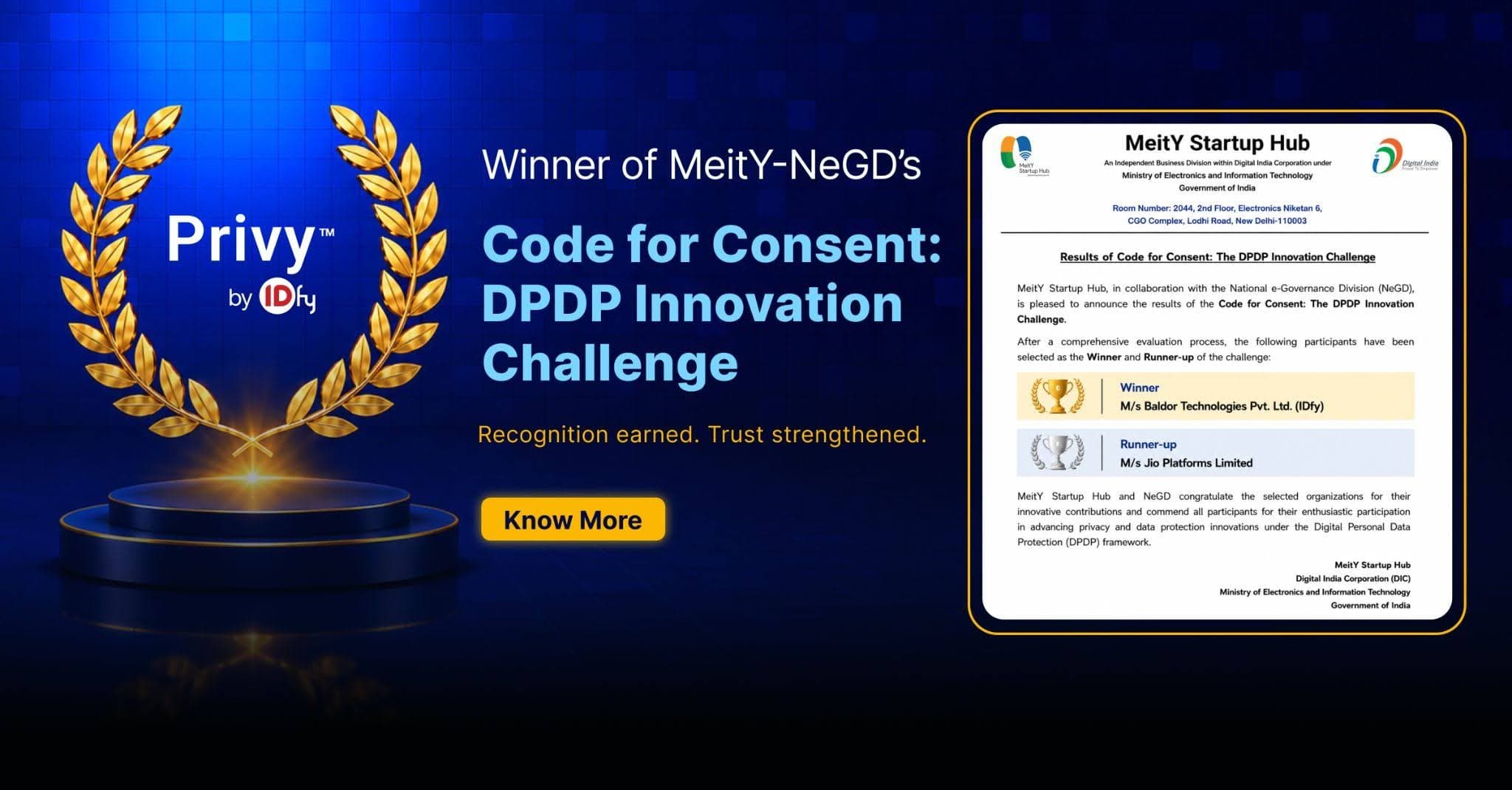
In July 2026, IDfy won MeitY NeGD's DPDP Innovation Challenge, evaluated on technical, functional, and legal readiness against every other Indian consent manager applicant. This is not a self-awarded badge. It is a government-run evaluation, and it puts a specific, hard-to-replicate fact on the table: Privy's approach to consent architecture met the same bar the regulator itself set.
Foreign platforms are structurally excluded from this recognition in a way that has nothing to do with product quality and everything to do with where a Consent Manager under India's Consent Manager framework is required to be based. That is a fact worth stating plainly rather than leaving implied, because it is one of the few comparison points a buyer can verify independently rather than take on faith from either side. Privy's full validation details are documented on the official MeitY Innovation Challenge winner page.
How Privy by IDfy Compares With Other DPDP Platforms in India
Comparing DPDP platforms purely on feature checklists can be misleading. Most vendors can point to consent management, assessments or reporting. The more useful question is whether the platform can help an enterprise operationalise DPDP at scale across privacy, data governance, data security, third-party risk, incident management and AI governance.
This is where Privy by IDfy is positioned differently.
Privy brings these capabilities together in a full-stack privacy and data governance platform, spanning consent and Data Principal rights, personal data discovery and classification, DSPM, PETs, data lineage, privacy assessments, third-party risk, incident management and AI-assisted compliance. Instead of maintaining separate tools and trackers, enterprises can create a connected operating model around the same underlying personal data.
But breadth of capability is only one part of the evaluation. A DPDP platform also needs to help enterprises establish institutionalised accountability with clear ownership, workflows, approvals and auditability and create a demonstrable defence through evidence, records and audit trails that can stand up to regulatory or internal scrutiny.
Execution matters just as much. Privy combines its DPDP-first technology with implementation experience to help organisations get compliance first-time-right and at speed, reducing rework and the operational burden of stitching together multiple point solutions. Over time, that also improves the ROI on privacy by lowering manual effort and making governance more efficient.
Privy also brings a combination that is difficult to capture in a simple comparison table: IDfy’s experience in Indian identity and trust infrastructure, DPDP-first product architecture, MeitY–NeGD recognition, and 50+ enterprise privacy implementations across regulated and high-scale industries.
For enterprises comparing Privy with global privacy platforms or newer India-focused DPDP vendors, the evaluation should therefore go beyond “Does this feature exist?”
The stronger questions are:
- Can the platform connect privacy, data governance and data security rather than manage them in silos?
- Can it establish ownership and accountability across teams?
- Can it produce evidence of compliance when required?
- Can it be implemented at enterprise scale without extensive rework?
- Can it reduce the ongoing cost and manual effort of privacy operations?
That is the benchmark Privy by IDfy is built to meet.
.png&w=3840&q=75)
Read more - DPDP Compliance Platform Comparison
What Indian Enterprises Actually Get With Privy by IDfy
Beyond the compliance checklist, enterprises running on Privy describe a similar shift in how their privacy function operates day to day, regardless of which industry they are in:
- Audit evidence, activity trails, and compliance reports are available on demand instead of assembled under deadline pressure.
- During a breach, teams can identify affected data principals and the data involved quickly enough to meet DPDP's notification timelines.
- Data discovery through Data Compass removes the biggest blind spot most enterprises have: not knowing where personal data actually sits across CRMs, cloud storage, and legacy systems.
- Privacy impact assessments stop being a one-off exercise before a launch and become something teams can run on a schedule instead, using the same criteria covered in how to choose the right PIA tool for DPDP compliance.
- Privacy shifts from a periodic assessment exercise to something closer to continuous operations, which is the model DPDP's ongoing obligations actually require.
None of this replaces the case-by-case work of implementation. It does explain why enterprises across seven different industries, with seven different starting points, tend to expand into the full platform rather than stay consent-only.
.png&w=3840&q=75)
Conclusion
Multiple enterprises across seven industries is not a vanity number. It is 50 plus separate procurement processes, legal reviews, and implementation teams that independently concluded the same thing: a platform built for GDPR and adapted for India carries more risk than one built for DPDP from its first line of code, and a company with 15 years inside Indian identity and compliance infrastructure understands the problem in a way a two or three year old startup has not yet had time to.
The Consent Manager registration window opens on 13 November 2026, and the substantive obligations under the Act take effect on 13 May 2027. Enterprises that are still deciding between a retrofitted global tool and a platform built for this law specifically have a shrinking amount of time to make that call carefully rather than urgently, and comparing incident response readiness is a reasonable place to start: how to choose privacy incident management software in 2026 walks through the same evaluation criteria enterprises used before choosing Privy.
Privy by IDfy's full approach across all three pillars and seven industries is covered on the solutions page. Want to see how Privy maps to your specific DPDP obligations? Talk to Shivani for a walkthrough, or book a demo directly.
FAQ’s
Is Privy by IDfy only built for BFSI?
No. Privy runs across all industries: banking and insurance, NBFCs, investment and wealth, retail and ecommerce, fintech and payments, telecom, and healthcare. BFSI has some of the earliest live implementations because of its audit exposure, but the platform's data governance and consent modules are sector-agnostic.
How is Privy by IDfy different from platforms built for GDPR?
Privy was designed against India's DPDP Act and Rules from the start, including India-specific consent artefact requirements, physical and digital consent journeys, and RBI, SEBI, and IRDAI-aware data mapping. Platforms built first for GDPR adapt a European consent and legal basis model to fit DPDP afterward.
Does Privy recognise Indian identity documents like Aadhaar and PAN?
Yes. Data Compass, Privy's discovery and classification module, is backed up on IDfy's identity verification background and recognises Aadhaar, PAN, Voter ID, and driving licence patterns, including inside unstructured and scanned data.
Who is behind Privy by IDfy?
Privy is built by IDfy (Baldor Technologies), a company founded in 2011 that has spent over a decade in identity verification, fraud detection, and compliance infrastructure before building Privy as a full-stack platform for DPDP.
What is the MeitY Code for Consent Challenge, and why does it matter?
It is a government-run evaluation by MeitY's NeGD that assesses consent manager applicants on technical, functional, and legal readiness. IDfy won the challenge in July 2026, a form of validation that foreign platforms are not eligible for under India's Consent Manager framework.
How is Privy by IDfy different from a consent-only platform?
Consent is one of three pillars in Privy's architecture. The platform also covers continuous compliance and risk (privacy impact assessments, incident management, third-party risk management) and personal data discovery and governance through Data Compass, unified by the AI-Copilot.

What a DPDP solution must have in 2026: consent governance, DPRM automation, processor oversight, RoPA, security, and audit readiness

In this article, we discuss the top 5 consent management platforms that can help your enterprise comply with the Digital Personal Data Protection rules 2025.

Learn what the cross-border data transfer rules under DPDP in India are and how Privy by IDfy helps in data transfer flow in India and outside the country.