
Mis-Selling in Insurance: IRDAI's Latest Clawback Proposal Needs a Verifiable Record of the Sale
Author
Vikas Chaurasia
Date Published
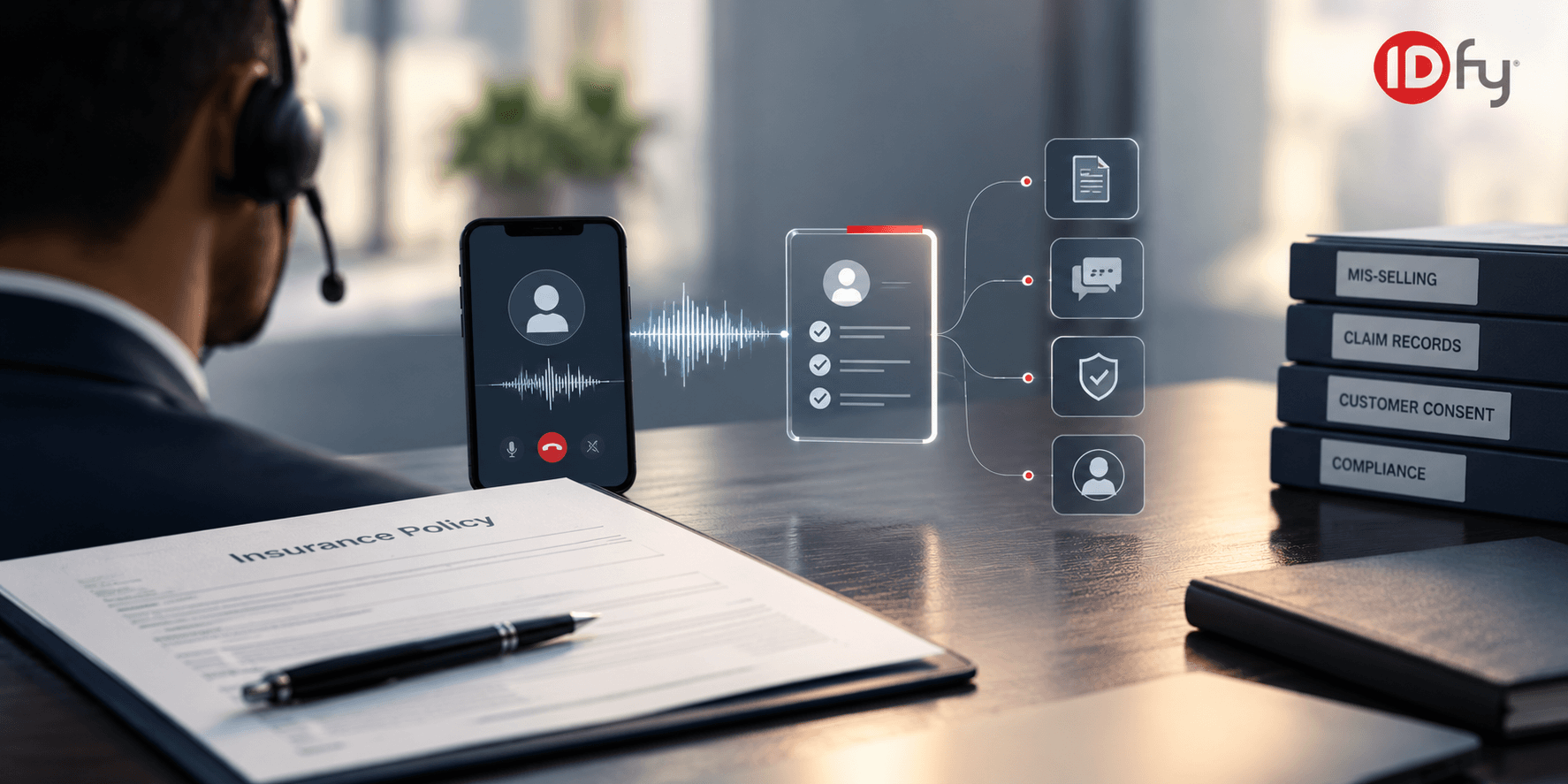
Complaints against Indian life insurers did not rise in FY25. Mis-selling complaints did.
On 23 September 2026, IRDAI released a two-part consultation paper, Recalibrating Economics of Insurance Distribution. It proposes to price insurance mis-selling through commission clawback and to publish mis-selling records against individual sellers. Tagging each policy to its seller is already notified under separate regulations and applies from 1 January 2027.
But a clawback is only as enforceable as the evidence behind it, and most mis-selling leaves no record at the point of sale. The one recorded interaction that most life insurers already hold before issuance is the pre-issuance verification call (PIVC). In its current form, however, it seldom meets the standard of proof a clawback dispute would demand.
What the FY25 Grievance Data Shows
IRDAI defines mis-selling as the sale of an insurance product without proper disclosure of its terms, conditions or suitability.
The consultation paper lists twelve illustrations (proposed). They include regular-premium policies sold as single-premium products, insurance presented as a fixed deposit, ULIPs (unit-linked insurance plans, which carry market risk) sold without an explanation of that risk, and customers induced to replace existing policies through misleading return claims.
The record shows three patterns, drawn from IRDAI's Annual Report 2024-25 and the consultation paper:
- Unfair business practice grievances rose from 23,335 in FY24 to 26,667 in FY25, while total life grievances moved from 1,20,726 to 1,20,429.
- Only 48% of life policies remain in force at the 61st month, against 71% for policies bought directly online. The measure is the persistency ratio, which is the share of policies still paying premiums at a given point.
- Of the ₹6.3 lakh crore that life insurers paid in benefits in FY25, surrender payouts accounted for ₹2.33 lakh crore (37%) and death claims for ₹0.47 lakh crore (7%).
From an operational standpoint, none of these figures proves mis-selling on its own. Customers surrender policies for liquidity reasons, and direct online buyers are a self-selected cohort, so the persistency gap overstates what sales conduct alone explains. IRDAI nevertheless reads the pattern as a sign of poor solicitation.
More importantly, the complaint outcomes show where the difficulty lies. Of the mis-selling grievances disposed of in FY25, more than 15,000 were decided against policyholders and about 11,400 went fully or partly in their favour. A rejected complaint is not necessarily baseless. It often reflects how hard it is to prove what was said in a sales conversation.
Why Mis-Selling Persists: Rewards Arrive Early, Accountability Does Not
IRDAI's analysis shows motor premium growing about 34% between FY23 and FY25 while motor commission grew about 259%. Across lines, the paper puts distributor remuneration growth at four to five times premium growth. When the reward in a line grows more than seven times faster than the business it brings, the system pays for volume rather than fit.
The incentive problem is compounded by a visibility problem.
Life insurers distribute through thousands of agents and corporate agent branches, and no insurer can hear every sales conversation. A wrong promise made at a kitchen table or a bank counter stays hidden until the customer stops paying or files a complaint. By then the dispute is one person's recollection against another's.
This matters because the costs fall unevenly. The seller earns commission at issuance. The insurer absorbs early lapse, surrender, complaint handling and reputational damage months or years later, without the records needed to assign that cost to the party that created it.
IRDAI's Proposed Measures and the Data Each Requires
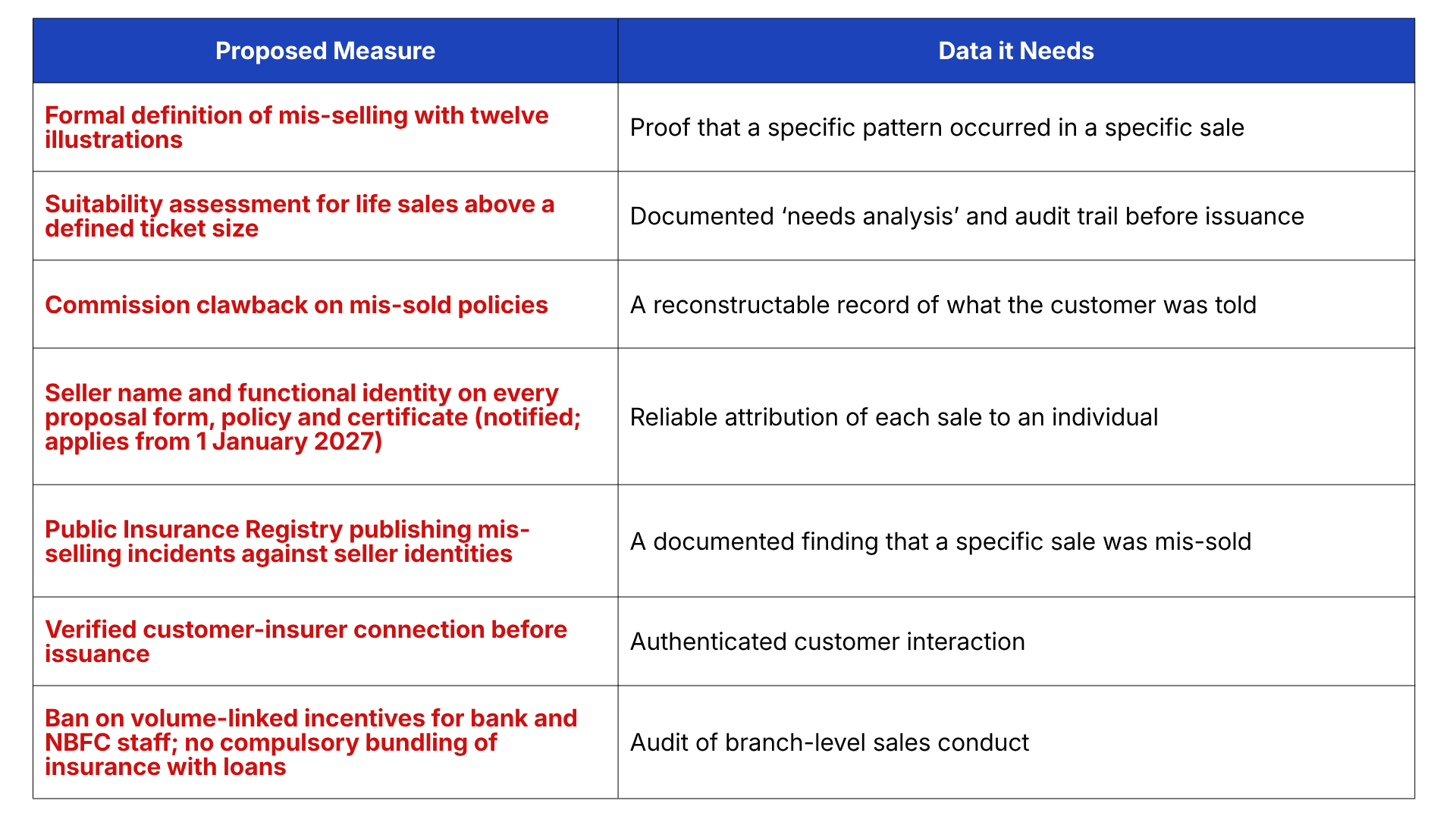
In regulated sectors, a penalty without proof becomes a negotiation. A clawback dispute between an insurer and a distributor will turn on who can show what the customer was told. The consultation paper sets the price and relies on existing records to supply the proof. Current checks and mechanisms were not built to supply it.
The economics only sharpen at this point. The paper also proposes lower commission ceilings and tighter expense-of-management (EoM) limits. Life insurers would move to 15% of premium within two years and 12.5% within five, and general insurers to 25% and 20%. These changes reduce the cost of acquiring a policy and leave the cost of claims untouched.
General insurers closed FY26 with a combined ratio of 113%, which means underwriting lost money before investment income. Industry profit after tax fell 23% to about ₹10,000 crore.
With less margin to absorb claims leakage (value lost to fraud, inflation and poor risk selection after issuance), insurers will need to assess risk on more data points before accepting it.
How to Turn a Pre-Issuance Verification Call into a Reliable Record
A Pre-Issuance Verification Call (PIVC), often conducted via video, allows insurers to verify a customer's identity, proposal details, and policy understanding before policy issuance.
But many insurers run it as a script of yes-or-no questions. A customer can answer yes throughout and still not know what was bought, especially when someone seated beside them prompts them to say yes, supplying the answers.
IDfy's analysis of verification calls shows the scale of the problem-
In the cases reviewed,
- 34% showed signs of third-party prompting, where another person coached the customer on what to say.
- In 1.5% of rejected cases, customers themselves pointed out errors in the details read to them, including wrong names, wrong premium amounts and sum assured values they had never agreed to.
IRDAI already treats call quality as a control question. In an order reported in September 2026, it imposed a ₹1 crore penalty on a private life insurer over a deferred annuity sold to an 88-year-old customer through a corporate agent. The regulator cited an inadequate verification call, inconsistencies in the proposal form and the absence of a suitability assessment, and described the combination as a systemic failure of internal controls.
A verification call has to answer three questions later: what the customer was told, what the customer understood, and who influenced the answers.
Four Changes That Make a Verification Call Reliable
- Ask open questions on the verification call. Replace yes-or-no scripts with questions that test understanding. What type of plan is this: term, ULIP, savings or pension? How were the market-linked returns explained to you? What is the lock-in period? If the customer cannot answer, the sale needs a second look.
- Analyse the call, not just record it. Detect coaching from a third party, customer corrections, and mismatches between what the customer says and what is on the proposal form.
- Keep a reviewable record. It gives the customer, the insurer and the agent a shared reference. The same record that catches prompting protects an agent who explained the product properly.
- Feed early signals into underwriting. Early-lapse patterns by channel belong in acceptance and pricing rules, and call-level flags arrive way before persistency data does.
Implications for Insurers, Banks, NBFCs and Distribution Platforms
- Life insurers will find persistency becoming both a regulatory and a commercial signal. Verification outcomes belong in distributor scorecards before any clawback regime takes effect.
- General and health insurers have little room for leakage at a 113% combined ratio. Checks at underwriting and empanelment become an economic necessity rather than a preference.
- Banks and NBFCs acting as corporate agents or credit life distributors face proposed limits on bundling and staff incentives. Branch-level sales conduct would come under audit, and a verified call on credit-linked policies protects the lender as well as the insurer.
- Marketplaces and aggregators face seller tagging from 1 January 2027 and a proposed prohibition on collecting a phone number or email before showing product features and price. Consent-led, auditable journeys would become the baseline.
Outlook: Seller Accountability, Persistency and the DPDP Timeline
A well-run verification call addresses one side of the problem, which is how a policy was sold. The other side is what was sold, and to whom.
Mis-selling and claims leakage trace to the same gap: information that existed before issuance and was not acted on. Commission caps and tighter expense limits reduce the cost of acquiring a policy but leave the cost of claims untouched, and an industry running at a 113% combined ratio has little margin to absorb a risk that was never examined.
IRDAI will consider comments after 25 October 2026 before draft regulations follow, so the final shape of the clawback remains open.
Seller tagging is further along. The IRDAI (Insurance Intermediaries) (Amendment) Regulations, 2026, notified on 30 July 2026, require proposal forms, policies and certificates to carry the name and functional identity of the authorised salesperson from 1 January 2027.
The consultation paper builds on this with a regulator-promoted Public Insurance Registry that would hold sector-wide seller identities and publish mis-selling records against them (proposed).
Clawback raises the stakes further, because insurers will be expected to show what they knew about the customer, the vehicle or the provider when they accepted the risk. This is why insurers need to look for solutions on the risk side as well, in checks that run before issuance or empanelment and test legal history, ownership records and credentials against what the applicant declared.
A verified sale and a verified risk answer different questions to achieve the same goal, and insurers need both.
Separately, the DPDP Rules, notified in November 2025, make notice, consent and retention duties for call recordings enforceable from 13 May 2027.
The Early-Signal Logic in Motor and Health Insurance
Signals available before issuance cost less to act on than those that arrive with the claim.
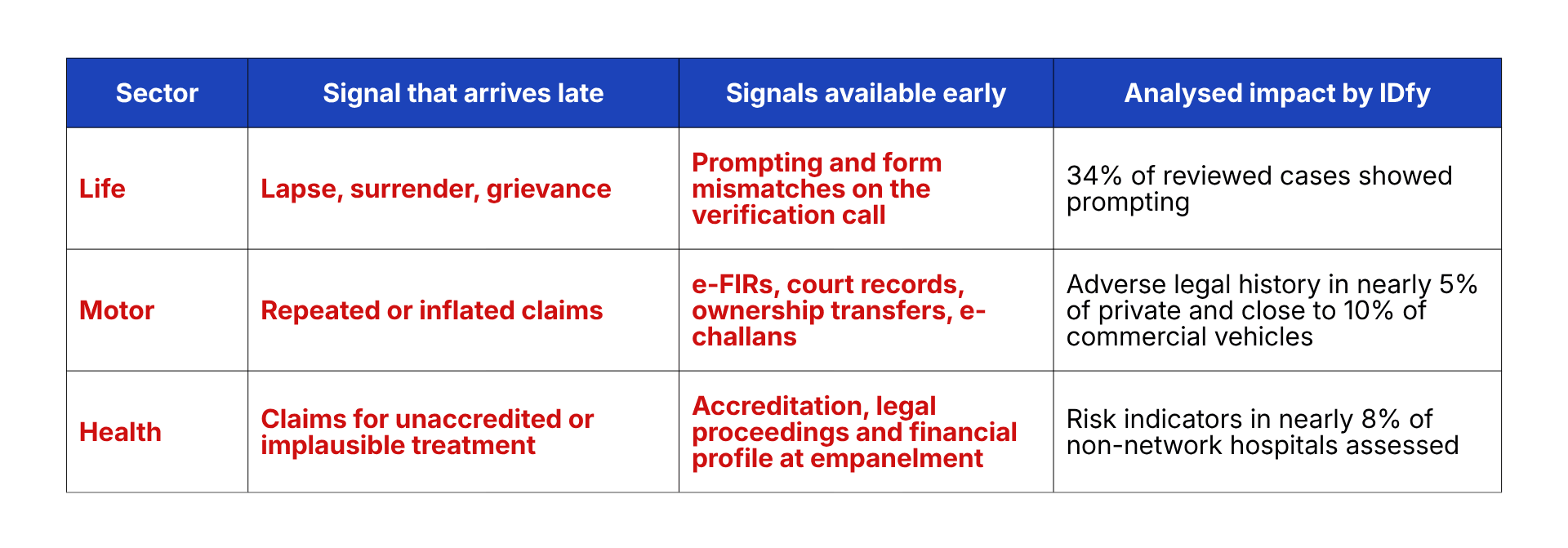
Standard motor underwriting checks make, model, age and prior claims. These describe the vehicle and say little about the applicant, which lets adverse selection (the disproportionate acceptance of higher-risk applicants) pass unseen. In March 2026, Shriram General Insurance, using these checks, flagged a fraudulent ₹50 lakh personal accident claim. Tracing it exposed a ring that had taken policies from about ten insurers in the insured's name, targeting ₹7.5 crore in total.
Hospital fraud is a network problem. Some mismatches are visible before payment, such as a day clinic billing for a week-long cardiology procedure, or a facility with ₹25 lakh in annual revenue submitting five claims worth ₹20 lakh. Triangulated checks across financial, legal, authenticity and credential records can flag these.
Conclusion
Seller tagging answers who made the sale, and the proposed clawback answers what a bad sale will cost. Neither answers what actually happened, and that gap is where disputes will be resolved. A reliable record of what the customer was told, and of what the insurer knew about the risk at acceptance, settles those disputes quickly.
With distribution margins narrowing and claims costs untouched, that early visibility is likely to separate insurers who manage mis-selling from those who only pay for it.
FAQs
What is mis-selling in insurance?
IRDAI defines it as selling an insurance product without proper disclosure of its terms, conditions or suitability. Common forms include presenting a savings plan as a fixed deposit, selling ULIPs without explaining market risk, and selling regular-premium policies without explaining surrender value or the effect of stopping payment.
What is a pre-issuance verification call (PIVC) in insurance?
A PIVC is a call or video session that an insurer conducts before issuing a policy. It confirms the customer's identity, the proposal details and the customer's understanding of the product. It is the main recorded checkpoint between the sale and the issuance of the policy.
How can a policyholder prove mis-selling?
Proof is difficult because sales conversations are rarely recorded. Useful documents include the verification call recording, the proposal form, the benefit illustration and written communication from the seller. Complaints can be raised with the insurer, through IRDAI's Bima Bharosa portal or with the insurance ombudsman. The free-look period allows a policy to be returned after delivery, subject to deductions.
What is clawback in IRDAI's consultation paper?
It is a proposed mechanism under which insurers would recover commission paid on policies found to be mis-sold. It is not in force. The paper is at consultation stage, with comments invited until 25 October 2026.
What is the persistency ratio, and why does it matter?
The persistency ratio is the share of policies still in force at a given point, such as the 61st month. IRDAI's paper reports 48% at the 61st month, against 71% for policies bought directly online. A low ratio can indicate early lapse or surrender, which may reflect poor solicitation.

IRDAI's 2026 distribution reforms cap commissions. Why cheaper acquisition moves insurer advantage to underwriting and risk selection.