

Contact Point Verification in 2026: The Complete Guide for Payment Aggregators, Gateways and Fintechs
Date Published
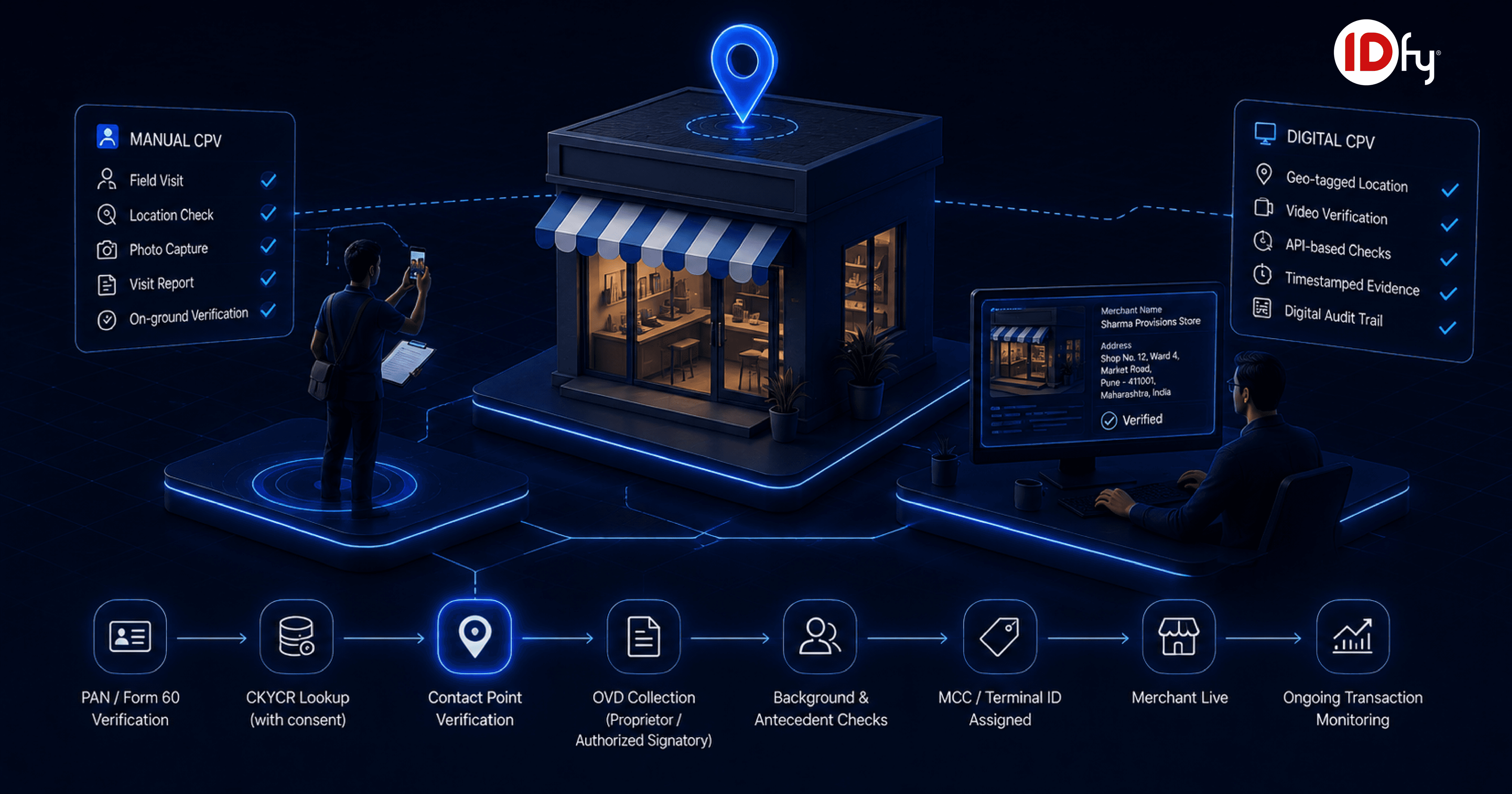
A payment aggregator onboards a merchant on paper documents alone, and three months later that merchant's storefront turns out to be a rented address with no business behind it. By then, transactions have already flowed through the account. This is the scenario Contact Point Verification (CPV) exists to prevent, and it's why the RBI has kept it as a non-negotiable step in merchant due diligence even as the rest of onboarding has moved digital.
For payment aggregators (PAs), banks, and the NBFCs and fintechs building on top of them, CPV isn't a formality buried in a compliance checklist. It's one of the few onboarding checks that verifies a merchant physically exists at the address they've declared. Getting it wrong, or doing it slowly, creates a direct trade-off between fraud exposure and onboarding velocity. This guide covers what CPV actually requires under India's payments regulation, how manual and digital CPV differ operationally, and what a payments compliance or risk team should evaluate before choosing an approach.
What Is Contact Point Verification (CPV)?
The CPV full form is Contact Point Verification: a check that confirms a merchant's declared place of business is real, occupied, and consistent with the business profile submitted at onboarding. In banking and payments, it usually means a verifier, in person or via a digital equivalent, confirms the address, the nature of the establishment, and that the entity operating there matches the merchant's KYC record.
CPV sits inside a payments entity's broader Know Your Customer and Customer Due Diligence process, not apart from it. RBI's consolidated Master Direction on Payment Aggregators, issued in September 2025, brought online, physical, and cross-border PA regulation under one framework and tightened merchant KYC obligations across the board. Under this framework, PAs must pull merchant records from the Central KYC Records Registry (CKYCR) with consent, and complete full KYC per RBI's KYC Master Direction where those records are incomplete.
Where CPV becomes explicitly relevant is in the simplified onboarding path for smaller merchants. For merchants with domestic annual turnover up to ₹40 lakh, or export turnover up to ₹5 lakh, PAs can onboard using three checks: PAN or Form 60 verification, CPV, and a certified copy of one officially valid document (OVD) from the proprietor or authorized signatory. This simplified path exists precisely because full KYC is disproportionate for small merchants, but the regulator hasn't removed physical or digital verification of the business address from the requirement. Background and antecedent checks, plus ongoing monitoring, still apply regardless of which onboarding path a merchant is routed through.
It's worth being precise about what CPV is not. It is not a substitute for KYC, and it is not a credit or income verification. CPV answers one narrow question: does this business exist where the merchant says it does. That narrowness is what makes it fast to do digitally and expensive to skip.
CPV in Payments: Where It Actually Sits in the Onboarding Flow
For a payment aggregator, CPV typically triggers at merchant onboarding, and again during periodic re-KYC or when a merchant's risk profile changes. In practice, it's one gate among several: PAN and OVD checks confirm identity, CKYCR and KYC Master Direction checks confirm regulatory compliance, and CPV confirms operational reality.
For NBFCs and fintechs building merchant-facing payment products, CPV usually isn't something they run independently. It's inherited from whichever PA or bank they route settlement through, and it's the aggregator's responsibility to have completed it before funds start moving. That dependency is exactly why CPV turnaround time matters commercially, not just for compliance. A merchant waiting on a physical site visit is a merchant not yet live and not yet transacting.
Physical CPV: What It Solves, and Where It Breaks Down at Scale
Physical CPV works the way it sounds: a field agent visits the declared address, confirms the business is operating there, photographs the premises, and files a report. For low volumes, this is thorough and defensible. For a payments business onboarding hundreds or thousands of merchants a month, the model runs into three structural limits.
- Turnaround time: A field visit depends on agent availability, geography, and the merchant simply being present when the agent arrives. Multi-day turnaround is common, and re-visits for no-shows extend it further. For a payments product where onboarding speed is a competitive lever, this is a direct cost.
- Cost and coverage: Field verification scales linearly with volume. Every additional merchant is another agent dispatch, and coverage in tier-2 and tier-3 markets, exactly where much of India's merchant growth is happening, is often thinner and slower than in metros.
- Fraud gaps that manual verification doesn't close. A physical visit confirms a location on the day the agent shows up. It doesn't inherently produce a timestamped, geo-tagged, auditable record that can be checked later against a dispute or a regulatory query. Paper-based CPV reports are also easier to falsify or backdate than most compliance teams would like to admit.
None of this makes Physical CPV wrong. It remains necessary in specific cases, high-risk merchant categories, remote areas without digital infrastructure, or disputes that need in-person resolution. The issue is treating it as the default at payments scale, where volume and speed are the operating constraints.
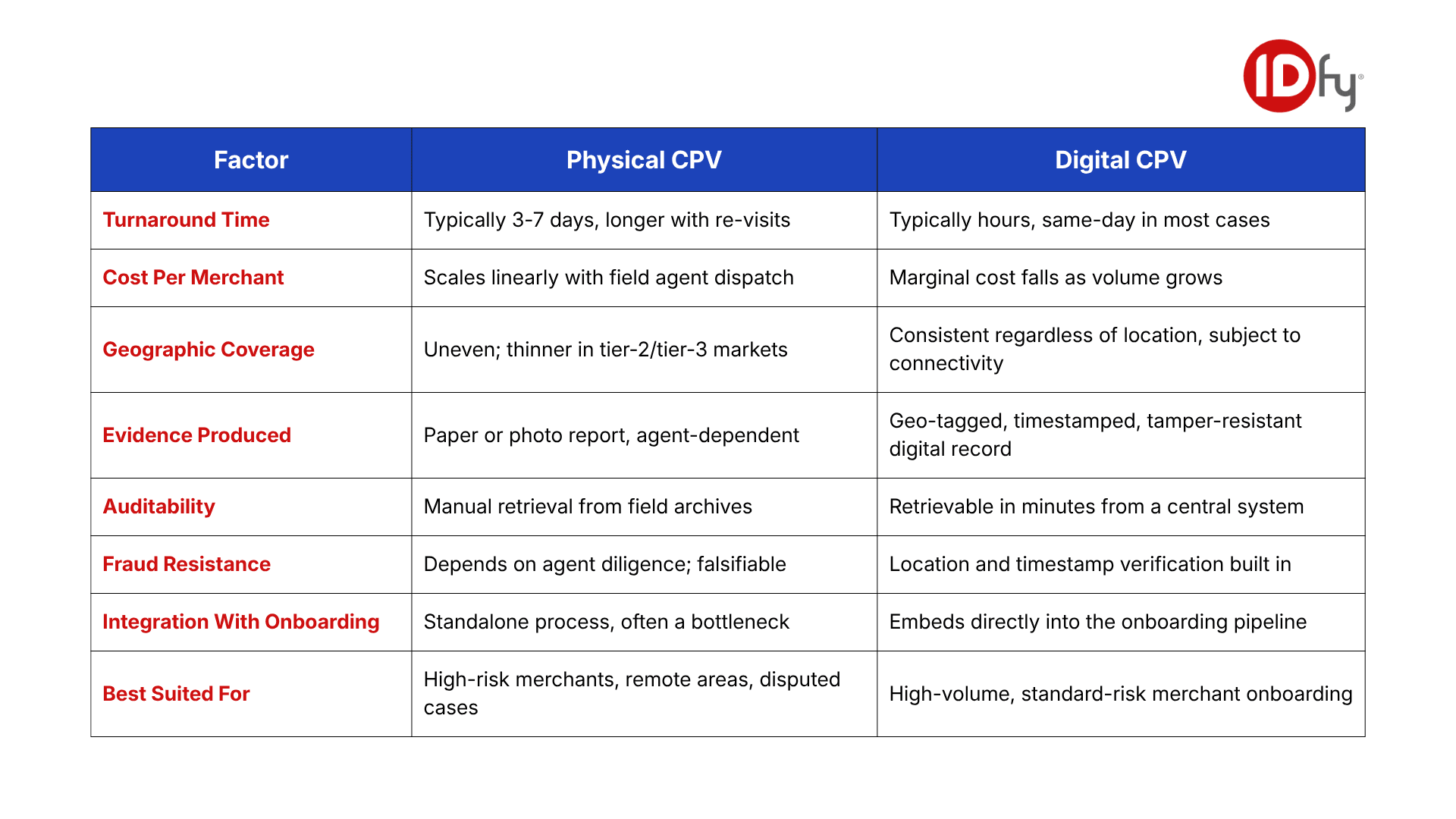
Physical CPV vs. digital CPV: turnaround, cost, and fraud resistance compared
Digital CPV: What It Is and How It Works
Digital CPV replaces or augments the physical visit with technology-driven verification methods that produce the same evidentiary outcome, confirmation that the business exists at the declared address, faster and with a stronger audit trail.
In practice, this takes a few forms:
- Geo-tagged verification: field agents or merchants themselves capture location-stamped photographs of the premises, tying the verification record to GPS coordinates and a timestamp that can't be altered after the fact.
- Video-based CPV: a live or recorded video call where the merchant walks through their premises, similar in spirit to Video Customer Identification Process (V-CIP) used elsewhere in digital KYC, giving a verifier real-time visual confirmation without a physical visit.
- API-based verification: address and business-existence checks run against databases, utility records, and prior verification history, flagging inconsistencies automatically before any human review is needed.
The operational difference is significant. Digital CPV can typically be completed within hours rather than days, produces a verifiable digital record by default, and scales without a linear increase in field headcount. It also integrates directly into onboarding workflows, so a merchant application doesn't sit in a queue waiting for a separate offline process to catch up.
Digital Address Verification in India: The Broader Context
CPV doesn't operate in isolation. It's part of a wider shift toward digital address verification across India's financial sector, driven by the same forces: rising onboarding volumes, RBI's tightening of KYC and CDD standards, and the maturity of geo-tagging, document OCR, and API infrastructure that makes remote verification reliable enough to trust.
This matters for payments specifically because merchant onboarding volumes in India are not shrinking. Every UPI-enabled kirana store, every D2C brand adding a payment integration, and every marketplace seller onboarded through a PA adds to the verification load. A digital-first address verification layer isn't just a payments-team convenience, it's increasingly what makes RBI's own push toward CKYCR-first, low-friction onboarding for small merchants operationally viable.
A Framework for Evaluating Digital CPV Infrastructure
For a payments compliance or risk team deciding whether to build, buy, or upgrade digital CPV capability, five factors matter more than vendor marketing.
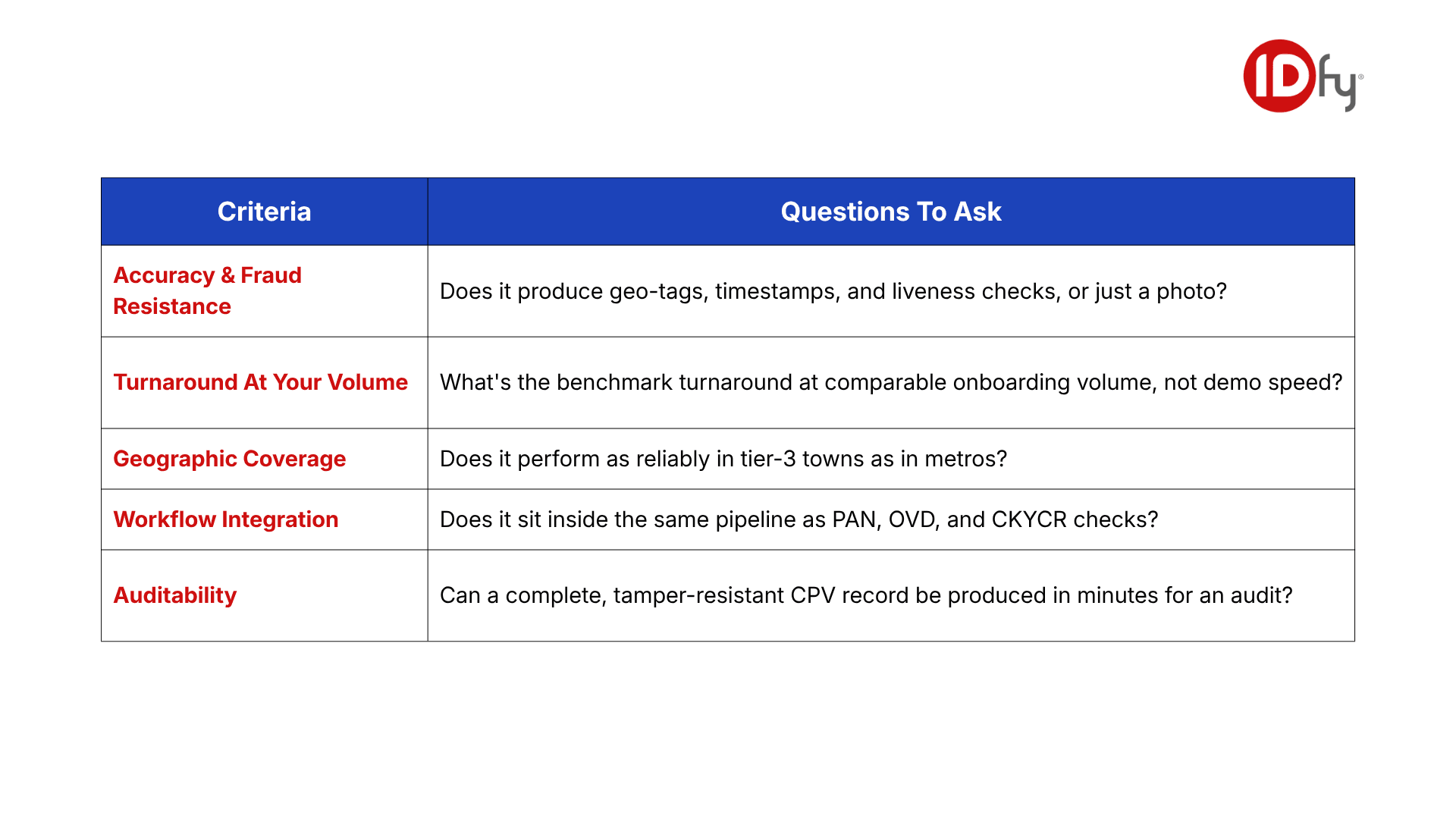
A five-point scorecard for evaluating digital CPV infrastructure before you switch
Regulatory and Risk Considerations Specific to Payments Entities
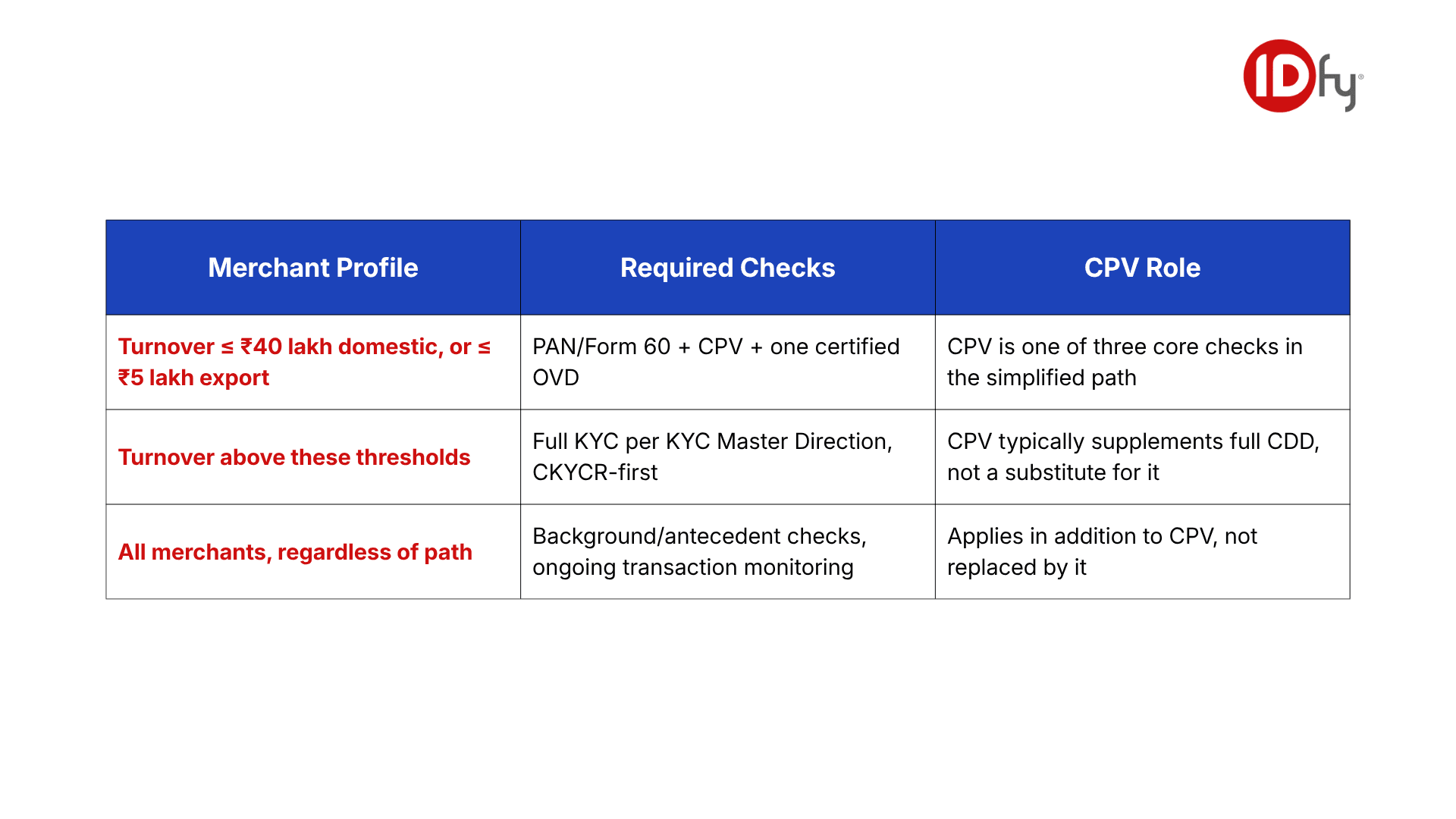
How CPV fits into RBI's merchant onboarding requirements by turnover threshold
A few things are worth stating plainly for payments compliance teams building or reviewing their CPV process. First, CPV under the simplified small-merchant path doesn't remove the obligation to conduct background and antecedent checks, or to monitor merchants on an ongoing basis after onboarding. It's one check among several, not a complete due-diligence substitute. Second, non-bank PAs that rely on designated agents to perform digital KYC and CPV retain responsibility for vetting those agents; outsourcing the verification doesn't outsource the compliance liability. Third, as physical PAs move through RBI's authorization process, with the December 2025 deadline having already reshaped how physical point-of-sale aggregators operate, CPV standards that were previously inconsistent across smaller physical PAs are converging toward the same digital-evidence expectations already common among online PAs.
The practical risk for payments companies isn't usually willful non-compliance. It's inconsistency, one region's merchants getting thorough digital CPV, another region's getting a rushed field visit with thin documentation, because the underlying process wasn't standardized. That inconsistency is exactly what shows up as a finding in an RBI audit.
Where CPV Is Headed for India's Payments Industry
Three things are converging that make digital CPV less of an optional upgrade and closer to table stakes by 2027. RBI's consolidated PA Master Direction has already pushed merchant onboarding toward CKYCR-first, standardized processes, closing the gap between how online and physical PAs handle due diligence. Merchant onboarding volumes, driven by UPI penetration and small-merchant digitization, continue to outpace what field-agent models can support economically. And the audit expectations around verification evidence, geo-tagging, timestamps, tamper-resistant records, are converging with what regulators already expect from digital KYC elsewhere in the stack. Payments companies that treat CPV as a manual afterthought will increasingly find it's the slowest, least defensible part of an otherwise digital onboarding pipeline.
Conclusion
The shift from manual to digital CPV isn't primarily about efficiency, though the turnaround-time gains are real. It's about closing a compliance and fraud gap that manual, paper-based verification structurally can't close at payments scale: producing evidence that's timestamped, geo-verified, and auditable on demand, rather than a field report that's easy to falsify and slow to retrieve. For a payments compliance or risk lead evaluating their CPV stack, the decision isn't whether to eventually go digital, RBI's own direction of travel makes that clear, it's how quickly the switch can happen without creating gaps in coverage or auditability along the way.
Verification infrastructure that can run geo-tagged, video-based, and API-driven CPV within a single onboarding pipeline, and produce an audit-ready record for every merchant, is what makes that switch operationally realistic rather than another compliance project competing for engineering time. As merchant onboarding volumes keep growing and RBI's audit expectations keep tightening, the payments companies with that infrastructure already in place will spend less time explaining their CPV process and more time scaling it.
FAQs
- What is the full form of CPV?
CPV stands for Contact Point Verification. It refers to confirming that a customer or merchant's declared address is genuine and matches their business or personal profile.
- What is contact point verification and why is it required?
CPV verifies that a merchant or customer physically exists at their declared address. In payments, it's required as part of RBI's merchant due diligence framework, particularly for the simplified onboarding path available to smaller merchants.
- What is the difference between CPV and KYC?
KYC is the broader identity and compliance verification process, covering PAN, officially valid documents, and CKYCR checks. CPV is narrower: it confirms the physical existence and location of a business, and functions as one component within the overall KYC and CDD process.
- What is digital CPV and how does it work?
Digital CPV uses geo-tagged photo capture, video-based verification calls, or API-driven address checks to confirm a business's existence remotely, producing a timestamped, auditable record without requiring a field visit for every merchant.
- Is digital CPV RBI-compliant?
RBI's regulation specifies that CPV must be conducted; it does not mandate that verification be exclusively physical. Payments entities using digital methods that produce reliable, auditable evidence of address verification are operating within the spirit and letter of the requirement, provided the broader KYC and due-diligence obligations are also met.
- How long does digital CPV take compared to physical CPV?
Physical CPV typically takes multiple days, depending on field agent availability and merchant presence at the site. Digital CPV can generally be completed within hours, since it doesn't depend on scheduling a physical visit.
See how IDfy's merchant due diligence goes beyond document checks to catch fake storefronts before they onboard, verified through geo-tagged address checks, MCA and GST triangulation, and continuous risk monitoring.
Explore the 2026 payment fraud landscape in India. Learn the most common types of payment fraud, the emerging fraud trends, and how to build a future-ready fraud prevention strategy.
Learn important payment terms in simple language. Understand UPI, BNPL, Payment Gateways, Merchant Onboarding, and more with our easy 2026 guide.