

Payment 101: Simple Definitions for Payment Terms (2026)
Date Published
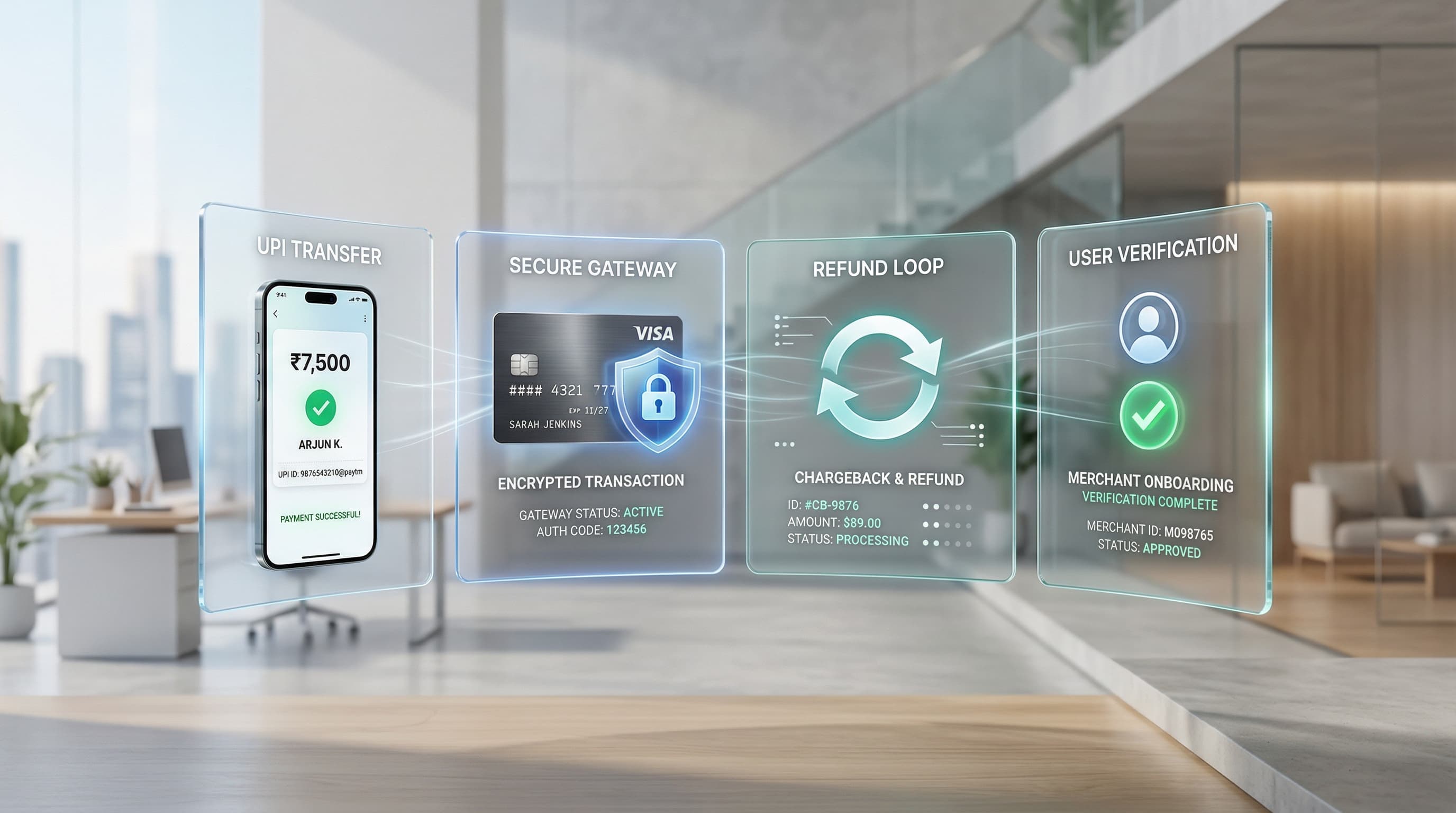
Understanding how money moves from a buyer to a seller can be difficult because the payments industry uses many technical words. This glossary explains those terms in plain language. Whether you are starting a new business or just want to know how your credit card or UPI payments work, these definitions will help you understand the world of digital payments.
A
Acquirer (Acquiring Bank)
The bank that helps a store accept credit and debit card payments. It helps route the payment request from the store to the customer’s bank and ensures the money is settled into the store’s account.
Authentication
The step that proves a person is who they say they are. This is done using a password, a fingerprint, or a code sent to a phone to make sure the real owner is using the card, often required by regulations (like 2FA in India).
Authorisation
A message from the customer's bank that confirms that the card is valid, the user is authenticated, and sufficient funds or credit are available.
API (Application Programming Interface)
A set of rules that lets two different computer programs talk to each other. In payments, it lets a website send order details to a payment company instantly.
B
BNPL (Buy Now, Pay Later)
It is a way for a customer to buy something immediately and pay for it in smaller parts over time. Usually, it's interest-free if paid on time, but may include late fees or charges.
Batch Processing
A way for banks to handle many payments all at once at the end of the day, instead of one by one.
C
Chargeback
A return of money to a customer after they tell their bank that a purchase was wrong or not made by them. The bank initiates a dispute process through the card network and may reverse the transaction from the store’s account.
Capture
The final step, where a store tells the bank to actually move the money that was previously approved during authorisation.
Cross-border Payments
A payment made when the person buying and the person selling are in two different countries. This may involve currency conversion and additional regulatory checks.
D
Due Diligence
A safety check where a payment company looks at a business to make sure it is legal and follows the rules before they help them move money.
Digital Wallet
An app on a phone or watch that keeps card information safe. It lets people pay without needing a physical plastic card.
E
Encryption
A way of hiding information by turning it into a secret code. This stops hackers from seeing private card numbers while they travel over the internet.
F
Fraud Orchestration
Using multiple tools and data signals together to detect and prevent fraudulent transactions in real time.
G
Payment Gateway
The software that securely sends payment data from the website to the payment processor and banks to complete the transaction.
H
Hosted Payment Page
A checkout page that is built and kept safe by a payment company. The store sends the customer to this page to type in their card details securely.
I
Interchange Fee
A small fee that a store's bank must pay to the customer's bank for every card sale.
Issuing Bank (The Issuer)
The bank that gives the credit or debit card to the customer. This bank plays a key role in approving transactions and initiating chargebacks when disputes arise.
M
Merchant Category Code (MCC)
A four-digit number that describes what kind of things a store sells. Banks use this to determine fees, risk levels, rewards, and compliance requirements.
Merchant Onboarding
The process of signing up a new store so they can start accepting payments. This includes checking their ID and setting up their account.
P
Payment Aggregator
A company that processes payments through a shared infrastructure, making onboarding faster without needing a direct bank integration. This makes it very fast for a new business to start selling.
PCI DSS
It is a list of security rules that every company handling credit cards must follow. These rules help keep card information safe from being stolen.
Q
QR Code Payments
A way to pay by using a phone camera to scan a square image. The scan tells the phone where to send the money.
R
Reconciliation
Comparing the list of sales made by a store to the list of money received in the bank. This makes sure all the numbers match perfectly.
S
Settlement
After transactions are processed and cleared, the money is actually put into the store's bank account so they can use it.
T
Two-Factor Authentication (2FA)
It is a security check that asks for two things to prove who you are. Usually, this is something you know (like a password) and something you have (like a code sent to your phone).
Tokenisation
Replacing a real card number with a fake string of numbers called a "token." If the token is stolen, it cannot be used by anyone else to buy things.
U
UPI (Unified Payments Interface)
UPI is a system that lets people send money from one bank account to another instantly using a phone app.
V
Virtual Account
A digital account that acts like a real bank account. Stores use them to keep track of which customer sent which payment. It is a unique account number mapped to a real bank account, used to identify and track incoming payments.
W
White-label Payments
A payment system made by one company but sold to another company so they can put their own name and logo on it.
X
XML (Extensible Markup Language)
XML is a specific way of writing down data so that different bank computers around the world can read it without making mistakes. It is one of the formats used to structure data between systems (along with modern formats like JSON).
Y
Yield Optimisation
The process of using data and routing logic to choose the best payment path to improve success rates and reduce costs.
Z
Zero Liability Protection
A promise that a customer will not lose their money if someone else uses their card without permission.
Frequently Asked Questions
Can I stop all Chargebacks?
No. But you can reduce them by using Tokenisation, keeping good records, and making sure your store name is clear on bank statements.
Is a Payment Aggregator better than a bank account?
Payment aggregators are easier to start with, while direct bank integrations offer more control and lower costs at scale.
Is Yield Optimisation only for big companies?
No. Many Payment Aggregators now include these tools automatically to help all stores save money.
Explore the 2026 payment fraud landscape in India. Learn the most common types of payment fraud, the emerging fraud trends, and how to build a future-ready fraud prevention strategy.
Learn how BNPL works in India, its risks, regulations, business models, and future trends in digital payments and embedded finance.